 Burlington
 Guemes Island Puts a Deck Through More Than a Typical Backyard
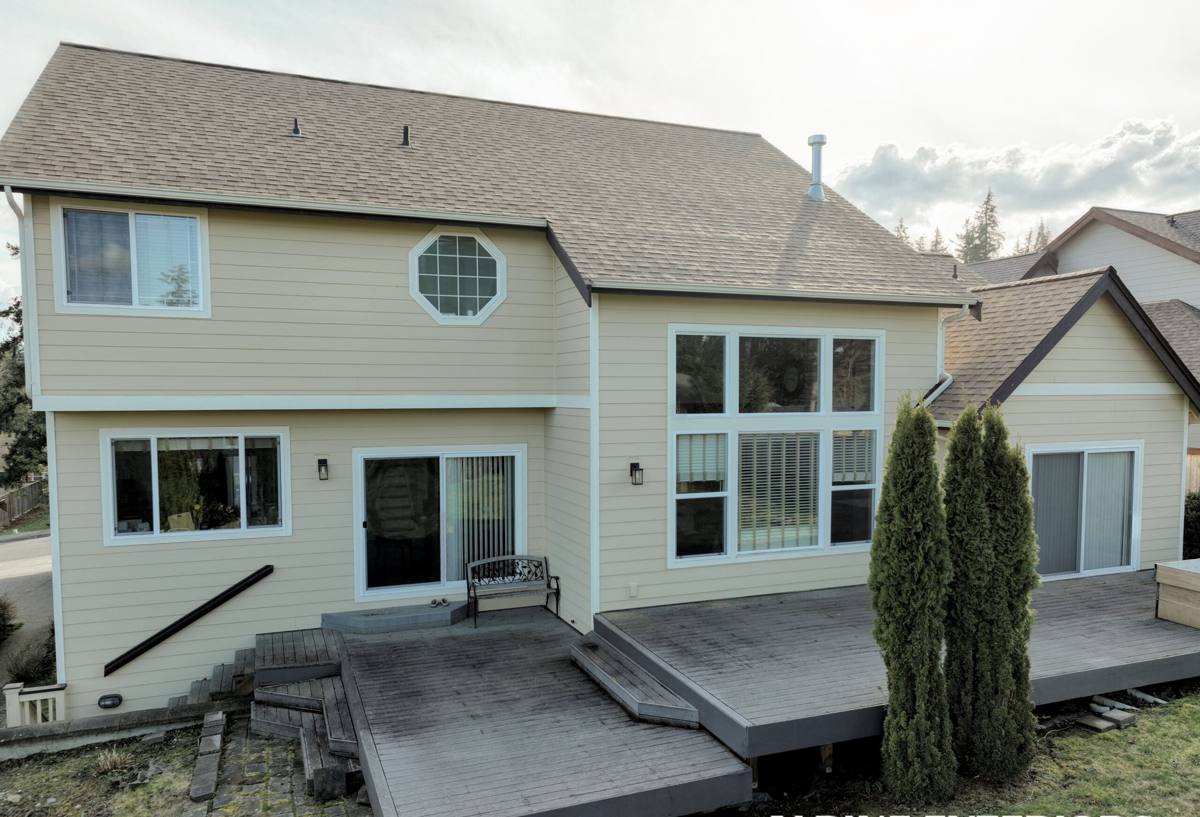
A deck on Guemes Island lives a harder life than one twenty minutes inland. The island sits out in the salt air of the Salish Sea, which means fasteners, flashing, and any exposed metal take a beating that mainland Skagit County decks don't see nearly as fast. Add driving rain that comes in sideways off the water during winter storms, and a moss season that can stretch from October well into spring under our marine cloud cover, and you've got three separate stresses working on the same structure at the same time. Composite decking handles all three better than wood, but only if it's specified and installed with those conditions in mind. A board that's rated fine for a dry inland patio can still under-perform here if the substructure, fasteners, and drainage details underneath it aren't matched to the site.
Salt Air and Fasteners
Salt-laden air corrodes uncoated or lower-grade metal fasteners and hardware faster than most homeowners expect, especially anything close to grade or tucked into a shaded, damp corner of the frame. On an island property, that clock runs faster than it would in downtown Burlington. The fix isn't complicated — it's using hardware actually rated for coastal exposure — but it does mean the "standard" fastener package a lot of decking jobs default to isn't the right call out here.
Driving Rain and Standing Water
Wind-driven rain doesn't just fall on a deck, it gets pushed under railings, into ledger connections, and behind picture-frame trim. If the flashing and drainage details aren't done right the first time, water finds its way into the one place composite decking can't protect: the framing underneath it. Composite boards themselves don't rot, but the joists, ledger, and fasteners holding them up can if they're not detailed for sustained wet exposure.
The Long Moss Season
Shaded, north-facing, or tree-covered sections of an island deck stay damp for months at a time. That's exactly the environment moss and surface algae like. Composite resists it far better than wood, but "resists" isn't "immune" — board texture, airflow underneath the deck, and a bit of seasonal upkeep all affect how much moss actually takes hold before spring.
What "Composite Decking" Actually Covers
Composite decking isn't one product — it's a category that ranges quite a bit in how it performs in exactly the conditions Guemes Island throws at it.
Capped vs. Uncapped Composite
Capped composite has a polymer shell wrapped around a wood-plastic core, which is what actually blocks moisture absorption and resists staining and surface growth. Uncapped composite (or composite that's only capped on the top face, not the sides and ends) can still take on some moisture at cut ends and exposed edges over time. In a marine climate with a long wet season, that difference matters more than it would in a drier region.
PVC Decking vs. Wood-Plastic Composite
Fully cellular PVC boards contain no wood fiber at all, so there's nothing for moisture to wick into even at a cut edge — the trade-off is usually a higher price point and a slightly different look and feel underfoot than wood-composite blends. Capped wood-plastic composite (the category that includes major lines like Trex and TimberTech) sits in between: strong moisture and moss resistance with a more traditional wood-grain appearance, at a more moderate cost. Which one makes sense depends on how exposed the deck is, how much shade it sits in, and the budget.
What a Correct Install Requires on an Island Site
The decking boards get most of the attention, but the parts you don't see after the job is done are what determine whether the deck holds up through a decade of Guemes Island winters.
Substructure and Fasteners
We spec fasteners and hidden-clip hardware rated for coastal/marine exposure, not the standard-grade hardware that's fine for a drier inland lot. Where it makes sense, we'll also use composite or coated substructure components instead of bare treated lumber in the areas most exposed to standing moisture, which takes wood rot out of the equation entirely in those spots.
Ledger Flashing and Moisture Barriers
The ledger board connection — where the deck attaches to the house — is the single most common failure point on any deck, composite or wood, and it's the one detail that driving rain will exploit fastest if it's not done right. That means proper flashing, a moisture barrier between the ledger and the house band board, and fasteners sized and spaced correctly, every time, not just when it's convenient.
Airflow Under the Deck
Low, tight-to-grade framing with poor ventilation traps humidity underneath the deck, which is exactly what feeds moss and mildew on the underside of boards and along the frame. Where deck height and grade allow it, we build in enough clearance and avoid solid skirting that blocks airflow, so the space underneath can actually dry out between storms instead of staying damp all winter.
Choosing the Right Board for an Island Home
There's no single "best" composite board — the right pick depends on how much shade and moss exposure the specific deck location gets, and what you're willing to do for upkeep.
| Board Type | Moisture / Salt Air Resistance | Moss & Algae Resistance | Relative Cost | Best Fit |
|---|---|---|---|---|
| Cellular PVC (fully capped) | Excellent — no wood fiber to absorb moisture | Very good, especially with a low-texture surface | Highest | Fully shaded or heavily tree-covered sites, waterfront exposure |
| Capped wood-plastic composite | Very good on all capped faces and edges | Good; varies by embossing/texture depth | Mid-to-high | Most island homes balancing look, cost, and durability |
| Uncapped or partially capped composite | Fair — cut ends and uncapped sides can absorb moisture | Fair; more prone to surface film in shaded areas | Lower | Sunnier, well-drained sites where budget is the priority |
Board texture matters more here than in a lot of climates: deep wood-grain embossing looks great but can hold a thin film of moisture longer than a smoother or more tightly grained surface, which gives moss and algae more of a foothold during our wetter months.
Our Installation Process on Guemes Island
- Site visit to check existing structure, grade, drainage, and sun/shade exposure across the deck footprint.
- Inspection of the ledger connection and any existing framing being reused, checking for hidden moisture damage before we build on top of it.
- Substructure plan matched to the site — coated or composite framing components in the areas most exposed to standing water.
- Ledger flashing and moisture barrier installation done to full manufacturer and code detail, not shortcut.
- Coastal-rated fasteners and hidden-clip hardware selected for the specific board system being installed.
- Board installation with correct gapping for drainage and material movement, plus picture-frame and trim detailing.
- Final walkthrough covering how the specific board and hardware we used should be cared for through moss season.
Getting Materials and a Crew to the Island
Working on Guemes Island means planning around the county ferry for both materials delivery and crew scheduling — it's a real logistical factor that a mainland-only crew has to figure out fresh on every job, and it shows up in scheduling delays and staging headaches when they haven't done it before. Because we already work the island regularly, we build ferry timing into the project schedule from the start: material drops are consolidated to minimize trips, and crew days are planned around realistic ferry windows rather than guessed at. That's not a small thing on a job where weather windows for outdoor work are already tight for a good chunk of the year.
Maintenance in a Marine, Mossy Climate
Composite decking is genuinely low-maintenance compared to wood, but "low-maintenance" in a marine climate still means a bit of seasonal attention — skip it entirely and moss and salt film will build up faster than the board's built-in resistance can shed on its own.
- Rinse salt spray and airborne residue off the deck periodically, especially on more exposed, waterfront-facing sections.
- Keep gutters and downspouts clear so roof runoff isn't sheeting across the deck surface during heavy rain.
- Sweep leaves and organic debris off the boards through fall before they can trap moisture underneath.
- Trim back overhanging branches and vegetation where possible to improve sun exposure and airflow over shaded sections.
- Clean the surface with a soft-bristle brush and mild soap ahead of moss season rather than after moss has already taken hold.
- Avoid a high-pressure setting when power washing — it can damage the cap layer on some boards; a garden hose and brush is usually enough.
- Check visible fasteners and railing hardware annually for early signs of corrosion, particularly in shaded or low-airflow spots.
Why Hire a Crew That Already Works Guemes Island
A lot of what makes a composite deck actually last out here isn't in the product brochure — it's knowing which fastener grade holds up against salt air over years instead of months, which flashing details actually stop wind-driven rain, and which board textures shed moss better through a Skagit County winter. That's the kind of judgment that comes from having built and maintained decks on the island before, not from a general decking crew's first trip out. It also means realistic scheduling around ferry logistics instead of surprises mid-project, and a crew that already understands the site conditions specific to island properties versus mainland ones.
If you're thinking about a composite deck on Guemes Island, we're happy to walk the site, talk through board options for your specific exposure, and put together a straightforward, no-pressure estimate — just use the form below to get started.