 Burlington
 Building Exteriors for a Peninsula Community
Samish Island sits out on its own narrow spit of land off the Skagit County mainland, connected by a causeway and surrounded on nearly every side by saltwater. Homes here face a different set of pressures than a house a few miles inland in Burlington or Mount Vernon. Wind comes off Samish Bay with almost nothing to slow it down, rain drives sideways more often than it falls straight, and the salt in the air settles on every exterior surface, year-round, whether the sun is out or not. If you own a home on the island, or you're planning to build or remodel one, the exterior materials you choose matter more here than almost anywhere else in the county.
We work throughout Skagit County, and Samish Island is one of the areas where we see the clearest, fastest difference between siding products that were built for coastal exposure and products that were not. This page walks through what that exposure actually does to a house, and why our company made the decision years ago to install only one type of siding.
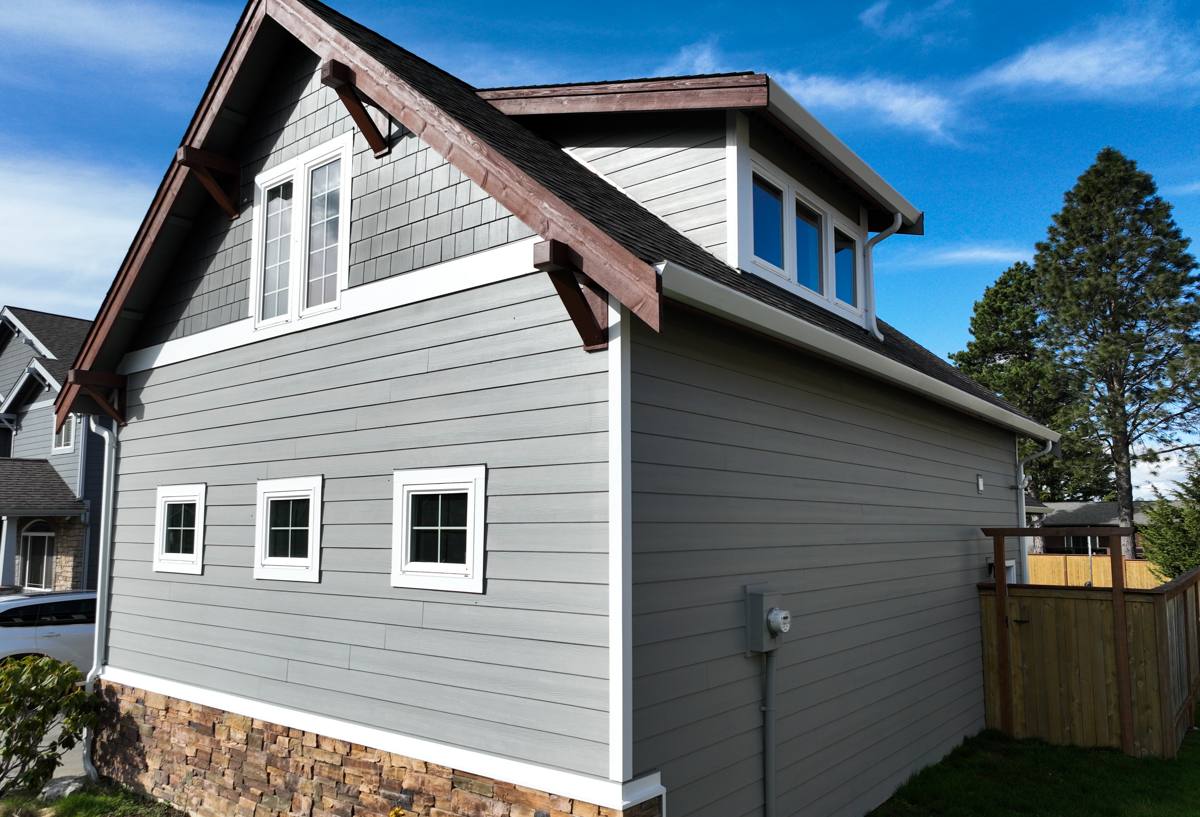
What Salt Air, Wind, and Rain Do to a House
Salt Air
Airborne salt is corrosive to metal fasteners, flashing, and hardware, and it's abrasive to painted and coated surfaces over time. On a waterfront or near-waterfront property, salt fog and salt spray settle on siding, trim, and window frames even on days with no direct rain. Materials that rely on a surface paint film to keep moisture out are the ones that suffer most, because salt accelerates the breakdown of that film, and once the film is compromised, the substrate underneath is exposed.
Driving Rain
Samish Island gets wind-driven rain that hits siding at an angle instead of running straight down the wall. That matters because a lot of siding systems are designed and tested assuming rain sheets off vertically. Wind-driven rain finds horizontal laps, fastener heads, and butt joints that would otherwise stay dry, and it pushes water into any gap in the water-resistive barrier or flashing detail. A house on the island needs an exterior that's forgiving of imperfect seals and built to handle water intrusion at the plane of the siding itself, not just at the housewrap behind it.
Moss and Shade
Skagit County's long wet season, combined with tree cover on parts of the island and homes that sit close to grade or under a heavy tree canopy, gives moss and algae a long window to take hold. North-facing walls and shaded trim stay damp for weeks at a stretch in fall and winter. Siding that absorbs and holds moisture gives moss something to grip; siding that sheds water and dries out between storms doesn't.
Why We Only Install James Hardie Fiber Cement
We get asked fairly often why we don't offer vinyl, LP SmartSide, cedar, or other fiber cement brands like Cemplank or Allura. The honest answer is that we looked at how each of these products actually performs in a marine, high-moisture climate like Skagit County's, and we standardized on the one that holds up best without asking the homeowner to babysit it.
Vinyl
Vinyl siding is inexpensive and low-maintenance in mild climates, but it's a thin plastic product that expands and contracts significantly with temperature swings, and its seams and laps are more prone to moisture intrusion under sustained wind-driven rain. In direct coastal exposure it can also become brittle and discolor faster than in sheltered inland settings. It's not a product we're willing to put our name behind on a site like Samish Island.
LP SmartSide (Engineered Wood)
LP SmartSide is a wood-strand product with a resin-saturated outer layer, and it performs reasonably well when installation and maintenance are done exactly to spec. The catch is that it's still wood-based, meaning any breach in the factory coating or field-cut edge that isn't properly sealed becomes a path for moisture to swell and eventually rot the substrate. On a property with constant salt exposure and driving rain, that margin for installation error is thinner than we're comfortable with.
Cedar and Primed Spruce
Real wood siding has genuine curb appeal and a long history in this region, but it demands a repainting and recaulking cycle that most homeowners underestimate, and it's combustible. In a wet, salt-heavy environment, wood siding's maintenance interval shrinks and its long-term cost climbs.
Other Fiber Cement Brands
Cemplank and Allura are also fiber cement, and fiber cement as a category is the right material family for this climate. Where we draw the line is the brand: James Hardie engineers regional HZ5 product formulations specifically for climates like the Pacific Northwest, backs its siding with a factory-applied ColorPlus finish and a strong transferable warranty, and has the deepest track record of any fiber cement manufacturer in the country. We'd rather install one product exceptionally well, with installers who know it inside and out, than spread our expertise across several brands.
Material Comparison at a Glance
| Material | Moisture Behavior | Salt/Coastal Suitability | Maintenance Burden |
|---|---|---|---|
| James Hardie Fiber Cement | Non-combustible, engineered to resist moisture-driven warping and cracking | Designed for regional/coastal exposure (HZ product lines) | Low — factory finish holds up for years between repaints |
| Vinyl | Seams and laps vulnerable under wind-driven rain | Can become brittle, fades faster in direct salt/sun exposure | Low, but limited repair options if damaged |
| LP SmartSide | Wood-based; edge sealing and coating integrity are critical | Performs well if installed and maintained to spec | Moderate — coating and caulk need regular inspection |
| Cedar / Primed Spruce | Absorbs moisture; prone to swelling, cupping, rot at breaches | Demands frequent maintenance in wet coastal air | High — repaint/reseal cycle every few years |
More Than Siding: A Full Exterior Envelope
Siding doesn't work in isolation. On a property exposed to the wind and rain that Samish Island sees, the roof, windows, and any exterior decking all have to work together to keep water out and stand up to the weather. We handle all four:
- Roofing — the first line of defense against driving rain and wind uplift; proper flashing at every penetration matters even more on an exposed site
- Siding — James Hardie fiber cement, installed with the flashing and clearance details that coastal exposure requires
- Windows — proper flashing integration where the window meets the siding plane is one of the most common failure points we find on older island homes
- Decks — outdoor living space that has to tolerate constant damp, salt air, and, on many island lots, direct sun with no wind break
Coordinating these trades under one crew means the siding installer and the window and roofing details are talking to each other, instead of three separate contractors each assuming someone else sealed a given joint.
What Correct Installation Looks Like Here
Fiber cement siding is only as good as its installation, and that's especially true in a marine climate. On Samish Island projects we pay particular attention to:
- Proper rainscreen or drainage gap behind the siding so any moisture that does get past the surface can drain and the wall can dry
- Correct fastener spacing and type — stainless or coated fasteners rated for the exposure, not standard interior-grade hardware
- Flashing at every window, door, and roofline transition, lapped correctly so water sheds outward and down
- Manufacturer-specified clearance between the bottom of the siding and grade, decks, and roof lines, so splash-back and standing moisture don't sit against the material
- Sealed and painted cut edges on every field cut, since a factory-finished panel is only fully protected where the factory coating is intact
These aren't optional upgrades — they're the baseline for a siding job that's going to hold up on an exposed, salt-air site for decades instead of years.
Why a Local Crew Matters on the Island
A contractor based elsewhere in the state, or a crew that mostly works dry inland subdivisions, doesn't necessarily think about rainscreen detailing, fastener corrosion resistance, or wind-driven rain the same way a Skagit County crew does. We work this climate regularly, which means we're not learning coastal detailing for the first time on your house. Local also means we can be back promptly if a question comes up after the job, and we know the access realities of a causeway-connected island — narrow roads, limited staging space on some lots, and weather windows that can close quickly.
What to Check When Hiring Any Exterior Contractor
- Washington State contractor license and current insurance, verifiable through the state's contractor lookup
- Manufacturer training or certification on the specific siding product being installed
- A written scope that spells out flashing, drainage gap, and fastener details — not just "install siding"
- Willingness to explain why they use the products they use, including trade-offs of alternatives
- A clear, itemized estimate with no vague allowances for the details that matter most in this climate
What Drives the Cost of a Project Here
| Factor | Why It Matters on Samish Island |
|---|---|
| Existing siding removal | Older wood or vinyl siding, especially with hidden moisture damage, adds tear-off and sheathing repair time |
| Sheathing and structural repair | Coastal homes with a history of moisture intrusion sometimes need rot repair before new siding goes on |
| Home size and wall complexity | Dormers, multiple gables, and tall walls common on view lots increase labor and material needs |
| Access and staging | Narrow lanes and tight waterfront lots can limit equipment access and slow material delivery |
| Product line and finish | James Hardie's HZ5 panels and ColorPlus finish options vary in cost depending on style and color selection |
Maintenance to Expect After Installation
One of the practical advantages of James Hardie in a climate like this is how little upkeep it asks for. A rinse-down once or twice a year to knock off salt residue and organic growth, a periodic look at caulking around windows and trim, and an occasional inspection after major windstorms is generally enough. That's a meaningfully lighter maintenance load than wood siding demands, and it holds up better under salt exposure than vinyl over the long run.
If you own a home on Samish Island and you're weighing your options for siding, roofing, windows, or a deck, we're glad to walk the property with you and talk through what the exposure on your specific lot calls for. There's no pressure and no cost to get an estimate — just a straight assessment from a crew that works this climate every day.