 Burlington
 Blanchard's Climate Is Harder on Siding Than Most Homeowners Realize
Blanchard sits in the northern reach of Skagit County, tucked between the flats and the foothills that run up toward Chuckanut and the Samish Bay shoreline. That location puts homes here in a specific weather pattern: marine air moving in off the water, driving rain funneled through the low passes, and long stretches of overcast, damp days that stretch from fall through spring. It's a beautiful place to live. It's also a tough place to keep exterior materials looking and performing the way they did the day they were installed.
Three things stand out for siding specifically in this area. First, salt-laden air off the bay accelerates corrosion on fasteners, trim metal, and any coating that isn't formulated to resist it. Second, driving rain — often coming sideways during winter storms — finds every gap, seam, and poorly flashed penetration and pushes water behind the siding rather than just running down the face of it. Third, the tree cover and humidity common to this part of Skagit County mean moss, algae, and mildew get a long growing season on north-facing and shaded walls, sometimes nearly year-round.
None of that is unique to any one house. It's the baseline every siding product on a Blanchard home has to survive, year after year, without babying.
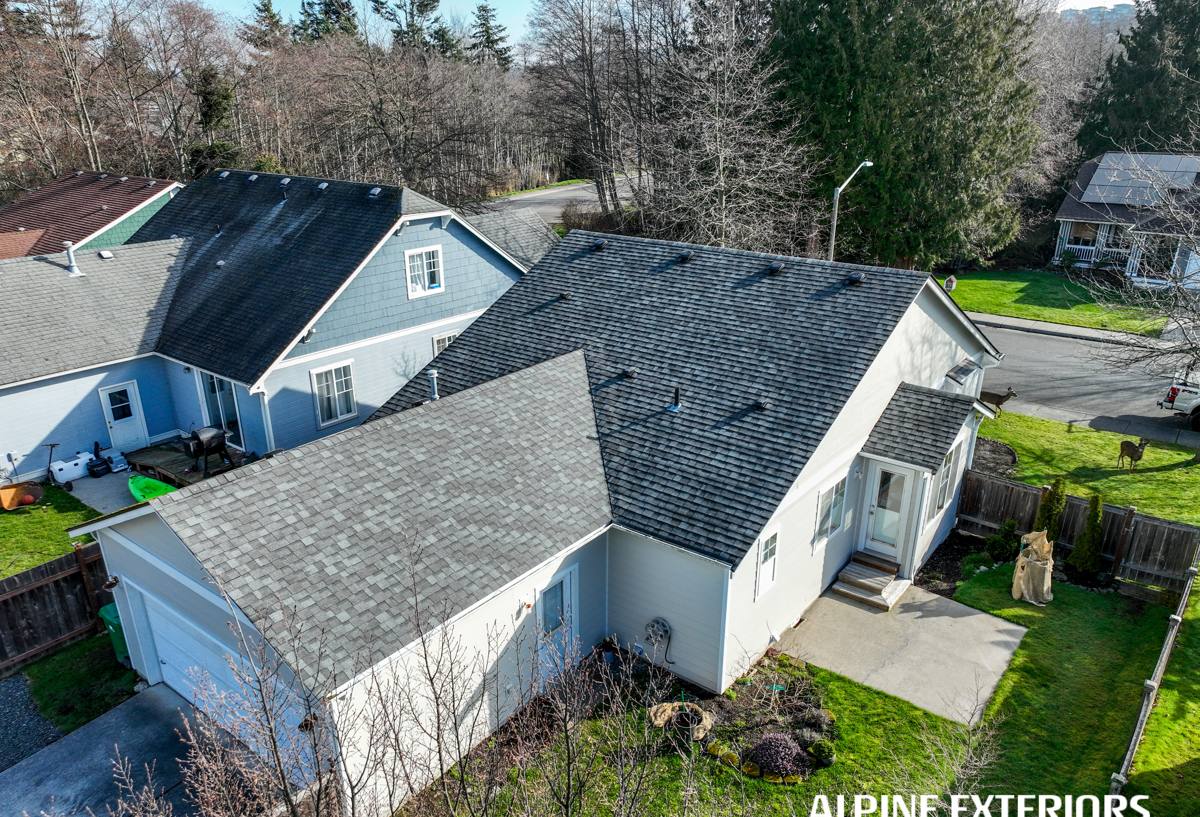
Why We Standardized on James Hardie and Nothing Else
We install James Hardie fiber cement siding exclusively. We don't install vinyl, LP SmartSide, Cemplank, Allura, or bare/primed wood siding like cedar or spruce. That's not a marketing position — it's a decision we made after years of doing tear-offs and repairs on this exact coastline and seeing which products actually held up to salt air, wind-driven rain, and moss pressure, and which ones needed constant attention or failed early.
Fiber cement is made from cement, sand, and cellulose fibers, which makes it non-combustible and dimensionally stable — it doesn't expand and contract with moisture the way wood-based products do, and it doesn't soften or delaminate when it stays wet for extended periods, which matters a lot in a climate where "extended periods" can mean a whole winter. James Hardie's ColorPlus finish is baked on at the factory under controlled conditions, which gives it better fade and chip resistance than field-applied paint, and their HZ5 product line is engineered specifically for climates with more moisture exposure — which describes most of western Washington, and especially exposed or wooded lots near Skagit County's shoreline.
We're not going to tell you every other product is junk — vinyl, engineered wood, and cedar all have legitimate uses and honest advocates. But when we're the crew whose name is on the installation and the warranty, we only put our name behind the product we've seen perform, over the long term, in this exact climate.
How Hardie Compares for a Coastal Skagit County Home
| Factor | James Hardie Fiber Cement | Vinyl | Cedar / Primed Wood |
|---|---|---|---|
| Moisture behavior | Stable; doesn't swell, rot, or delaminate | Won't rot, but can warp/buckle and trap moisture behind it | Absorbs moisture; needs sealed end cuts and consistent maintenance to resist rot |
| Salt air exposure | Factory finish resists fading and chalking | Can become brittle and discolor over time | Finish breaks down faster; more frequent recoating needed |
| Fire resistance | Non-combustible | Combustible, can melt/deform near heat sources | Combustible |
| Moss/algae resistance | Smooth factory finish resists buildup better than raw wood grain | Resists growth but shows dirt streaking | Wood grain and shaded exposure invite moss and mildew |
| Long-term maintenance | Periodic washing; no repainting needed with ColorPlus | Low maintenance but limited repair options once brittle | Regular repainting/staining and caulking required |
Our Siding Process for Blanchard Homes
Every home we work on in this area gets treated as a coastal-climate install, not a generic siding job. That shows up in the details more than in the marketing.
What we pay close attention to
- Weather-resistive barrier and flashing details at every window, door, and penetration — this is where wind-driven rain actually gets in, not through the field of the siding itself
- Proper fastener spacing and type, sized for both the product and the exposure category of the wall
- Correct clearance at grade, decks, and roof lines so water has somewhere to go instead of wicking up into the bottom course
- Caulking and sealant choices rated for sustained damp conditions, not just occasional rain
- Ventilation behind the siding so trapped moisture has a path out rather than sitting against the substrate
James Hardie's own installation instructions are specific about clearances, fastening patterns, and joint treatment — and a lot of the underperformance we see on older siding jobs in Skagit County traces back to a crew that treated those details as optional. They're not. They're the difference between siding that holds up for decades and siding that needs attention in five years.
Beyond Siding: Roofing, Windows, and Decks
Siding doesn't perform in isolation. On a coastal Skagit County home, the roof, windows, siding, and any attached decking all interact at the same set of transitions — roof-to-wall flashing, window trim, deck ledger connections — and a weak point at any one of those is where water problems usually start. We handle all four (siding, roofing, windows, and decks), which means when we're on your property we're looking at the whole envelope, not just the wall cladding, and flagging issues at those transition points before they turn into rot or interior damage.
That matters more in Blanchard than in a lot of places. A roof-to-wall detail that's marginal in a dry climate can fail outright under the driving rain this area gets several months a year. If your roof or windows are aging out around the same time your siding is, it's worth having one crew look at the whole picture rather than coordinating three separate contractors who each only see their own piece.
What Drives Cost on a Blanchard Siding Project
Every home is different, and we don't quote sight unseen — but these are the factors that most commonly move the price on a job in this area.
| Factor | Why it matters here |
|---|---|
| Existing siding removal | Older wood or vinyl siding, especially with rot or hidden moisture damage, adds tear-off and possible sheathing repair time |
| Wall exposure and elevation | West- and south-facing walls exposed to open weather often need more attention to flashing and joint sealing than sheltered walls |
| Trim and detail complexity | Homes with more windows, dormers, or architectural trim take more labor per square foot than a simple rectangular footprint |
| Access and site conditions | Sloped lots, mature landscaping, or limited driveway access common on wooded Skagit County parcels can affect staging and scaffolding |
| Product line and finish | Hardie's HZ5 line and specific ColorPlus finishes vs. field-painted options carry different material costs |
Why a Local Burlington Crew Makes a Difference
We're based out of Burlington and work throughout Skagit County, which means we're not learning this climate on your project — we already know how it behaves. We know what a winter of wind-driven rain off the bay does to a poorly flashed window, what a shaded, mossy north wall looks like after a few years of neglect, and which details on a fiber cement install actually matter in this weather versus which ones are just extra steps.
That local familiarity also means faster response if something needs a follow-up look, and a crew that's still around and reachable well after the installation is finished — not a traveling outfit that's moved on to the next region by the time a warranty question comes up.
Keeping Your Siding Performing Long-Term
Fiber cement siding is low-maintenance compared to wood or vinyl, but "low-maintenance" isn't "no-maintenance," especially in a climate like this one.
- Rinse siding periodically, especially shaded or north-facing walls prone to moss and algae buildup
- Keep gutters clear so overflow isn't running down the wall face during heavy storms
- Trim back vegetation that keeps siding shaded and damp for extended periods
- Inspect caulking at trim, window, and door joints every year or two and have any gaps resealed
- Watch for staining or discoloration at the base of walls near grade, which can signal a drainage or clearance issue
If you're seeing consistent moss growth, chalking, warping, or soft spots on your current siding, those are signs it's past the point of routine maintenance and worth having looked at.
Get a Free, No-Pressure Estimate
If you're in Blanchard and thinking about new siding — or noticing your roof, windows, or deck could use attention at the same time — we're glad to come take a look. There's no obligation and no pressure, just a straight assessment of what your home actually needs and what it would take to do it right. Use the form below to get started.