 Burlington
 Exterior Contractors Serving Conway, WA
Conway sits in the lower Skagit River valley, close enough to Puget Sound and the Skagit Bay tideflats that salt-tinged air is part of daily life for homes in the area. Add in the valley's low elevation, heavy seasonal rainfall, and the shade cover from the mature trees that line so many rural properties here, and you have a combination that is genuinely hard on exterior building materials. We work with property owners in Conway and throughout the Burlington area, and we build our approach around what this specific stretch of Skagit County actually does to a house over time.
This page covers how we think about siding, roofing, windows, and decks for homes in and around Conway, and why we standardized on one siding product instead of offering the usual lineup of options.
What Conway's Climate Does to a House
Salt Air and Moisture
Proximity to Skagit Bay and the broader Puget Sound means a steady low-level presence of salt-laden moisture in the air, especially on windier days. Salt air accelerates corrosion on fasteners, flashing, and any metal components on a home's exterior, and it can also speed up the breakdown of wood fiber and certain coatings that aren't built to handle it.
Driving Rain
Skagit County gets a lot of rain, and a good portion of it doesn't fall straight down — wind off the water and through the valley pushes it sideways into walls, window trim, and any gaps or seams in the exterior envelope. Driving rain finds weaknesses that a vertical downpour would never reach, which is why water-resistant barriers, correct flashing details, and tight joints matter more here than in drier, calmer climates.
Moss and Shade
Between the tree cover common on Conway properties and the region's long stretch of overcast, damp weather, moss has a long growing season here. Moss and algae hold moisture against siding and roofing surfaces far longer than they'd otherwise sit wet, which is a slow but steady stressor on materials that aren't moisture-tolerant.
None of this makes Conway a uniquely harsh place to own a home — it's a normal Pacific Northwest lowland climate. But it does mean product choice and installation quality matter more here than they would in a milder, drier region.
Why We Install Only James Hardie Fiber Cement Siding
We don't offer vinyl siding, LP SmartSide, Cemplank, Allura, or primed spruce and cedar siding. That's a deliberate professional standard, not a lack of options, and it's worth explaining honestly.
- Vinyl is affordable and low-maintenance in mild conditions, but it can warp or become brittle over time with temperature swings, and it doesn't hold up structurally the way fiber cement does over the long run.
- Wood-based products (LP SmartSide, primed spruce, cedar) can look great and perform well when maintained aggressively, but they rely on an intact factory or field coating to keep moisture out. In a climate with this much sustained dampness and salt air, any breach in that coating opens the door to swelling, rot, or fungal growth — and upkeep becomes a recurring commitment, not a one-time task.
- Other fiber cement brands (Cemplank, Allura) are legitimate cement-based products, and we don't claim they're defective. We simply standardized on one manufacturer so we can guarantee consistent factory finish quality, warranty terms, and installation specs across every job we do.
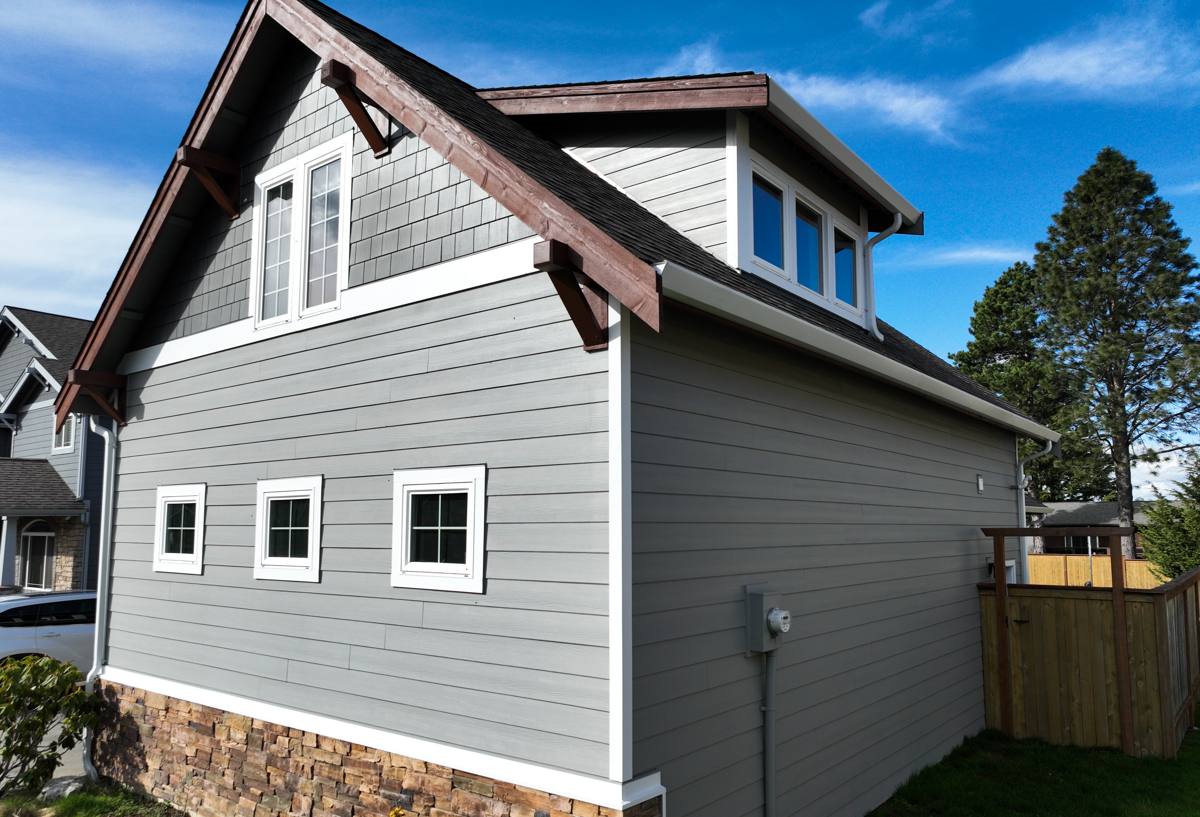
James Hardie fiber cement is non-combustible, dimensionally stable, and engineered specifically for the wet Pacific Northwest climate through its HZ5 product line. Its ColorPlus factory-applied finish is baked on under controlled conditions rather than sprayed on-site, which gives it more consistent, longer-lasting color adhesion than field-applied paint. Combined with a strong transferable warranty, it's the product we're willing to put our name behind on homes exposed to salt air, driving rain, and a long moss season.
Siding Product Comparison
| Material | Moisture Tolerance | Maintenance | Typical Lifespan |
|---|---|---|---|
| James Hardie Fiber Cement | High — engineered for wet climates | Low — occasional wash | Multi-decade with correct install |
| Vinyl | Moderate — can warp with heat/cold cycling | Low | Variable, shorter under UV and temperature stress |
| Wood-based (LP SmartSide, cedar, primed spruce) | Depends heavily on coating integrity | High — recoating, caulking, inspection | Shorter if maintenance lapses |
| Other fiber cement brands | High | Low | Comparable, but warranty/finish specifics vary by manufacturer |
Siding Installation in Conway
Installation quality matters as much as the product itself, especially with driving rain in the picture. We pay close attention to the water-resistive barrier, window and door flashing, kick-out flashing at roof-wall intersections, and proper gapping and fastening per Hardie's specifications. A siding job that looks right but skips these details will eventually let water behind the cladding — and in a climate like Conway's, that shows up faster than it would somewhere drier.
We also factor in ventilation and clearance from grade and landscaping, since trapped moisture and vegetation pressed against siding are two of the more common issues we see on older homes in wooded, low-lying areas like Conway.
Roofing for the Skagit Valley
Roofs in Conway deal with the same combination of sustained moisture, wind-driven rain, and shade-fed moss growth as siding does — arguably more, since a roof takes the brunt of it. We look at underlayment quality, flashing at valleys and penetrations, and ventilation as much as the shingle or roofing material itself. A roof that sheds water well but traps moisture underneath, or that isn't ventilated enough to let a damp attic dry out, will age faster regardless of the surface material's rating.
Moss control is part of the conversation too — not as a one-time treatment, but as an ongoing maintenance habit for any home under tree cover, which describes a lot of Conway.
Windows
Window performance in this climate comes down to two things: the unit's own seal quality and how well it's flashed and integrated into the wall assembly. A high-efficiency window installed with poor flashing will still leak, and a modest window installed correctly will often outperform it. We treat window replacement and siding work as connected projects when they overlap, since opening up the wall for one is the right time to verify or correct the other.
Signs a Conway Home May Need Exterior Attention
- Visible moss or algae buildup on siding or roofing that returns quickly after cleaning
- Soft spots, bubbling, or discoloration on wood-based siding or trim
- Drafts, fogging, or difficulty operating older windows
- Rust staining around fasteners, flashing, or hardware
- Peeling or chalking paint on siding that requires repainting more often than expected
- Water staining on interior ceilings or walls near roof lines
- Soft or spongy decking boards, especially near ground contact or under consistent shade
Decks
Decks in Conway face a similar set of pressures — standing moisture, shade-driven moss and algae, and, for decks near ground level, splash-back and limited airflow underneath. Material choice, proper spacing between boards, and ledger flashing where the deck meets the house are the details that determine whether a deck lasts or starts failing early. We build and repair decks with those specifics in mind rather than treating every deck the same regardless of its site conditions.
Why a Local Crew Matters Here
Conway isn't a large market on its own, but its conditions — salt air proximity, valley rainfall patterns, tree-shaded lots — are specific enough that generic exterior work doesn't always hold up. A crew that regularly works Skagit County homes recognizes these patterns quickly: where moss tends to establish first, which wall orientations take the worst of the driving rain, and which older installation methods are now showing their age. That familiarity shapes real decisions, from flashing details to product selection, rather than being a talking point.
What to Expect From a Project
Every property is different, but a typical exterior project — whether it's a full siding replacement, a roof, new windows, or a deck — starts with an honest look at current conditions, a clear explanation of what we're seeing and why it matters, and a straightforward scope and cost conversation before any work begins. We don't upsell products we don't install, and we'll tell you plainly if something is a maintenance issue rather than a full replacement.
If you own a home in Conway and want a clear-eyed look at how your siding, roof, windows, or deck are holding up against this area's climate, we're happy to take a look. Reach out for a free, no-pressure estimate using the form below.