 Burlington
 Oak Harbor sits close enough to open water that homeowners here deal with a different set of exterior problems than folks fifteen miles inland. Salt-laden air off the water, wind-driven rain that finds every gap in a building envelope, and a moss season that seems to stretch longer every year all put steady pressure on the outside of a house. We've built our business around understanding what that combination does to siding, trim, and roofing over time, and around installing products that are actually engineered to take it.
What Oak Harbor's Climate Actually Does to a House
It's easy to think of Pacific Northwest weather as just "a lot of rain," but the exposure profile near Oak Harbor is more specific than that. Proximity to saltwater means airborne salt settles on exterior surfaces and accelerates corrosion of fasteners, flashing, and any metal components that aren't rated for it. Add wind off the water and that salt gets driven into seams and joints instead of just sitting on the surface.
Then there's the rain itself. This part of Washington doesn't usually get dramatic downpours — it gets long stretches of steady, wind-pushed moisture that tests every seam, joint, and caulk line on a building. Siding that relies on face-sealed joints or that isn't dimensionally stable will eventually let water behind it, and once water gets behind siding, the sheathing and framing underneath are what actually pay the price.
Moss and algae growth is the third piece. Shaded, north-facing walls and anything under tree cover stay damp for extended periods much of the year, which is exactly the environment moss and mildew need to establish themselves on a wall surface. Porous or absorbent siding materials hold that moisture longer and give organic growth more to work with.
Why This Matters for Material Choice
None of this means a house near Oak Harbor is doomed to problems — it means the exterior materials and installation details need to match the exposure. A product that performs fine in a dry inland climate can fall short here, and a good installer in this region plans for salt, wind-driven moisture, and prolonged dampness as a matter of course, not as an afterthought.
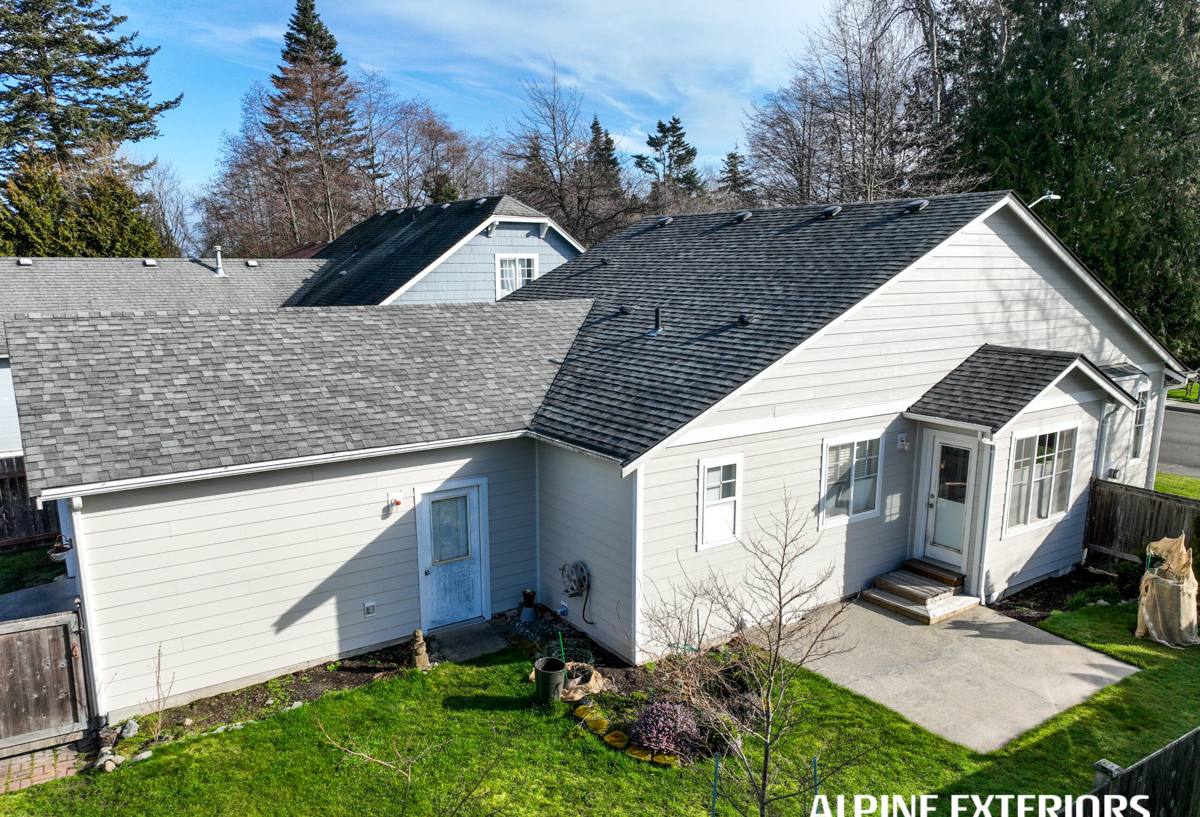
Why We Install James Hardie Fiber Cement — and Nothing Else
We made a deliberate decision as a company to install only James Hardie fiber cement siding. We don't install vinyl, LP SmartSide, Cemplank, Allura, or primed wood siding like spruce or cedar. That's not a marketing angle — it's a standard we hold because of what we've seen these products do, and not do, in exactly the conditions Oak Harbor sees.
Fiber cement is made from cement, sand, and cellulose fiber, which makes it dimensionally stable and non-combustible. It doesn't expand and contract with moisture the way wood-based products do, and it doesn't soften or deteriorate when it stays wet the way engineered wood products can if water gets behind them. Hardie's HZ5 product line in particular is engineered for climates with more moisture exposure, which fits this region well.
The factory-applied ColorPlus finish is another piece of why we standardized on Hardie. Because the color and finish are baked on in a controlled factory environment rather than sprayed on site, the finish holds up more evenly and resists fading, chipping, and the kind of moisture-related discoloration that painted or primed wood siding is prone to. That matters more in a salt-air environment, where lesser finishes tend to show wear faster.
We also value the transferable warranty structure Hardie backs its products with. It gives homeowners real protection and adds resale value, since a future buyer isn't inheriting an unknown quantity on the exterior of the house.
What We Turn Down, and Why
- Vinyl siding — lightweight and inexpensive, but it can warp or become brittle over time and doesn't offer the fire resistance or rigidity of fiber cement.
- LP SmartSide and similar engineered wood products — wood-based composites that perform well when installation is flawless, but they're more sensitive to sustained moisture exposure than fiber cement, which is a real concern in a wind-driven-rain climate.
- Cemplank and Allura — other fiber cement brands that are reasonable products, but we've standardized on one system, one warranty structure, and one factory finish process so we can guarantee consistent results.
- Primed spruce or cedar — attractive, but wood siding demands ongoing maintenance and repainting to keep water out, and that upkeep burden is steep in a climate that stays damp for much of the year.
We're not saying these products have no place anywhere. We're saying that for the specific combination of salt air, driving rain, and moss pressure that homes near Oak Harbor deal with, fiber cement is the material we're willing to put our name behind.
Beyond Siding: The Full Exterior Envelope
Siding doesn't work in isolation. Roofing, windows, and decking all interact with the same weather, and a weak point in any one of them can undermine the rest. We handle all four because they need to be thought about together, not as separate contracts with separate crews who never talk to each other.
Roofing
A roof that's shedding water properly protects everything below it, including the siding. Flashing details at wall-roof intersections are one of the most common places water finds its way into a structure, and getting those transitions right matters as much as the roofing material itself.
Windows
Window flashing and integration with the siding plane is another spot where problems hide. Wind-driven rain will find a poorly flashed window opening, and once water gets behind a window, the damage often isn't visible until it's already significant. We pay close attention to how new siding ties into existing or replacement windows.
Decks
Decks near the water take their own beating from salt air and moisture cycling — wood decking, fasteners, and ledger connections all need to be built or repaired with that exposure in mind, not treated like a dry-climate build.
What Correct Installation Looks Like
Fiber cement performs the way it's supposed to only when it's installed to manufacturer specification. That's true anywhere, but the margin for error is smaller in a climate like this one.
| Installation Detail | Why It Matters Here |
|---|---|
| Proper clearance from grade and roof lines | Prevents wicking moisture and standing water contact in a consistently wet climate |
| Correct fastener type and spacing | Salt air accelerates corrosion of the wrong fastener material over time |
| Rain screen / drainage plane behind siding | Gives any moisture that does get past the surface a path to drain and dry |
| Sealed and flashed joints, corners, and penetrations | Wind-driven rain finds unsealed seams that gravity-only rain would miss |
| Factory-cut and factory-primed edges where possible | Reduces raw-edge exposure that can absorb moisture and shorten finish life |
Skipping or shortcutting any of these doesn't usually cause an immediate visible problem. It shows up two, five, or ten years later as moisture damage, premature finish failure, or rot in the sheathing — long after the original install crew is gone. That's part of why we care as much about the installation process as the product itself.
A Local Crew That Understands This Coastline
Working near Oak Harbor and the broader Whidbey Island area isn't the same as working a dry inland job site. A crew that shows up with the same assumptions they'd use on a house forty miles from open water is going to miss details that matter here — clearance heights, fastener selection, flashing sequencing at wall-roof transitions, and where moss and algae are most likely to establish themselves on a given elevation.
We work throughout Skagit County and the surrounding region, and we treat every job's exposure conditions as specific to that site rather than applying a one-size-fits-all approach. A house tucked into trees on a shaded lot faces a different set of problems than one sitting exposed to open wind off the water, even if they're a mile apart.
Signs Your Siding May Already Be Struggling
- Soft spots or visible sagging anywhere on the wall surface
- Persistent moss or algae staining that returns quickly after cleaning
- Peeling, bubbling, or chalky paint that won't hold a fresh coat
- Visible gaps or separation at seams, corners, or trim boards
- Rust streaking near fasteners or metal flashing
- A musty smell or discoloration on interior walls that share an exterior wall
Any one of these on its own isn't necessarily an emergency, but they're worth having looked at, especially before another wet season sets in.
What to Expect When You Work With Us
We start with an honest look at the current condition of your siding, roofing, windows, or decking, and we'll tell you plainly if something can be repaired versus if full replacement is the better long-term call. We don't oversell a job that doesn't need it, and we don't sugarcoat one that does.
Every siding job we quote is scoped around James Hardie's product lines and the specific exposure conditions of your property — sun, shade, wind direction, and proximity to water all factor into material selection and installation detail. We'll walk you through why we're recommending a particular Hardie product line and finish for your specific situation rather than defaulting to a generic package.
If your home near Oak Harbor is due for new siding, roofing, windows, or a deck, we're happy to take a look and give you a straightforward, no-pressure estimate — just fill out the form below to get started.