 Burlington
 Two Very Different Materials, Often Sold as the Same Thing
When homeowners in Burlington start researching siding replacement, they usually run into two products that get lumped together in the same conversation: fiber cement and engineered wood siding. Sales materials sometimes blur the line between them, since both come as long horizontal planks, both can look like traditional wood lap siding, and both are marketed as upgrades over vinyl. But the materials themselves are fundamentally different, and that difference matters a lot once siding is on a house in Skagit County dealing with salt air, driving rain, and a moss season that can stretch for months.
This page lays out what each product actually is, how each one holds up in our climate, and why our company installs only James Hardie fiber cement siding. We don't install engineered wood products, and we want to explain that decision honestly rather than just state it.
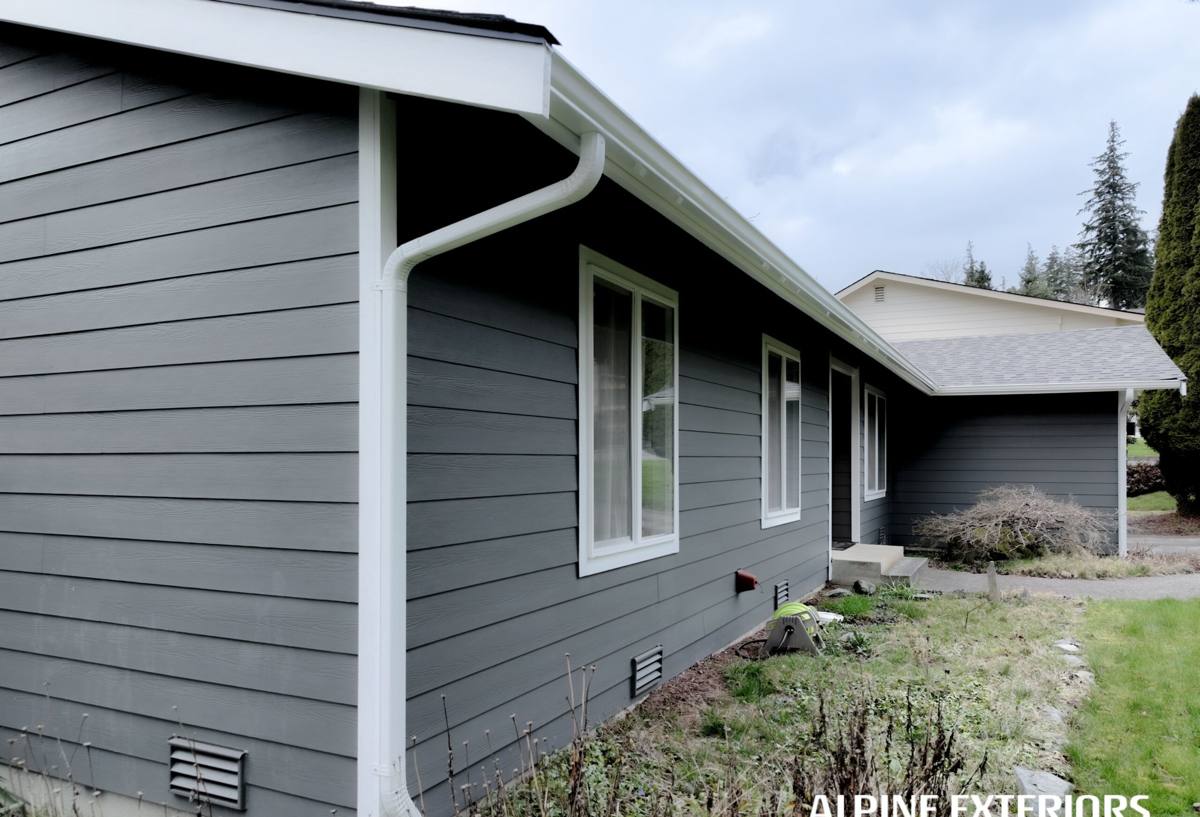
What Engineered Wood Siding Actually Is
Engineered wood siding (the category that includes products like LP SmartSide) is built from wood strands or fibers bonded with resins under heat and pressure, then finished with a treated overlay and a factory primer or coating. It's a real step up from raw plywood or hardboard siding of decades past — modern engineered wood is treated with zinc borate and other additives specifically to resist fungal decay and insects, and manufacturers back it with meaningful warranties.
The appeal is understandable. It's lighter than fiber cement, easier on saw blades and installer backs, and it takes paint and stain in a way that feels familiar to anyone used to working with real wood. In dry regions with long, hot summers, engineered wood siding has a solid track record.
Where the Wood Origin Still Shows Up
The core of the product is still wood fiber. That means the same physics that govern any wood-based building material still apply: wood fiber swells when it takes on moisture and shrinks as it dries. The resin treatments slow water absorption and resist rot, but they don't change the fact that if water gets past a compromised joint, a poorly sealed cut edge, or a failed caulk line, the underlying material is dealing with moisture the way wood does — not the way cement does.
What Fiber Cement Siding Actually Is
Fiber cement is a mix of Portland cement, sand, and cellulose fibers, cured into a rigid, dimensionally stable plank. There's no wood fiber in the core to swell, rot, or feed fungal growth. It's inherently non-combustible, which matters for insurance considerations and fire risk, and it holds paint and factory finishes far longer than wood-based products because the substrate itself doesn't move much with temperature and humidity swings.
James Hardie is the manufacturer we standardized on. Their HardiePlank lap siding, HardiePanel, and HardieShingle products come in climate-specific formulations — the HZ5 product line is engineered for the kind of wet, temperate, freeze-thaw-variable climate we have here in the Pacific Northwest, as opposed to the HZ10 formulation built for hot, humid southern climates. That regional engineering is a detail worth knowing: siding isn't one-size-fits-all, and the same product sold nationally may be formulated differently depending on where it ships.
How Each Performs in Skagit County's Climate
Burlington sits close enough to Puget Sound and Padilla Bay that salt-laden air is a real factor on siding, trim, and fasteners. Add driving rain off the water, a moss and lichen season that can run from fall through spring on shaded and north-facing walls, and repeated freeze-thaw cycles in the colder months, and you have a climate that stress-tests any exterior product's moisture management.
Moisture and Rot Exposure
Fiber cement doesn't rot. Full stop. Even where caulking fails or a fastener backs out and water finds its way behind a panel, the cement substrate isn't feeding decay the way a wood-fiber core can. Engineered wood siding is treated to resist this, but the resistance is a treatment applied to a wood-based material, not a change in the material's fundamental nature. In a climate with our rainfall totals and our long damp shoulder seasons, we've made moisture behavior our top priority when choosing what to put on a house.
Moss, Algae, and Surface Growth
Neither product is immune to moss and algae growth on the surface — that's a function of shade, moisture, and exposure more than substrate material. But the factory-applied ColorPlus finish on Hardie products is baked on and UV-cured, which holds up to the periodic washing needed to keep moss and algae in check better than field-applied or lower-grade factory coatings tend to.
Expansion, Contraction, and Joint Integrity
This is where the two products diverge most in real-world performance. Fiber cement has a very low coefficient of expansion — it doesn't move much across seasonal temperature and humidity swings. Engineered wood, being wood-based, expands and contracts more with moisture content. Over years of wet winters and drier summers, that movement can work at caulked joints and butt seams, which is exactly where water intrusion starts if maintenance lapses.
Side-by-Side Comparison
| Factor | Fiber Cement (James Hardie) | Engineered Wood |
|---|---|---|
| Core material | Cement, sand, cellulose fiber | Wood strands/fiber with resin binder |
| Rot resistance | Does not rot — no wood fiber to decay | Treated to resist rot; wood-based core |
| Combustibility | Non-combustible | Combustible (treated, but wood-based) |
| Dimensional stability | Very stable across seasons | More expansion/contraction with moisture |
| Factory finish | Baked-on ColorPlus, long fade resistance | Factory primer or coating, repaint sooner |
| Weight/installation | Heavier, requires specific fastening and cut practices | Lighter, faster to handle |
| Typical warranty | Long-term, transferable material warranty | Solid manufacturer warranty, wood-based exclusions apply |
Why We Don't Install Engineered Wood Siding
To be fair to the product: engineered wood siding installed correctly, maintained on schedule, and kept well-caulked can perform well for a long time, and plenty of homes around the country wear it successfully. Our decision isn't that it's a bad product. It's that we chose to standardize our crews, our warranty, and our reputation around one system rather than juggle installation specs, caulking schedules, and moisture-management practices across multiple materials with different failure modes.
Given our specific climate — the salt air, the rain volume, the moss season — we decided the long-term, lower-maintenance performance of a non-combustible, dimensionally stable, factory-finished fiber cement product was the better bet for homes in this area. That's a professional standard we hold ourselves to, not a claim that every engineered wood installation is destined to fail.
What Correct Fiber Cement Installation Requires
Fiber cement's long-term performance depends heavily on installation quality. This isn't a product where "close enough" caulking and flashing hold up over 20-plus years.
- Proper starter strip and flashing at all penetrations, windows, and doors
- Correct fastener type, spacing, and embedment depth per manufacturer spec
- Adequate clearance between siding and grade, decks, and roof lines to keep the bottom edge out of standing water
- Factory-cut or properly sealed field-cut edges, since exposed raw edges are the most vulnerable point on any fiber cement product
- Correct panel gaps and caulking at butt joints to allow for minor movement without trapping water
- Rainscreen or drainage plane detailing appropriate for a high-rainfall region like ours
When any of these steps get rushed or skipped, a homeowner can end up with problems that have nothing to do with the material itself and everything to do with the install. That's true of fiber cement, engineered wood, or any siding product — installation quality is often the real variable, which is why vetting a contractor's specific fiber cement experience matters as much as the material choice.
Cost Considerations
Engineered wood siding typically costs somewhat less than fiber cement up front, both in material and in labor, since it's lighter and faster to install. Fiber cement carries a higher upfront cost but tends to even out over the life of the siding through longer repaint cycles (Hardie's ColorPlus finish is designed to go well over a decade before needing attention), lower rot-related repair risk, and a warranty structure built around a material that isn't fighting its own composition to stay intact. Homeowners weighing the two should look at total cost of ownership over 20-30 years, not just the installed price on day one.
Warranty Differences Worth Understanding
Warranty terms on both product types are worth reading closely rather than taking on faith. Engineered wood warranties are generally solid but often carry specific exclusions around moisture exposure and maintenance requirements, given the wood-based core. James Hardie's warranty on its fiber cement products is structured around a non-combustible, non-organic substrate, and it's transferable, which matters if you plan to sell the home within the warranty period. We only stand behind installations we perform to spec, so understanding what's covered — and what installation practices are required to keep that coverage valid — is part of any honest siding conversation.
Making the Right Call for Your Home
If you're comparing siding options in Burlington, Mount Vernon, or elsewhere in Skagit County, the right choice depends on your home's exposure, your tolerance for maintenance, and how long you plan to own the property. We're happy to walk through your specific situation, look at sun and rain exposure on each elevation, and explain exactly why we'd recommend James Hardie fiber cement for your home. If you'd like a straightforward, no-pressure estimate, use the form below and we'll get back to you.