 Burlington
 Siding in Lyman: Built for a Wet, Green Corner of Skagit County
Lyman is one of the smaller communities we serve out of Burlington, tucked into the Skagit Valley among farmland, timber, and river bottomland. It doesn't get the same foot traffic or attention as the bigger towns along I-5, but the homes here face the same demanding climate as the rest of Skagit County — arguably a more concentrated version of it. Salt-laden air moving in off Puget Sound, long stretches of driving rain, and a moss season that seems to start earlier and end later every year all take a toll on exterior materials that aren't built for it. That combination is what separates a siding job that looks good on day one from one that still looks good fifteen years later.
We install James Hardie fiber cement siding exclusively. That's not a marketing angle — it's the result of years spent installing, inspecting, and repairing exterior systems throughout this region and paying attention to which materials actually held up and which ones didn't. On a property like a home in Lyman, where a house might sit closer to trees, closer to damp ground, or simply see less direct sun than a home on an open lot, the margin for error in siding choice and installation gets smaller, not bigger.
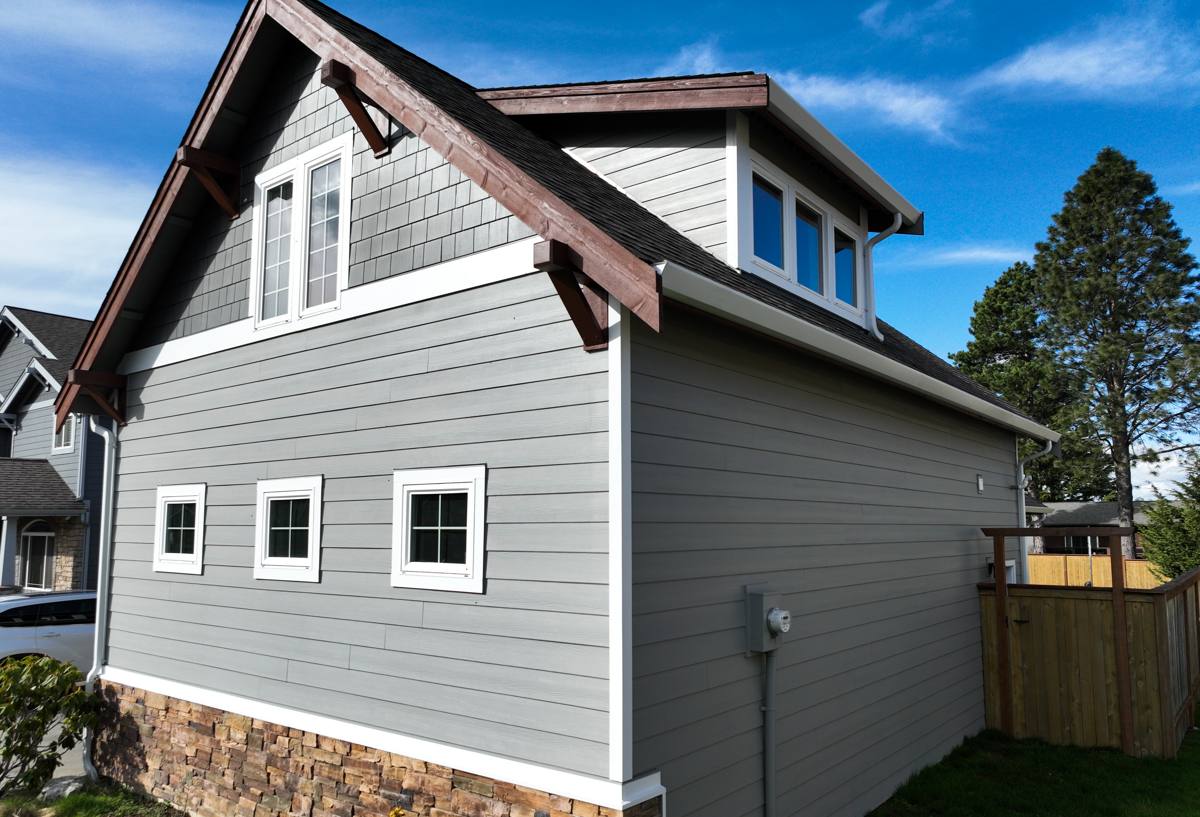
What Skagit County's Climate Does to a Home's Exterior
Driving Rain and Wind-Driven Moisture
This part of Washington doesn't just get rain — it gets rain pushed sideways by wind off the water often enough that vertical rainfall totals alone understate the real exposure. Wind-driven rain finds its way into gaps, laps, and seams that would stay dry in a calmer climate. Siding systems that rely on face-sealed joints or that aren't detailed with proper flashing and drainage planes are the ones that end up with hidden water damage behind an exterior that still looks fine from the curb.
Salt Air and Corrosion
Proximity to Puget Sound means a meaningful amount of salt in the air across Skagit County, and that salt doesn't stay near the water — wind carries it inland and it settles on siding, trim, flashing, and fasteners. Over time it accelerates corrosion in anything metal and degrades finishes that aren't built to resist it. It's one more reason a factory-applied, engineered finish matters more here than it would in a landlocked climate.
A Long Moss and Algae Season
Cool temperatures, high humidity, and shaded, tree-lined properties — common around Lyman — add up to a moss and algae season that runs most of the year. Any siding material that's even slightly porous, or that traps moisture at the surface, becomes a growth surface for green and black staining. North-facing walls and shaded corners are usually the first place it shows, and once organic growth establishes itself, it holds moisture against the siding and makes the underlying problem worse.
Why We Install Only James Hardie Fiber Cement Siding
We used to offer a broader range of siding products. We stopped, and the decision came from what we kept finding on service calls and tear-offs — not from a sales pitch. Here's what we look for in a product before we're willing to stand behind it in this climate:
- Non-combustible core: Fiber cement doesn't feed a fire the way wood-based or wood-derived products can, which matters for both safety and insurance considerations.
- Factory-applied ColorPlus finish: The finish is baked on under controlled conditions rather than brushed on at the jobsite, which holds up far better against sun, salt air, and moisture cycling than field-applied paint.
- Climate-engineered HZ5 formulation: Hardie's HZ5 product line is engineered specifically for regions with heavy moisture exposure and freeze-thaw cycling — a closer match to Skagit County's climate than a generic, one-size-fits-all product.
- Dimensional stability: Fiber cement doesn't swell, cup, or warp when it absorbs moisture the way engineered wood products can, which matters on a property that stays damp longer than average.
- Strong, transferable warranty: When installed to manufacturer specification, Hardie's warranty coverage is among the more substantial in the industry, and it transfers if the home changes hands.
What We Don't Install — and the Honest Trade-Offs Behind That
We won't install LP SmartSide, vinyl siding, Cemplank, Allura, primed spruce, or cedar, and we think homeowners deserve the real reasoning rather than a vague brush-off.
LP SmartSide and other engineered wood products perform reasonably well in drier climates, but they rely on cut-edge sealing and ongoing maintenance to keep moisture out at seams and penetrations — maintenance that's easy to fall behind on, and unforgiving when you do. Vinyl siding is inexpensive and low-maintenance in the sense that it doesn't need repainting, but it can trap moisture behind the panels rather than shedding it, and it's prone to warping and fading over time, especially with UV and temperature swings. Cemplank and Allura are also fiber cement products, and reasonable ones — our decision to standardize on Hardie isn't a claim that they're inferior products, it's that we'd rather commit our crews, our training, and our warranty relationships to one system we know inside and out. Cedar and primed spruce look excellent when new, but real wood siding demands consistent refinishing to keep moisture out, and in a climate with this much rain and shade, that maintenance schedule tends to slip faster than homeowners expect.
None of these products are without a legitimate use case somewhere. Our position is narrower than "these products are bad" — it's that after years of exterior work in this specific climate, we don't want to install anything we're not fully confident will still be performing well in two or three decades with reasonable, not exceptional, upkeep.
Full Exterior Protection for Lyman Homes: Siding, Roofing, Windows, and Decks
Siding rarely fails as an isolated problem. Roofing, windows, and decking all interact with the same rain, wind, and moisture load, and a weakness in one system usually shows up as damage somewhere else. We handle all four so a Lyman property gets evaluated as one connected exterior, not four separate trades that never talk to each other.
Siding
New installations, full tear-off replacements, and repair work, all using James Hardie fiber cement products installed to manufacturer specification — correct nailing patterns, clearances, flashing, and drainage details, which matter more in this climate than the product itself.
Roofing
A roof that isn't shedding water correctly — missing drip edge, undersized valleys, failing flashing at penetrations — overloads the siding and trim below it no matter how well that siding was installed. We look at roof condition as part of any exterior evaluation, not as a separate concern.
Windows
Window flashing and its integration with the siding plane is one of the most common points of failure we find during inspections. A window that isn't properly flashed lets water behind the cladding, where it causes damage long before anything shows on the surface.
Decks
Decks face the same rain and moss exposure as siding, plus standing water and direct ground contact. We build and repair decks with drainage, fastening, and material choices suited to a climate that stays wet for much of the year.
How We Approach a Siding Project, Start to Finish
Inspection and Moisture Assessment
We start by examining the existing siding, trim, flashing, and any visible signs of moisture intrusion — soft spots, staining, bubbling paint, or separation at seams and penetrations. On properties around Lyman, we pay close attention to shaded walls and areas near mature trees, since that's typically where moss and hidden moisture problems establish first.
Substrate Repair Before Anything Goes Up
New siding only performs as well as what's underneath it. Any water-damaged sheathing gets replaced, not covered over. Skipping this step is one of the most common shortcuts in lower-cost siding jobs, and it's the reason a lot of "new" siding starts failing within just a few years.
Installation to Manufacturer Specification
James Hardie products are engineered around specific nailing patterns, clearances, and flashing details, and those details aren't optional extras — they're what the warranty and the product's real-world performance depend on. In our experience, when fiber cement siding underperforms, the product itself is rarely the actual problem; a shortcut in installation almost always is.
Final Walkthrough and Care Guidance
We walk the finished job with the homeowner, checking seams, trim, and caulking, and go over what long-term care actually looks like — which, with Hardie's factory finish, is minimal compared to painted or wood-based siding.
Comparing Siding Materials for This Climate
| Material | Moisture & Salt Air Resistance | Ongoing Maintenance | Typical Lifespan |
|---|---|---|---|
| James Hardie Fiber Cement | High — factory finish engineered for wet, salt-exposed climates | Low | 30+ years with correct installation |
| Vinyl | Moderate — can trap moisture behind panels | Low, but prone to warping and fading | 15-25 years |
| LP SmartSide (engineered wood) | Moderate — vulnerable at cut edges and seams | Moderate — sealed edges need upkeep | 15-30 years, variable |
| Cedar / Primed Spruce | Low to moderate — absorbs moisture | High — regular refinishing required | 10-20 years without diligent upkeep |
These are general industry ranges, not guarantees. Actual performance always comes down to installation quality, upkeep, and how exposed a given wall or property is to sun, shade, and prevailing wind.
What Drives the Cost of a Siding Project
We don't publish flat prices because every home is different, but the variables that actually move the number on a Lyman project are consistent from job to job:
- Total square footage and the complexity of the home's shape — dormers, gables, and multiple stories all add labor
- Condition of the existing substrate, and whether water damage needs to be repaired before new siding can go up
- Amount of trim, corner detail, and custom work involved
- Whether roofing, window, or deck work is bundled into the same project
- Site access and staging conditions, including tree cover and driveway space common on more rural Skagit County properties
Signs Your Siding Needs Attention
- Moss or dark staining that keeps coming back shortly after cleaning
- Soft or spongy spots when you press on the siding, especially near the base or window trim
- Peeling or bubbling paint, particularly on shaded or north-facing walls
- Gaps or separation at seams, corners, or where siding meets trim
- Visible warping, cupping, or swelling in existing panels
Why a Local Skagit County Crew Matters
Siding detailed correctly for a wind-exposed lot near the water isn't necessarily detailed the same way for a shaded, tree-covered property further inland — and a crew that only shows up occasionally doesn't build that intuition. Working across Skagit County day in and day out teaches you where moss establishes first, which wall orientations stay damp the longest, and how salt air and driving rain actually behave here over a full year, not just on install day. That's the kind of local, repeated experience that shapes flashing details and product choices that hold up rather than just look right when the crew drives away.
Ready to Talk About Your Home?
If your Lyman home has siding that's showing its age — moss that won't clean off, soft spots, or paint that's failing faster than it should — we're glad to take a look and give you a straightforward, no-pressure assessment. Reach out using the form below to schedule a free estimate.