 Burlington
 Siding Replacement in Sedro-Woolley: A Skagit Valley Climate Problem
Sedro-Woolley sits at the edge of the Skagit Valley, where the flat farmland gives way to the foothills of the North Cascades. That location gives the town a mix of weather that's harder on exterior materials than it looks from the outside: valley moisture that settles in and lingers, driving rain that comes off the Sound and gets funneled up the valley, and a long, mild growing season that's just as good for moss and mildew as it is for the farm fields nearby. Homes here don't get the harshest coastal exposure in Skagit County, but they take a slower, steadier kind of punishment — the kind that shows up as soft trim, peeling paint, and green-streaked siding five or ten years before a homeowner expects it.
We install James Hardie fiber cement siding exclusively across Skagit County, including Sedro-Woolley. That's not a marketing position — it's a standard we settled on after years of tearing off failed siding on service calls and seeing the same patterns of moisture damage on products that weren't built for a climate like this one.
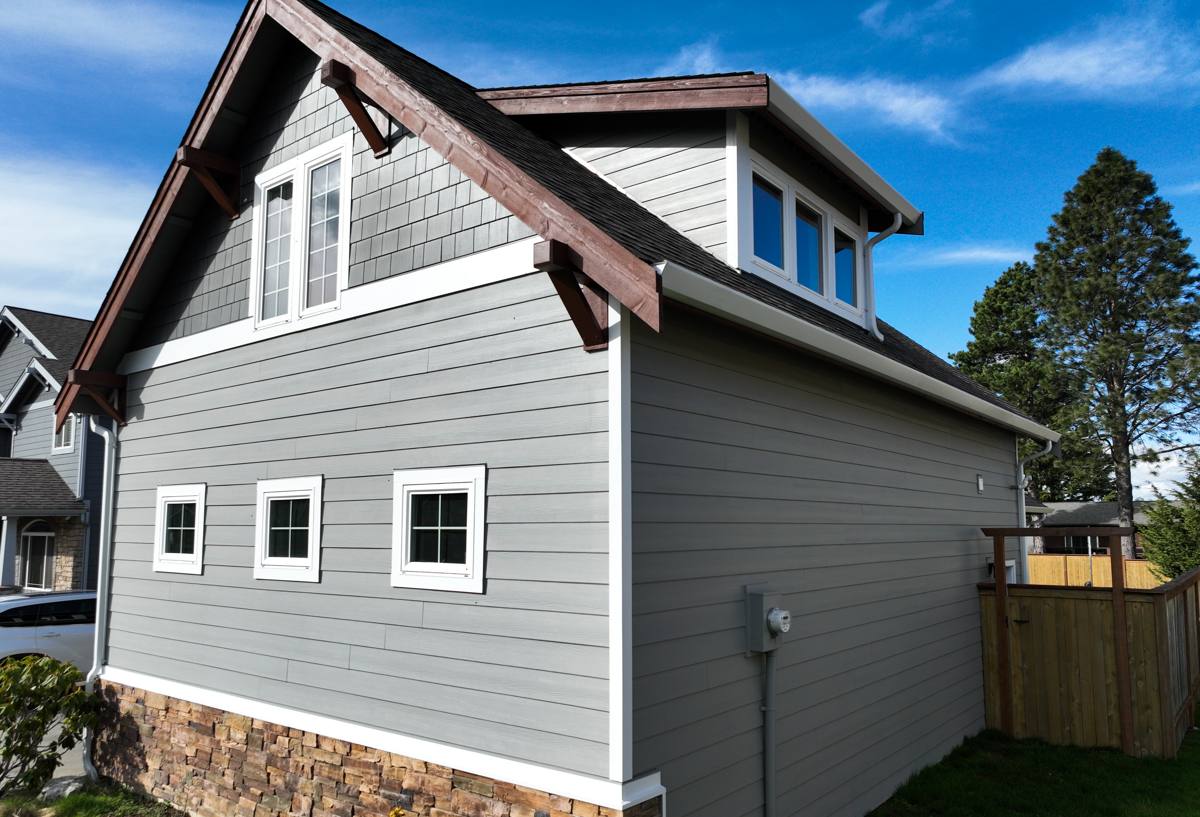
What Sedro-Woolley's Climate Actually Does to Exterior Siding
Driving Rain and Valley Moisture
Weather systems moving in off Puget Sound often get funneled and intensified as they push up the Skagit Valley, and Sedro-Woolley catches a good share of that driving rain. Wind-driven rain doesn't just fall on siding, it's forced sideways into seams, laps, and trim joints — which is exactly where cheaper or poorly installed siding systems start to fail first. Add in the valley's tendency to hold humidity longer after a storm than more open, breezier parts of the county, and you get siding that rarely gets a full chance to dry out between weather events, especially through the fall and winter months.
A Long Moss Season
Mild temperatures, filtered light from surrounding trees, and near-constant moisture add up to a moss and mildew season that runs most of the year in this part of Skagit County. North-facing walls, shaded siding under eaves, and anywhere airflow is restricted are the first places we typically see green or black growth establish. Any siding material with even a little surface porosity becomes a foothold for that growth, and once moss takes hold it holds moisture against the wall behind it, which accelerates whatever damage was already starting.
Salt Air's Reach Up the Valley
Sedro-Woolley isn't a coastal town, but Skagit County's salt-laden air off Puget Sound and the Sound-adjacent lowlands still reaches inland on windier weather patterns, adding a low but real corrosion load to fasteners, flashing, and exposed trim over time. It's a smaller factor here than in towns sitting directly on the water, but combined with the valley's rain and moss exposure, it's one more reason we spec exterior systems built for Pacific Northwest conditions rather than a generic national product.
Temperature Swings and Freeze-Thaw
Sedro-Woolley's proximity to the foothills means slightly cooler overnight temperatures and more frequent freeze-thaw cycling in winter than towns closer to the Sound. Materials that absorb moisture and then freeze are prone to cracking, swelling, and surface breakdown over repeated cycles — a slow-motion failure mode that's easy to miss until the damage is already extensive.
Why We Install Only James Hardie Fiber Cement
We used to offer a broader range of siding products. We stopped, and the decision came from the field, not from a sales strategy. Here's what drove it:
- Non-combustible core: Fiber cement doesn't contribute fuel to a fire the way wood-based siding products can, which matters for both safety and, in many cases, insurance considerations.
- Factory-applied ColorPlus finish: The color coat is cured in a controlled factory process rather than brushed on at the jobsite, which holds up longer and more evenly against sun, rain, and repeated wet-dry cycling than field-applied paint.
- Climate-engineered HZ5 line: Hardie's HZ5 formulation is built for regions with significant moisture exposure and freeze-thaw cycling — a closer match to Skagit Valley conditions than the company's warmer-climate product lines.
- Dimensional stability: Fiber cement doesn't swell, cup, or warp the way engineered wood products can when they take on moisture, which matters in a valley climate where materials rarely get a long dry stretch.
- Transferable warranty: Hardie's warranty structure is one of the stronger ones in the industry, provided the product goes on to manufacturer specification.
We don't install LP SmartSide, vinyl siding, Cemplank, Allura, primed spruce, or cedar. Each of those products has legitimate use cases and homeowners who are satisfied with them, and we're not here to tell you they're worthless. But we've made a professional call: given the rain load, moss season, and freeze-thaw cycling we see year after year in this part of Skagit County, we don't want to install anything that asks a homeowner to keep up with more maintenance vigilance than we think is reasonable to expect.
How We Handle a Siding Replacement in Sedro-Woolley
Inspection First, Estimate Second
Before we quote anything, we walk the exterior and look at what the current siding, trim, and flashing are actually telling us — soft spots, staining patterns, failed caulk lines, and gaps at penetrations like hose bibs, vents, and light fixtures. In Sedro-Woolley specifically, we pay close attention to shaded and tree-adjacent walls, since that's typically where moss and slow-drying moisture problems start first.
Checking What's Underneath
Once old siding comes off, we check the sheathing and framing underneath before anything new goes up. Rotted or water-damaged substrate gets repaired, not covered over. Skipping this step is the single most common shortcut in low-bid siding jobs, and it's the reason a lot of "new" siding fails within a handful of years regardless of what product went on top.
Installation to Manufacturer Spec
James Hardie siding is engineered around specific nailing patterns, clearances above grade and roof lines, and flashing details at every window, door, and penetration. The product itself rarely fails on its own — installation shortcuts are what cause the moisture intrusion and premature wear we get called out to fix on other companies' work.
Final Walkthrough and Care Guidance
We walk the completed job with the homeowner, checking seams, trim lines, and caulking, and go over basic long-term care — mainly how to keep an eye out for moss regrowth and what a normal maintenance rinse should look like on a fiber cement exterior.
Full Exterior Services, Not Just Siding
Siding doesn't fail in a vacuum. Roofing, windows, and decks all interact with the same rain and moisture load a home takes on, and a problem in one system usually shows up as damage in another. We handle all four so a Sedro-Woolley home's exterior gets looked at as one connected system.
Roofing
How a roof sheds water — drip edge, valleys, flashing at penetrations — directly determines how much water load the siding below has to deal with. A roof that's dumping water in the wrong place will overwhelm even a well-installed siding system over time.
Windows
Window flashing and its integration with the siding plane is one of the most common places we find hidden moisture intrusion during inspections. Water that gets behind the cladding at a poorly flashed window does its damage long before anything shows on the surface.
Decks
Decks in this part of Skagit County face the same driving rain and moss exposure as siding, plus standing water and ground-contact wear. We build and repair decks with drainage and material choices suited to a valley climate that stays damp much of the year.
Comparing Siding Options
| Product | Moisture Resistance | Maintenance | Typical Lifespan |
|---|---|---|---|
| James Hardie Fiber Cement | High — engineered for Pacific Northwest moisture exposure | Low — factory finish, minimal upkeep | 30+ years with proper installation |
| Vinyl | Moderate — moisture can collect behind panels | Low upfront, but prone to warping and fading | 15-25 years |
| LP SmartSide (engineered wood) | Moderate — vulnerable at cut edges and seams | Moderate — cut edges and seams need ongoing sealing | 15-30 years, variable |
| Cedar / Primed Spruce | Low to moderate — absorbs and holds moisture | High — regular refinishing and inspection needed | 10-20 years without diligent upkeep |
These are general industry ranges, not guarantees — actual results always depend on installation quality, maintenance habits, and how exposed a specific wall or elevation is.
Cost Factors for a Sedro-Woolley Siding Project
We don't post fixed prices because every home is different, but the variables that move the number on a Sedro-Woolley siding job are consistent from house to house:
- Total square footage and how complex the home's shape is — dormers, gables, and multiple stories all add labor
- Condition of the existing substrate and whether water-damaged sheathing needs repair before new siding goes on
- Amount of trim, corner boards, and custom detail work involved
- Whether roofing, window, or deck work is bundled into the same project timeline
- Site access, including tree cover, driveway space, and staging room, which varies a lot on the more rural lots common around Sedro-Woolley
Signs Your Current Siding Is Losing the Battle
- Green or dark staining that keeps coming back within months of cleaning
- Soft, spongy areas when you press on siding near the bottom courses or under windows
- Peeling, bubbling, or chalking paint, especially on shaded or north-facing walls
- Visible gaps or separation at seams, corners, or trim joints
- Warping, cupping, or swelling in existing panels or boards
- Rising energy bills that track with drafts near exterior walls
Why Working With a Local Crew Actually Matters
A siding job installed correctly for a wind-exposed coastal Skagit County property isn't automatically installed correctly for a valley setting like Sedro-Woolley, and the reverse is just as true. A crew that works this county on a daily basis knows which wall orientations dry out slowest here, where moss establishes first, and how the valley's rain patterns actually behave across a full year rather than on a single install day. That local, repeated exposure is what shapes flashing choices, clearances, and product decisions that hold up over decades instead of just looking good when the crew packs up.
It also means accountability. A local company is easy to find if something needs a second look after the job is done, and has a reputation in the community worth protecting — not just a job number in a call center queue.
Get a Free, No-Pressure Estimate
If your Sedro-Woolley home's siding is showing its age, or you're planning ahead for a replacement before small problems turn into expensive ones, we're glad to take a look and give you a straight assessment. No pressure, no upsell script — just an honest read on what your exterior needs. Use the form below to schedule a free estimate.