 Burlington
 Why Fir Island Asks More of a Siding Job
Fir Island sits low in the Skagit River delta, out where the farmland meets Skagit Bay. That location is what makes the ground so good for growing tulips and potatoes, and it's also what makes the air around a house so hard on exterior materials. Homes here sit closer to open water and tidal flats than most of the rest of Skagit County, which means more salt-laden air moving across the siding, more wind-driven rain hitting walls at an angle instead of falling straight down, and very little tree cover or terrain to break that wind before it reaches a building. Add in the marine layer that sits over the delta for a good part of the year, and you've got a siding job that has to handle near-constant dampness, not just occasional storms.
None of that is a reason to avoid siding a house out here — it's just the reason a generic installation approach doesn't hold up as long on Fir Island as it might a few miles inland in Burlington or Mount Vernon proper. The material, the flashing details, and the fastening all need to account for a site that's wetter and saltier than average for this part of Washington.
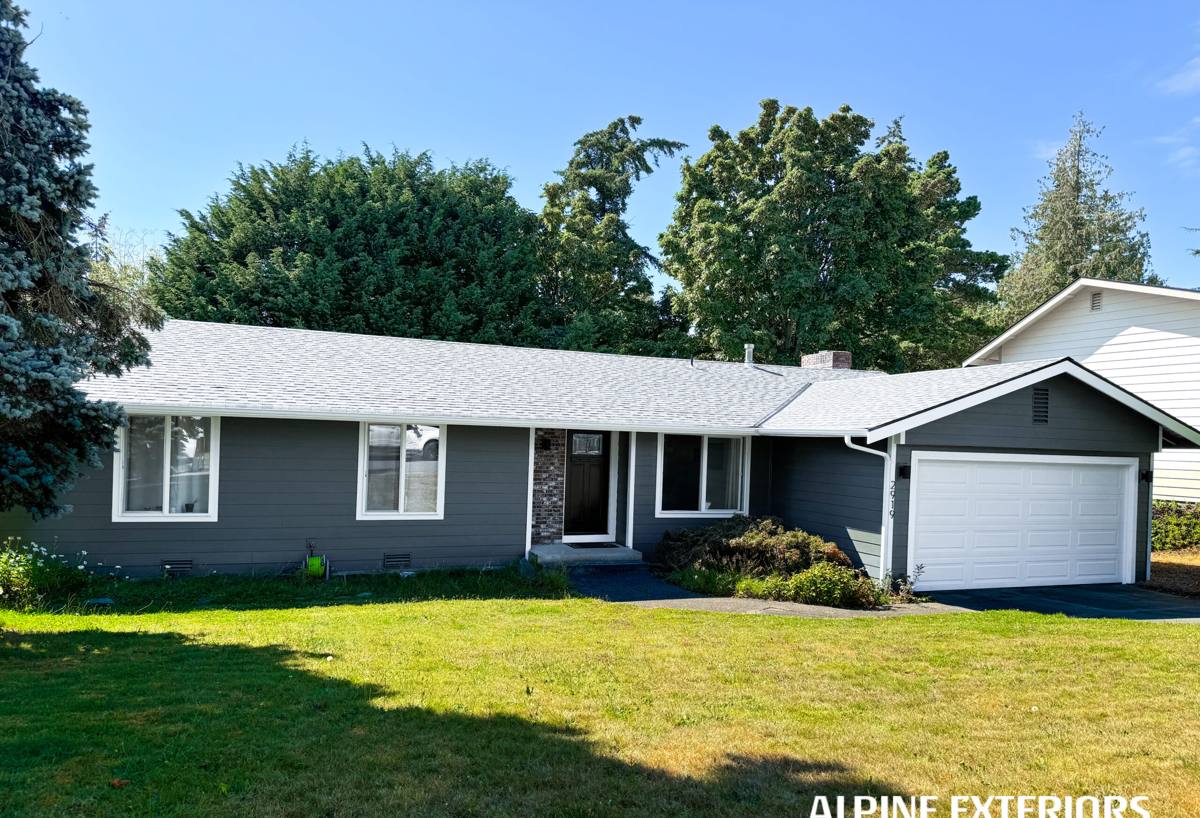
What Salt Air and Driving Rain Actually Do to Siding
Salt in the air isn't dramatic — it doesn't eat through a wall in a season — but it works slowly and constantly. It accelerates corrosion on any exposed metal fastener, flashing edge, or trim piece that isn't properly protected, and it leaves a fine residue on siding surfaces that holds moisture longer than clean rain would. Combine that with wind-driven rain, which pushes water sideways and upward into laps, seams, and butt joints that were only ever designed to shed water falling straight down, and you get two mechanisms working together: more water finding its way behind the siding, and more corrosion wherever water meets metal.
Moss adds a third layer to the problem. Skagit County's moss season runs long — cool, wet, low-light stretches where moss and algae get a real foothold on any siding surface that stays damp and shaded. Moss isn't just cosmetic. It holds moisture against the siding face, and on materials that aren't dimensionally stable, that trapped moisture is what starts rot, delamination, or swelling at the edges.
Where Problems Usually Start
- Butt joints between siding boards where caulking has failed or was never back-primed
- Corner trim and window/door casing where flashing was skipped or undersized
- Bottom courses close to grade, splash zones, and areas shaded by landscaping
- Fastener heads that weren't corrosion-resistant for a marine-influenced environment
- Areas with north or west exposure that stay damp longest after a storm
Why We Only Install James Hardie Fiber Cement
We standardized on James Hardie fiber cement siding and don't install vinyl, LP SmartSide, primed spruce, cedar, or other fiber cement brands. That's not a marketing position — it's a decision based on what actually holds up in this climate over decades, not just years. Fiber cement is non-combustible, dimensionally stable in wet-dry cycling, and doesn't feed moss the way wood-based products can once the surface starts breaking down. James Hardie's HZ5 product line is engineered specifically for climates like ours — wet, marine-influenced, freeze-thaw at the margins — and the ColorPlus factory finish means the color coat is baked on in a controlled environment rather than field-applied, which matters a lot when a house is going to sit exposed to salt air and UV for the next 30-plus years.
We're not going to tell you every other product on the market is worthless — vinyl and engineered wood sidings have their place and their price point. But for a site like Fir Island, where the air is saltier, the wind is more direct, and the moss season is longer than average, we've made the call that fiber cement done correctly is what we're willing to put our name on. If you want the longer version of that reasoning, our general Hardie education pages go into the product lines, warranty structure, and cost comparisons in more depth.
What a Correct Installation Looks Like Here
The material is only half the equation. A lot of the siding failures we get called out to inspect on older homes near the water aren't material failures at all — they're installation shortcuts that didn't matter for the first five years and then compounded into real problems by year fifteen. On a site with this much moisture exposure, the installation details carry more weight than usual.
The details that matter most in this location
- Weather-resistive barrier installed as a continuous drainage plane behind the siding, not just a wrap that gets punctured and taped over
- Rainscreen gap or furring where conditions call for it, so bulk water and incidental moisture can drain and the wall can dry out between storms
- Flashing at every horizontal transition — window heads, door heads, roof-to-wall intersections, deck ledgers — with proper laps, not caulk used as a substitute for flashing
- Corrosion-resistant fasteners rated for the exposure, driven to the manufacturer's specified depth and pattern, not overdriven or underdriven
- Correct clearances from grade, roof lines, and horizontal surfaces so splash-back and standing water aren't sitting against the bottom course
- Factory-cut and sealed edges wherever possible, since field-cut fiber cement edges need to be primed and sealed to match the factory protection
Every one of those items is standard practice, not an upsell — but standard practice only protects a house if it's actually followed on every course, every corner, every year the crew is on the job. That consistency is where experience on wet, exposed sites actually shows up.
Our Installation Process
- On-site assessment — we look at wall orientation, drainage, existing damage, and how exposed each elevation is to wind and salt air before we ever talk product or price.
- Tear-off and substrate check — removing the old siding lets us actually see the sheathing and framing underneath, which is often where the real story is.
- Repair before we cover anything up — any rot, soft sheathing, or compromised framing gets fixed first. Covering a problem with new siding just hides it for a few more years.
- Weather-resistive barrier and flashing installed as a complete system, with particular attention to every penetration and horizontal transition.
- James Hardie installation to manufacturer spec — fastening, clearances, and joint treatment done to the standard the warranty actually requires.
- Trim, caulking, and final detailing at corners, openings, and transitions where most long-term failures originate if rushed.
- Walkthrough so you understand what was done, what maintenance to expect, and what the warranty covers going forward.
Cost Factors on a Fir Island Home
Every job is different, but the variables that move the price on a delta-exposed home tend to be consistent. Rough ranges below are for planning conversations only — an accurate number requires a look at the actual house.
| Factor | Why It Matters Here |
|---|---|
| Home size and wall complexity | More corners, gables, and dormers means more cutting, flashing, and labor time |
| Extent of substrate repair needed | Older homes near the water more often have hidden moisture damage under existing siding |
| Siding profile and trim package | Lap width, shingle-style panels, and trim detail all affect material cost and install time |
| Wind/rain exposure of each elevation | Higher-exposure walls may warrant additional flashing or rainscreen detail |
| Accessibility | Site access, staging area, and building height affect labor time and equipment needs |
Living With the Siding After It's Installed
Correct installation gets you most of the way to a low-maintenance exterior, but a house in this location still benefits from a little seasonal attention — especially given how long the moss season runs here.
- Rinse siding surfaces periodically, especially shaded or north-facing walls, to keep moss and algae from establishing
- Keep gutters clear so overflow isn't running down the siding face during heavy rain
- Trim back landscaping that shades siding or holds moisture against a wall
- Check caulking at trim joints and penetrations every year or two, since caulk is a maintenance item even on a well-installed job
- Address any impact damage promptly rather than letting a small chip become an entry point for moisture
James Hardie's factory ColorPlus finish means you're not repainting every few years the way you would with a field-finished product, which is one less maintenance cycle to manage on a house that already deals with more weather exposure than most.
Why a Crew That Already Works This Area Matters
Fir Island isn't a huge population center, but the homes out here have a distinct set of exposure conditions compared to a sheltered lot in Burlington or Sedro-Woolley. A crew that hasn't worked sites this close to the bay may not think twice about a flashing detail or fastener spec that's routine inland but insufficient here. We work throughout Skagit County, including the delta communities, and we plan every job around the actual exposure of the actual walls — not a one-size-fits-all install. That's the difference between siding that looks right for five years and siding that's still doing its job in year thirty.
If you're planning a siding project on Fir Island, we're happy to come take a look, walk the exterior with you, and put together a straightforward, no-pressure estimate based on what your home actually needs. There's a form below to get that started.