 Burlington
 Why Guemes Island Decks Wear Out Faster Than Inland Decks
A deck on Guemes Island lives a harder life than one ten miles inland in Skagit County. The island sits right in the path of salt-laden air off Rosario Strait and the Guemes Channel, and that salt air doesn't just make hardware rust faster — it accelerates the breakdown of wood fibers, finishes, and coatings on every exposed surface. Add in Western Washington's long stretch of driving rain each fall and winter, plus a moss season that can run from October well into spring, and you've got a deck that's fighting moisture and organic growth from almost every angle, almost every month.
Most decks don't fail because the boards themselves gave out. They fail because water got into a joint, a fastener hole, or a ledger connection and stayed there. On Guemes Island, that process moves faster than it does elsewhere in the county, which is why a deck that might get another five years out of it on the mainland often needs full replacement sooner near the water.
Signs a Repair Won't Cut It Anymore
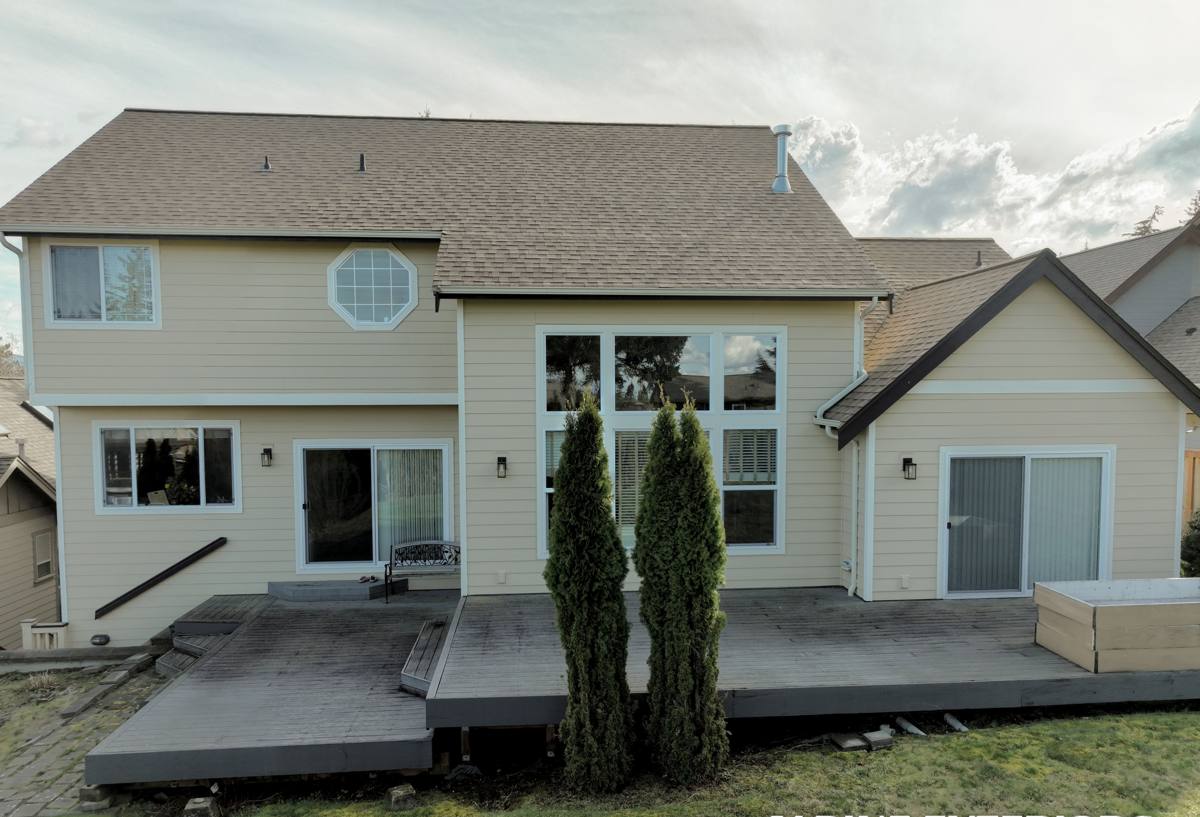
Homeowners often ask us to "fix a few boards" and then find out the problem runs deeper. Here's what tells us a deck needs full replacement rather than patchwork repair:
- Soft, spongy, or springy spots underfoot, especially near the house or at board ends
- Visible gaps or separation where the deck ledger meets the house siding or trim
- Rust streaks running down from screws, joist hangers, or other fasteners
- Moss or algae that keeps coming back within weeks of cleaning, even in shaded areas
- Cracked, cupped, or delaminating boards on more than a handful of spots
- Railings or stairs that feel loose or wobble under normal weight
- A musty smell coming from underneath the deck, which usually points to trapped moisture in the framing
Any one of these on its own might be a repair. Two or three together, especially involving the framing or the ledger connection, usually means the structure has been compromised long enough that patching individual boards is just delaying the real job.
What an Actual Deck Replacement Involves
It Starts Below the Decking, Not At It
A lot of deck work in this region focuses on what's visible — new boards, new railings — while leaving the framing underneath untouched. That's a mistake on a marine-climate island where the framing is usually the part taking the worst beating from moisture. A correct replacement means pulling the old decking and railings, then actually inspecting the ledger board, joists, beams, and posts before deciding what stays and what goes.
The Details That Actually Determine How Long It Lasts
- Ledger flashing — where the deck attaches to the house is the single most common failure point on Pacific Northwest decks. Proper flashing, installed and lapped correctly with the house's water-resistive barrier, keeps water from working its way behind the siding.
- Joist protection — capping or wrapping joists so end grain and top edges aren't sitting exposed to standing water and salt air.
- Fastener selection — using coated or stainless fasteners rated for coastal exposure, not standard galvanized hardware that will streak and corrode within a couple of seasons this close to the water.
- Proper drainage slope — decking installed with a slight pitch away from the house so water sheds instead of pooling against the ledger.
- Ventilation underneath — enough clearance and airflow below the deck so the framing can actually dry out between rain events instead of staying damp for weeks at a time.
Skip any one of these and you can end up with a deck that looks new for a year or two while the same rot and corrosion problems start rebuilding underneath it.
Choosing Decking Material for Salt Air and Moss Season
There's no single "best" decking material for every home — it depends on your budget, how much upkeep you're willing to do, and how close your lot sits to open water. Here's how the common options actually perform in Guemes Island's conditions:
| Material | How It Holds Up Here | Maintenance Reality |
|---|---|---|
| Pressure-treated wood | Affordable and strong, but end grain and fastener holes are vulnerable to moisture intake near salt air; needs consistent sealing | Annual cleaning and re-sealing to keep water out |
| Cedar | Naturally moisture- and insect-resistant, ages to a silver-gray if left unfinished, but softer surface can show wear faster in driving rain | Periodic cleaning; refinishing if you want to keep the original color |
| Composite decking | Resists rot and doesn't absorb moisture like wood, generally handles salt air well; quality varies a lot by brand and core construction | Low — mainly regular cleaning to keep moss and algae from taking hold on the surface |
| PVC/capped polymer | Fully sealed surface, best resistance to moisture intrusion and staining, holds up well against algae and moss compared to wood | Lowest — occasional washing is usually enough |
We'll walk you through the real trade-offs for your specific deck rather than pushing one product line. A shaded, north-facing deck under trees needs different thinking than an open deck with full water exposure, even on the same island.
Framing and Structural Choices Matter as Much as the Decking
The decking surface gets all the attention, but the framing underneath is what actually determines whether your new deck holds up for fifteen-plus years or starts having problems again in five. On Guemes Island projects we pay particular attention to using framing lumber rated for the exposure it's getting, sizing joists correctly for the actual span and load rather than the bare minimum, and making sure every structural connection — post to beam, beam to joist, joist to ledger — uses hardware rated for the environment, not just what's cheapest at the yard. It costs a little more upfront. It's a lot cheaper than tearing the deck apart again in eight years because the framing failed while the boards on top still looked fine.
Our Process, From Estimate to Finished Deck
- On-site assessment — we look at the existing deck's framing, ledger connection, and overall condition, not just the surface boards, and talk through what your household actually uses the deck for.
- Honest scope and estimate — you get a clear picture of what needs full replacement versus what can reasonably be reused, with pricing broken out so you understand what's driving the cost.
- Material selection — we go over decking and railing options against your budget and how much upkeep you want going forward.
- Scheduling around ferry logistics — material deliveries and crew scheduling for island jobs get planned around the ferry, so the job runs on a realistic timeline instead of guessing.
- Demolition and structural inspection — old decking and railings come off, and we inspect the framing before proceeding so there are no surprises mid-job.
- Rebuild — new framing where needed, proper ledger flashing, coastal-rated fasteners, correct drainage slope, then decking, railings, and stairs.
- Final walkthrough — we go over the finished deck with you, including what maintenance it actually needs going forward.
What Deck Replacement Typically Costs
Every deck is different, but these are the main factors that move the price up or down on a Guemes Island project:
| Factor | Why It Affects Cost |
|---|---|
| Deck size and footprint | More square footage means more material, more fasteners, and more labor hours |
| Framing condition | Rotted joists, posts, or ledger boards that need replacement add both material and labor |
| Decking material | Pressure-treated, cedar, composite, and PVC all sit at different price points, with composite and PVC typically costing more upfront |
| Height and stairs | Elevated decks with stairs and additional railing take more labor and material than a low, ground-level deck |
| Access and logistics | Island delivery and ferry scheduling can affect project timeline and, in some cases, delivery costs |
We'd rather give you a real number after seeing your deck than a broad range that doesn't mean much for your actual project. That's what the estimate is for.
Why a Crew That Already Works Guemes Island Matters
Deck work on an island isn't the same logistically as deck work on a standard mainland lot. Material deliveries have to be timed around the ferry. Crews need to plan their day around sailing schedules rather than just driving over whenever it's convenient. A contractor who hasn't worked the island before is learning these logistics on your job, which tends to show up as delays, scheduling surprises, or rushed work to make a ferry window.
We build our Guemes Island schedules around the realities of getting a crew and materials on and off the island efficiently, so your project moves at a normal pace instead of stalling out because nobody accounted for the ferry. That familiarity also extends to the building side — we know what salt air and marine exposure do to different materials and fasteners on island homes specifically, because we've seen it firsthand on other decks out there, not just read about it.
Keeping Your New Deck in Good Shape
A properly built deck still needs some upkeep in this climate — the goal is making that upkeep minor instead of a constant battle. A simple seasonal routine goes a long way:
- Sweep debris off the deck regularly, especially fallen leaves and needles that trap moisture against the boards
- Clean moss and algae off the surface as soon as you notice it forming, rather than waiting until it's established
- Check railings and stair connections once or twice a year for any looseness
- Rinse salt residue off the surface periodically if your deck faces open water directly
- Keep gutters and downspouts near the deck clear so runoff isn't draining directly onto or under it
- Re-seal wood decking on the schedule recommended for whatever finish was used, rather than waiting until it visibly needs it
If you're not sure whether your current deck needs full replacement or is still a reasonable repair candidate, we're happy to take a look and give you a straight answer either way. Reach out for a free, no-pressure estimate using the form below.