 Burlington
 Why Guemes Island Roofs Wear Differently
Guemes Island sits out in the salt air and open wind off Skagit County's waterways, and that changes how a roof ages compared to a house a few miles inland in Burlington or Mount Vernon. Salt-laden air accelerates corrosion on exposed fasteners, flashing, and metal roofing panels. Wind-driven rain off the water doesn't fall straight down — it gets pushed sideways under shingle tabs, around vent boots, and into any gap in the flashing that a calmer inland roof might never test. And because much of the island sits under tree cover, moss and moisture have a long season to work on shaded slopes, north-facing valleys, and anywhere debris collects.
None of that means Guemes Island homes need exotic materials or gimmicks. It means the repair has to account for corrosion resistance, wind-driven water paths, and moss/moisture control — not just patch the spot that's visibly leaking.
What This Looks Like in Practice
- Fasteners and flashing near the shoreline corrode faster than the same materials a few miles inland — repairs should use corrosion-resistant hardware, not whatever is fastest to grab.
- Wind-driven rain finds weaknesses at flashing laps, vent boots, and valley metal well before shingles themselves fail.
- Moss holds moisture against shaded and low-slope sections year-round, which shortens the life of the roofing material underneath it.
- Salt air combined with UV exposure on south-facing slopes can make asphalt shingles granule-shed faster than the manufacturer's rated lifespan assumes.
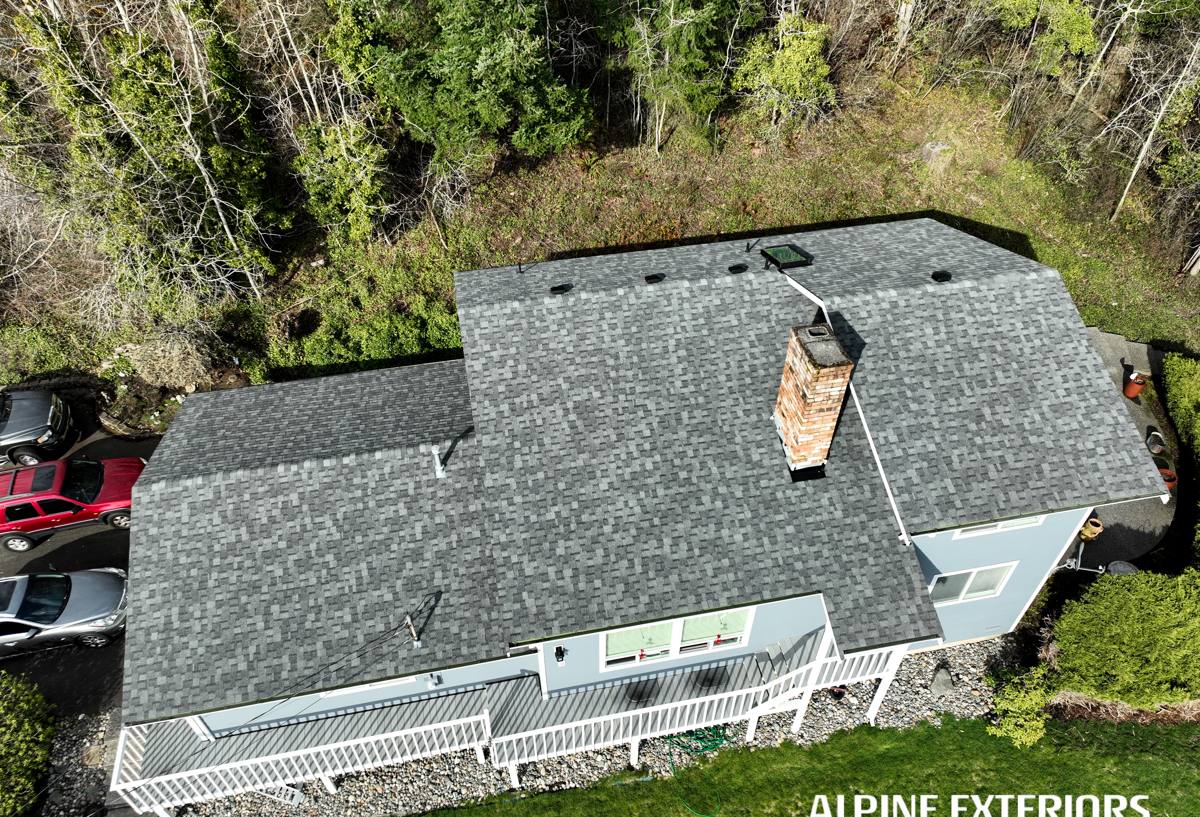
Signs a Guemes Island Roof Needs Repair, Not Just a Wait-and-See
A lot of roof damage on the island starts small and gets ignored because the house is a weekend place, a rental, or simply out of daily sight. By the time water shows up on a ceiling, the underlying damage is usually well ahead of the visible stain. Watch for:
- Dark streaking or thick moss growth on north-facing or shaded slopes
- Granules collecting in gutters or at downspout outlets — a sign shingles are wearing thin
- Lifted, cracked, or missing shingle tabs, especially after a windstorm
- Rusting or discolored flashing around chimneys, skylights, and roof-wall intersections
- Soft spots or slight sagging when walked on or viewed from a ladder
- Daylight visible through the roof deck from inside an attic
- Water stains on interior ceilings, especially near exterior walls or plumbing vents
Any one of these on its own might be minor. Two or more together, especially on a roof that's had several winters of driving rain and moss buildup, usually means the repair window is now, not next spring.
What a Correct Repair Actually Involves
A roof repair that's done right starts with figuring out where the water is actually getting in, which is not always where the stain shows up inside. Water can travel along rafters or sheathing for several feet before it drips somewhere visible. That's why a proper repair on an island roof includes:
1. Tracing the Leak to Its Source
This means getting on the roof, not just looking from the ground. We check flashing, valleys, vent boots, and any penetration point first, since that's where the large majority of leaks on Skagit County roofs actually originate — plain field shingle failure is less common than a failed flashing detail.
2. Assessing the Deck, Not Just the Surface
If water has been getting in for any length of time, the plywood or OSB deck underneath may be soft, delaminating, or rotted. Replacing shingles over a compromised deck is a short-term fix that fails again quickly. We check deck condition at every repair, not just at full re-roofs.
3. Matching Materials and Fastener Grade to the Site
Given the salt air exposure, we use corrosion-resistant fasteners and flashing on island jobs rather than the standard-grade hardware that's fine on a sheltered inland roof. It costs a little more up front and saves a repeat service call in a few years.
4. Addressing Moss and Moisture Retention, Not Just the Hole
If moss caused or contributed to the failure, we clear it properly and address the conditions that let it grow back aggressively — shade, debris buildup, poor airflow — rather than just patching around it.
5. Sealing and Re-Flashing to Handle Wind-Driven Rain
On an exposed island lot, flashing has to be installed to shed water that's being pushed sideways by wind, not just water falling straight down. That affects lap direction, sealant choice, and how far up a wall or chimney the flashing extends.
Common Repair Scenarios We See on the Island
| Problem | Typical Cause | What the Repair Involves |
|---|---|---|
| Ceiling stain near a chimney or skylight | Failed or corroded flashing, often from salt exposure | Remove and replace flashing, check deck for rot, reseal properly |
| Missing shingles after a windstorm | Wind uplift on an exposed, unsheltered roof plane | Replace missing shingles, check adjacent tabs for lifted or cracked sealant strips |
| Heavy moss on shaded slope | Long moss season, tree cover, poor airflow | Careful moss removal, treatment, and inspection of shingles underneath for granule loss |
| Soft spot when walking the roof | Long-term moisture intrusion into the deck | Localized deck replacement, not just a surface patch |
| Rust streaks on metal roofing fasteners | Salt air corrosion on standard-grade hardware | Fastener replacement with corrosion-resistant hardware, panel reseal |
Repair vs. Replacement: How We Make That Call
Not every roof problem on Guemes Island needs a full replacement, and we don't push toward one when a targeted repair will hold up. The honest factors that decide it:
- Age relative to expected lifespan — a 6-year-old roof with a flashing failure is a repair; a 22-year-old roof with the same symptom plus widespread granule loss is a replacement conversation.
- Extent of deck damage — one soft spot is repairable; rot spread across multiple rafter bays usually isn't worth chasing piecemeal.
- Number of separate problem areas — one leak source is a repair; five unrelated failure points on an aging roof usually means the whole system is past its practical life.
- How the home is used — a full-time residence with an attic that gets checked regularly can be repaired more conservatively than a seasonal or rental property where small leaks go unnoticed for months.
We'll always tell you plainly which category your roof is in and why, including when a repair is genuinely the right call rather than the more profitable one.
Why It Matters That We Already Work on Guemes Island
Guemes Island is ferry-access only, which changes how a repair job needs to be planned compared to a house in Burlington itself. A crew that hasn't worked the island before tends to underestimate scheduling around ferry timing, and that turns a same-day repair into a two-trip job — one to look, one to actually fix it, with materials and tools left behind the first time.
Working the island regularly means:
- We plan the trip to bring the right materials and fasteners the first time, based on what salt air exposure typically requires, not a generic parts list
- We're realistic with you about ferry-dependent scheduling windows instead of promising a same-day fix that isn't practical
- We already understand which failure patterns are common on exposed, waterfront, and heavily shaded island lots
- We treat a seasonal or vacation home with the same follow-through as a full-time residence, since we know these properties often go unchecked between visits
Maintenance That Extends the Repair
A repair holds up longer with basic upkeep that's easy to skip on a property you're not at every day:
- Clear gutters and downspouts at least once before winter, since clogged gutters back water up under the roof edge
- Remove moss buildup before it spreads across an entire slope, especially on shaded, north-facing sections
- Trim back overhanging branches that keep a roof section shaded and damp longer than it needs to be
- Have the roof looked at after any significant windstorm, even if nothing looks obviously wrong from the ground
- Check the attic occasionally for daylight, staining, or damp insulation, particularly if the home sits empty for stretches
What to Ask Before Hiring for Island Repair Work
Because getting a crew and materials to Guemes Island takes more coordination than a mainland job, it's worth confirming a few things before you commit:
- Do they regularly work on the island, or is this their first trip out?
- Will they bring corrosion-resistant fasteners and flashing suited to salt air exposure, or standard-grade hardware?
- Do they check the roof deck condition, not just replace surface shingles?
- Are they upfront about whether your situation is a repair or genuinely needs replacement?
- How do they handle scheduling around ferry timing so the job doesn't stretch into multiple trips?
A straight answer to all five is a good sign you're dealing with a crew that treats island work as routine rather than an inconvenience.
Get an Honest Look at Your Roof
If you're seeing moss buildup, a stain on a ceiling, or storm damage on a Guemes Island roof, it's worth getting an honest opinion before the problem grows past the point of a simple repair. We offer a free, no-pressure estimate — use the form below to get in touch and we'll take it from there.