 Burlington
 Why Mount Vernon Homes Need Siding Built for This Climate
Mount Vernon sits in the Skagit Valley, close enough to Skagit Bay and the greater Puget Sound air mass that homes here deal with a specific combination of stresses most siding products were never designed around: salt-tinged air moving in off the water, long stretches of driving rain pushed sideways by wind, and a moss and algae season that can run most of the year in shaded or north-facing exposures. Add the valley's flat, low-lying terrain, which holds humidity longer than the surrounding hillsides, and you get siding conditions that punish anything with a weak moisture story.
This is exactly the environment James Hardie fiber cement siding was engineered to handle, and it's why it's the only siding product we install on Mount Vernon homes. Wood-based and wood-derived siding products absorb and release moisture with the seasons, which is a slow path to swelling, delamination, and rot in a climate that rarely gives siding a chance to fully dry out. Vinyl handles moisture fine but softens, warps, and fades under UV and temperature swings over the years. Fiber cement doesn't have either problem — it's not organic material, so it doesn't feed mold or absorb water the way wood-based products do, and it holds its shape and color far longer than vinyl in coastal-influenced air.
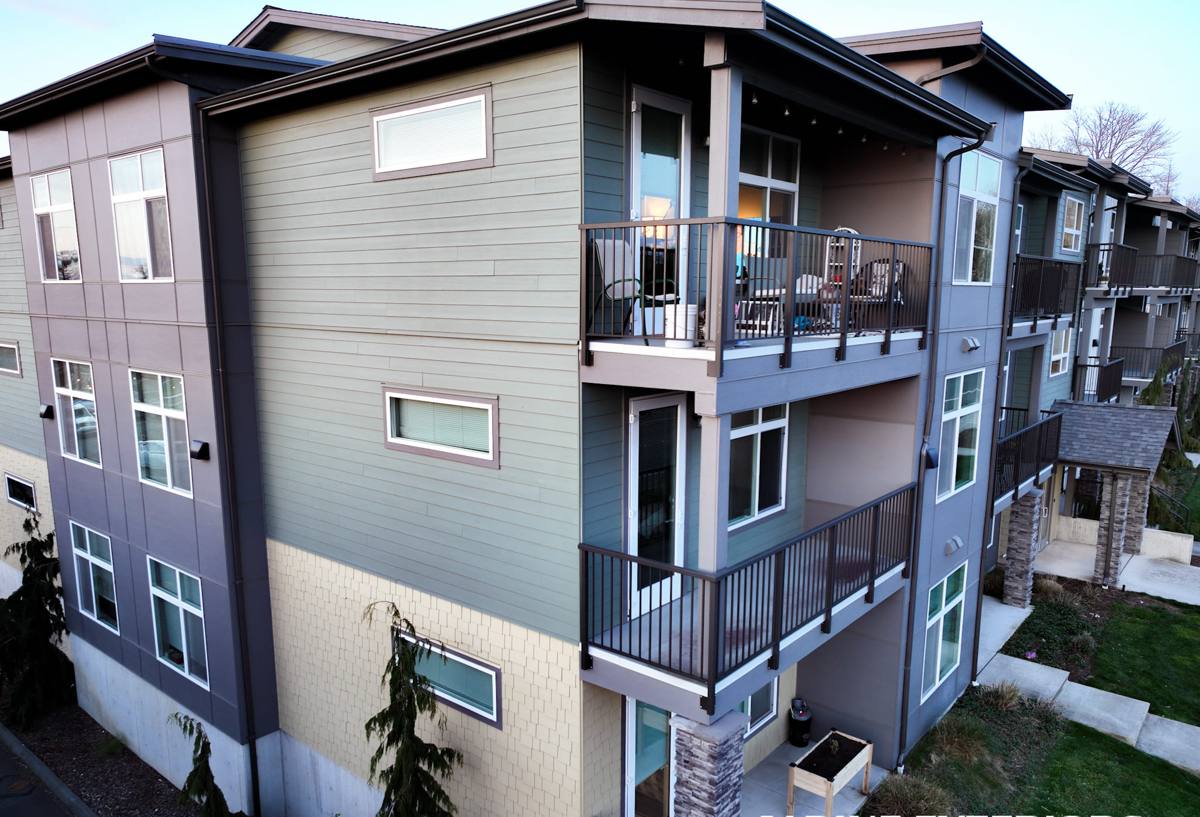
What Salt Air and Moss Actually Do to Siding
It helps to understand the specific failure modes we're designing against, because they explain every decision in a correct install.
Salt-Influenced Air
Even well inland from open coastline, air moving off Skagit Bay carries fine salt content that settles on exterior surfaces. Over years, this accelerates corrosion on exposed metal fasteners and trim, and it can degrade lower-quality paint finishes faster than a dry-climate home would experience. It doesn't damage James Hardie's fiber cement substrate, but it does make fastener choice and finish quality matter more than they would somewhere drier.
Driving Rain
Wind-driven rain doesn't just wet the siding surface — it tests every seam, joint, and penetration in the water-resistive barrier behind the siding. A siding product can look fine on the wall and still leak if the house wrap, flashing, and seams behind it weren't detailed correctly. This is a house-wrap and flashing problem as much as a siding problem, and it's the single biggest source of callbacks we see on homes that were sided by crews unfamiliar with this region's rain patterns.
Moss and Algae
Shaded walls, north-facing elevations, and anything near mature trees or dense landscaping stay damp longer here than in drier parts of the state. Organic siding surfaces give moss and algae something to root into. Fiber cement's factory-cured surface resists that kind of growth far better, though no siding is entirely immune — a correctly installed system with good drainage behind it and reasonable clearance from soil and vegetation is what actually keeps a wall clean over time.
James Hardie Product Lines Suited to This Area
James Hardie makes climate-engineered product lines, and for Skagit County's damp, marine-influenced conditions, the HZ5 line is the appropriate choice — it's formulated for wetter, cooler climates rather than the HZ10 line built for hot, dry regions. Within that, homeowners typically choose between a few formats:
- HardiePlank lap siding — the standard horizontal siding look, available in several exposure widths and textures (smooth or cedar-grain)
- HardieShingle — for homes wanting a shingle or shake appearance without the maintenance burden of real wood shingles
- HardiePanel — vertical panel siding, often used as an accent or on modern-style homes
- HardieTrim — matching trim boards for corners, window and door casings, and fascia
All of these come with the option of factory-applied ColorPlus finish, which is baked on under controlled conditions rather than field-painted. In a climate where field-applied paint has to cure between rain events, a factory finish is a real practical advantage — it goes on right the first time and carries its own finish warranty separate from the product warranty.
What a Correct Installation Involves
The siding itself is only part of the system. In a high-rainfall area like this, the details behind and around the siding determine whether it performs for decades or causes problems in five years.
Water-Resistive Barrier and Flashing
A continuous, correctly lapped house wrap behind the siding, with proper flashing at every window, door, and roof intersection, is non-negotiable here. This is the layer that actually stops driving rain from reaching your sheathing — the siding is the first line of defense, not the only one.
Rainscreen or Drainage Gap
On many homes, especially shaded or heavily rain-exposed elevations, we install furring strips or a purpose-built rainscreen product to create a small drainage and ventilation gap behind the siding. This lets any moisture that gets past the siding drain and dry out instead of sitting against the wall — a meaningful upgrade in a climate that doesn't offer long dry stretches.
Fastening
James Hardie specifies fastener type, spacing, and penetration depth, and following those specs matters more in coastal-influenced air where corrosion-resistant fasteners aren't optional. Under-driven or over-driven nails, wrong fastener material, or missing studs are common shortcuts that show up as cracking or loosening within a few years.
Clearances and Caulking
Correct ground clearance, gutter and downspout coordination, and disciplined caulking at joints and penetrations all reduce the amount of water the system ever has to deal with in the first place. Hardie's own installation guidelines are specific about minimum clearances from grade, decks, and roof lines — skipping these is one of the most common causes of moisture problems traced back to installation rather than product.
Comparing Siding Options for This Climate
| Factor | James Hardie Fiber Cement | Vinyl | Wood-Based Products |
|---|---|---|---|
| Moisture behavior | Non-organic, resists rot and swelling | Doesn't absorb water but can trap it behind panels | Absorbs moisture; prone to swelling and rot over time |
| Moss/algae resistance | Strong when installed with proper drainage | Moderate; can trap moisture that promotes growth | Weaker; organic surface feeds growth |
| Salt air durability | Substrate unaffected; finish holds up well | Can chalk and fade faster near salt air | Finish and substrate both degrade faster |
| Fire resistance | Non-combustible | Combustible | Combustible |
| Finish longevity | Factory ColorPlus finish, long warranty | Color molded in but fades over time | Requires repainting/restaining on a cycle |
| Long-term maintenance | Low — periodic washing, no repainting cycle | Low but brittle with age | Higher — regular painting, sealing, and repair |
Our Process for Mount Vernon Siding Projects
Because we work in this area regularly, we know what to check before a project ever gets to the install stage:
- An on-site assessment of your home's exposure — which walls take the most driving rain, which stay shaded and damp longer, and where existing moisture or rot issues may already exist behind the current siding
- Removal of old siding and inspection of the sheathing underneath, since a re-side is the one chance to catch and fix hidden moisture damage before it's covered up again
- Installation of a continuous water-resistive barrier with correctly lapped seams and flashing at every penetration
- Rainscreen or furring installation where the exposure calls for it
- James Hardie siding installed to manufacturer fastening and clearance specifications, in the HZ5 product line appropriate for this climate
- Trim, caulking, and final detailing at corners, windows, and rooflines
- A final walkthrough so you understand what was done and what maintenance, if any, to expect
What to Look For When Hiring a Siding Contractor Here
Not every siding crew installs correctly for this climate, and Mount Vernon's rain and moss pressure will expose bad shortcuts faster than a drier region would. Before hiring anyone for a James Hardie project, it's worth checking a few things:
- Are they James Hardie-focused, or do they install several competing products — which can mean less depth of expertise in any one system
- Do they talk about house wrap, flashing, and drainage detailing, or only about the visible siding itself
- Are they using the HZ5 product line appropriate for western Washington's climate, not a generic or wrong-zone product
- Do they follow Hardie's published fastening and clearance specifications rather than "how we've always done it"
- Can they explain how they'll handle your home's specific exposure — shaded sides, rain-facing walls, ground clearance issues
- Are they licensed and insured to work in Skagit County
What This Costs and What Drives the Price
Every home is different, and an accurate number requires seeing your specific siding condition, square footage, and detailing needs. In general, the biggest cost drivers on a Mount Vernon James Hardie project are:
- How much of the existing siding and sheathing needs to be removed and replaced versus reused
- Whether hidden moisture or rot damage is found once old siding comes off
- The amount of trim, window, and corner detailing on your home's design
- Whether a rainscreen/drainage gap system is added, which is a worthwhile upgrade on rain-exposed elevations
- Product format chosen — lap siding, shingle-style, or panel, and standard versus premium textures
We give straightforward, itemized estimates so you can see exactly what you're paying for and why, rather than a single lump number.
Ready to See What Correct Siding Looks Like on Your Home
If your Mount Vernon home's siding is showing moss staining, soft spots, peeling paint, or you're just planning ahead for a re-side, we're happy to take a look and walk you through what we'd recommend and why. Fill out the form below for a free, no-pressure estimate — there's no obligation, and you'll get a straight answer about what your home actually needs.