 Burlington
 Why La Conner's Climate Is Hard on a Roof
La Conner sits right on the Swinomish Channel, close enough to Puget Sound that salt air is part of daily life for homes here — not just for boats at the marina. Add the wind-driven rain that comes off the water during fall and winter storms, and a moss season that can stretch from October well into spring, and you've got three separate stresses working on a roof at the same time. A roofing material that performs fine forty minutes inland in drier parts of Skagit County can struggle here if it isn't matched to what La Conner actually throws at it.
Salt Air and Metal
Salt-laden air accelerates corrosion on unprotected steel and on fasteners, flashing, and trim that aren't rated for coastal exposure. This doesn't mean metal roofing is a bad fit near the water — it means the specific alloy, coating, and fastener package matter more here than they would on a home twenty miles inland. We choose products and detailing with that exposure in mind rather than defaulting to whatever's standard for a drier zip code.
Wind-Driven Rain
Storms moving up the channel don't just drop rain straight down — they push it sideways, up under eaves, and into any seam or lap that isn't sealed and lapped correctly. A roof that's watertight in a light straight-down rain can still leak in a wind-driven storm if the underlayment, flashing, and panel laps weren't built for that direction of attack.
The Long Moss Season
Skagit County's mild, wet winters give moss and algae months of ideal growing conditions. On older shake or aging composition roofs this shows up fast. Metal sheds moisture faster and gives moss far less to hold onto than most other roofing materials, but it isn't immune — a roof with poor airflow, clogged valleys, or overhanging tree cover can still grow moss in the seams and at debris pockets over time.
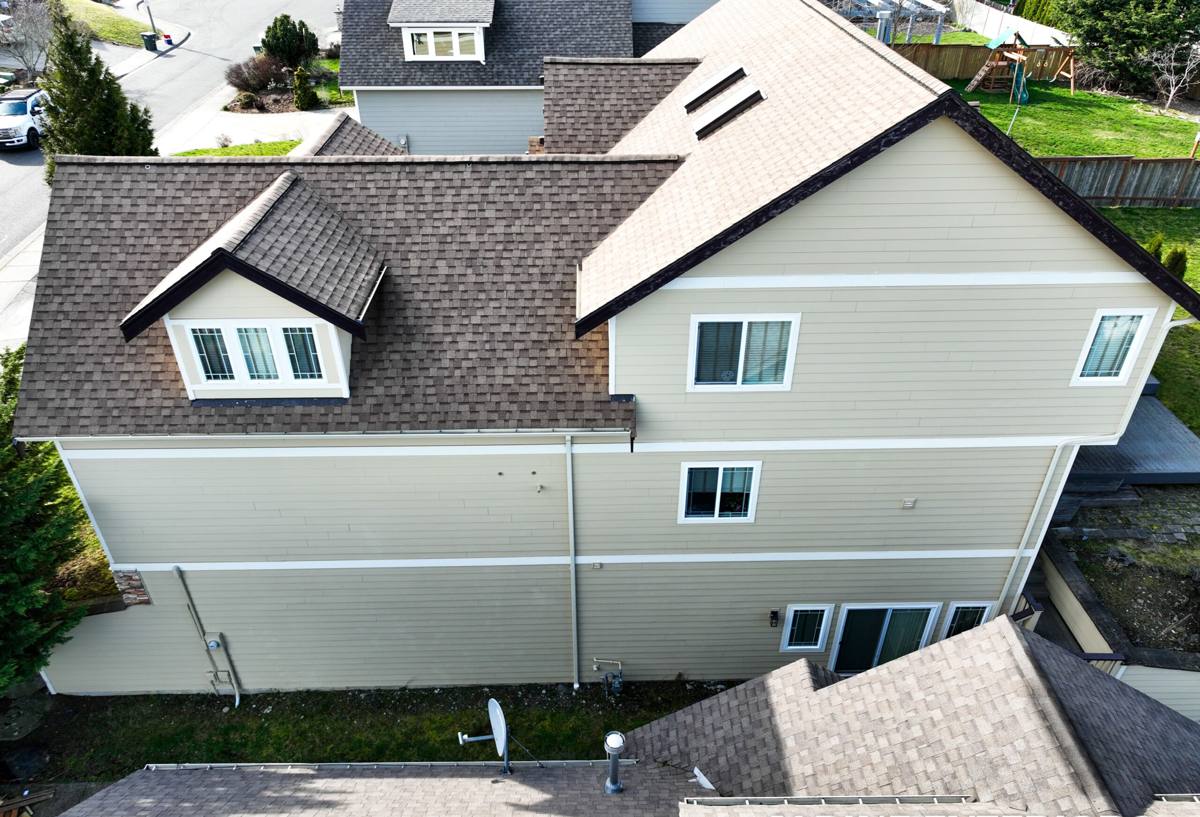
What a Correctly Installed Metal Roof Needs to Do Here
A metal roof built for a La Conner home needs to handle several jobs at once, not just look good going on. It needs to shed water fast enough that wind-driven rain never gets a chance to work backward under a lap. It needs corrosion-resistant materials at every fastener and flashing point, not just on the exposed panel face. It needs enough airflow underneath to keep condensation from forming on the underside of the panels — a common cause of hidden deck rot in humid coastal climates. And it needs clean, boring roof geometry at valleys, penetrations, and transitions, because that's where moss, debris, and leaks all start.
Panel Systems We Recommend for La Conner Homes
Not every metal roofing system is built the same way, and the right choice depends on your roof's pitch, exposure, and how long you plan to own the home. The two systems we install most often here are standing seam and exposed-fastener panels, and they perform differently once salt air and wind-driven rain get involved.
| Factor | Standing Seam | Exposed Fastener |
|---|---|---|
| How it sheds water | Concealed fasteners, raised interlocking seams — very little for wind-driven rain to catch | Fasteners penetrate the panel face; relies on washers and gaskets staying sealed |
| Coastal durability | Fewer penetration points means fewer places for salt-air corrosion to start | Exposed fasteners are the first thing to corrode or back out over time near water |
| Expected lifespan | Typically the longer-lived option when detailed correctly | Solid performer but generally needs fastener maintenance sooner |
| Upfront cost | Higher material and labor cost | More affordable upfront |
| Best fit | Homes with direct water exposure, longer ownership horizon, low-slope sections | Budget-conscious projects, outbuildings, shops, simpler rooflines |
We'll walk you through both honestly for your specific roof rather than push one system across the board — a detached shop and a primary residence facing the channel don't always need the same answer.
Materials and Coatings That Hold Up Near Salt Water
Underneath the finish color, the base metal and coating package are what actually determine how a roof ages near the water. Galvalume steel (steel coated with an aluminum-zinc alloy) is a solid, widely used option and performs well in most of Skagit County. For homes with more direct salt exposure, aluminum panels are worth the conversation — aluminum doesn't rust, which removes one variable entirely in a marine-influenced environment.
Fasteners and trim matter just as much as the panels. We use stainless steel fasteners in coastal-exposure applications rather than standard zinc-coated screws, which corrode faster in salt air. We also pay attention to keeping dissimilar metals from touching directly — certain metal combinations accelerate corrosion through galvanic reaction when they're in contact and exposed to moisture, so flashing, fasteners, and panel metal need to be compatible, not just whatever was on the truck.
Moss, Moisture, and Ventilation — Getting What's Underneath Right
A metal roof is only as good as what's built underneath it. Two things drive most of the moisture and moss problems we see on coastal Skagit County homes, and neither is about the metal itself.
Underlayment and Ice-and-Water Protection
We install synthetic underlayment rated for the full life of the panel system, with self-adhered ice-and-water membrane at eaves, valleys, and any low-slope transition — the spots where wind-driven rain and standing meltwater are most likely to find a way in. This is the layer that protects your roof deck if anything ever gets past the panels themselves, and it's not optional in this climate.
Airflow and Condensation
Metal panels installed directly against a poorly ventilated deck can trap moisture underneath, leading to condensation that rots sheathing from the inside — invisible until it's a real problem. We build in proper intake and ridge ventilation so warm, moist air has somewhere to go instead of sitting against the underside of the roof.
Design That Doesn't Fight the Climate
Valleys, low-slope dormers, and areas with tree overhang collect debris and hold moisture longer than open roof planes. We detail those areas so water and debris move through instead of pooling, and we're honest with homeowners about trimming back overhanging branches where they're feeding a moss problem the roof can't fix on its own.
Our Installation Process
Every metal roof we install in La Conner follows the same disciplined sequence — skipping steps is where coastal roofs fail early.
- Assessment and measurement — we look at pitch, existing roof condition, deck soundness, ventilation, and exposure to prevailing wind and salt air before recommending a system.
- Tear-off and deck inspection — old roofing comes off and we check the deck underneath for rot or soft spots, which are common on older homes near the water.
- Deck repair — any compromised sheathing gets replaced before anything else goes down. Metal panels installed over a bad deck fail early no matter how good the panels are.
- Underlayment and ice-and-water membrane — installed per the details above, with extra attention at eaves and valleys.
- Panel installation — panels go on with correct fastener spacing, laps, and clip or fastener choice matched to the system and exposure.
- Flashing and penetrations — chimneys, vents, and wall transitions are flashed and sealed, since these are the most common leak points on any roof.
- Ridge and ventilation tie-in — ridge vent and any required intake venting are completed and checked for airflow.
- Cleanup and walkthrough — site is cleared of debris and fasteners, and we walk the finished roof with you.
What Metal Roofing Costs in La Conner — And What Drives the Price
We don't quote a number without seeing the roof, but the factors below are what typically move the price up or down on a coastal Skagit County home.
| Cost Factor | Why It Matters |
|---|---|
| Roof pitch and complexity | Steep pitches, multiple valleys, and dormers take more labor and material per square foot |
| Tear-off vs. overlay | Removing old roofing and repairing the deck costs more upfront but is often necessary on older coastal homes |
| Panel system | Standing seam costs more than exposed-fastener panels but generally needs less attention over time |
| Base metal choice | Aluminum typically costs more than Galvalume steel but removes rust risk near the water |
| Access and site conditions | Steep sites, limited staging area, or difficult truck access add labor time |
| Ventilation upgrades | Adding proper intake/ridge venting where none existed is worth the added cost in this climate |
As a broad range, homeowners in this area typically see metal roofing land somewhere between mid and upper range compared to asphalt shingles, with the gap narrowing when you factor in how much less maintenance and how much longer a correctly installed metal roof lasts.
Maintenance Checklist for Coastal Skagit County Homes
Metal roofing is low-maintenance compared to most materials, but "low" isn't "none" — especially this close to the water. A quick seasonal check catches small issues before they become deck repairs.
- Clear gutters and valleys of needles, leaves, and moss debris at least twice a year
- Trim back tree limbs that overhang the roof and keep it shaded and damp
- Look for any streaking or discoloration at fastener heads or flashing, an early sign of corrosion
- Check that ridge vents and soffit intake aren't blocked by debris or nesting material
- After major windstorms, do a visual check for lifted panel edges or loosened trim
- Keep an eye on sealant at penetrations (vent pipes, chimneys) — sealant ages faster than the metal itself
Why a Crew That Already Works in La Conner Makes a Difference
Roofing crews that mostly work inland don't always think about salt exposure, wind direction off the channel, or how long moss season really runs here — and that shows up later in fastener choice, flashing details, or ventilation that was fine for a drier town but undersized for La Conner. We work throughout Skagit County, including La Conner regularly, so those decisions aren't an afterthought — they're built into how we spec every coastal job from the start.
Many homes in La Conner are older, and some sit in areas where exterior changes may involve an extra step or two with the town depending on the property. That's worth asking about early, since it can affect project timeline even when it doesn't affect the roofing material itself. A crew that's done work in town before can usually tell you what to expect before you're deep into a project.
If you're weighing metal roofing for a La Conner home, we're happy to take a look and give you a straight answer on what your roof actually needs — no pressure, no oversell. Reach out for a free estimate using the form below.