 Burlington
 Why Anacortes Roofs Age Differently Than Roofs Inland
Anacortes sits out on the water, and that changes what a roof has to deal with day to day. Homes a few miles inland in Skagit County catch plenty of rain, but they don't get the salt-laden air that rolls in off the water, the steady wind, or the shade-and-moisture combination that keeps roofs damp for weeks at a stretch during the fall and winter. An asphalt shingle roof built to a generic spec — the kind that works fine in a dry inland subdivision — often struggles here. It's not that shingles fail faster in Anacortes because they're bad shingles. It's that the install details that don't matter much elsewhere matter a great deal here.
We work on roofs throughout Burlington and the rest of Skagit County, but Anacortes gets treated as its own case. The salt air, the driving rain that comes in sideways during winter storms, and a moss season that can run most of the year on shaded, north-facing slopes all push a roof in the same direction: toward trapped moisture and accelerated wear at the details, not just the shingle field.
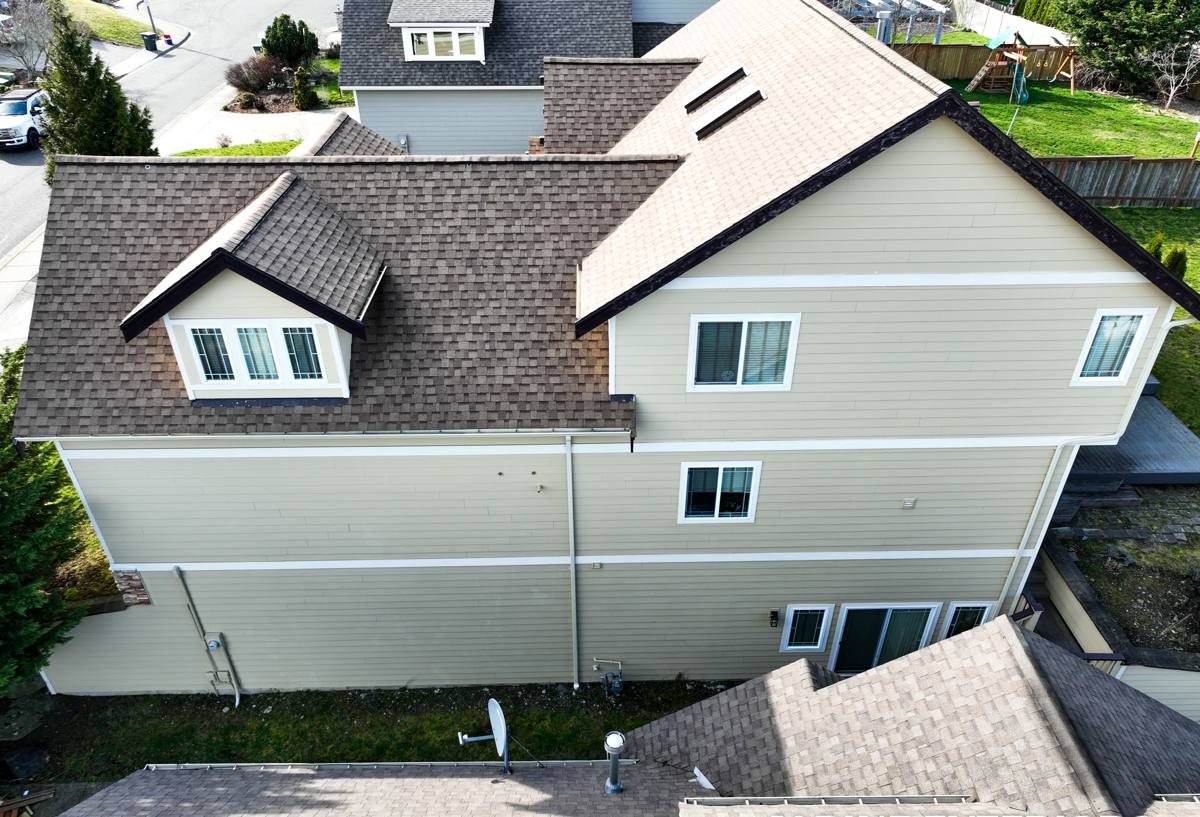
What the Marine Climate Actually Does to a Shingle Roof
Salt Air and Metal Components
Asphalt shingles themselves are fairly indifferent to salt air. The metal that goes with them is not. Flashing, drip edge, nail heads, ridge vents, and any exposed fasteners corrode faster near the water than they do a few miles inland. Once a flashing detail starts to rust and pit, it stops shedding water the way it's supposed to, and that's usually where a roof starts leaking — not in the open shingle field.
Moss, Algae, and Sustained Moisture
Anacortes' tree cover, shaded rooflines, and slow-drying air add up to long moss and algae seasons. Moss doesn't just look bad — it holds water against the shingle surface, works its way under tabs as it grows, and lifts the shingles it's rooted under. Algae staining is mostly cosmetic, but heavy moss growth left unaddressed will shorten a roof's real service life, sometimes by years.
Wind and Wind-Driven Rain
Storms coming off the water bring wind-driven rain that finds its way into gaps a straight-down rain never would. That means the seal strips, nailing pattern, and flashing at every penetration have to be right, because horizontal rain will test every weak point a light inland shower never would.
What a Correctly Installed Asphalt Shingle Roof Needs in This Climate
Underlayment and Water Barrier
A synthetic underlayment with a real water-resistant rating, not the cheapest felt available, is the baseline here. We also run self-adhering ice-and-water barrier at eaves, valleys, and around every penetration — not because Anacortes gets serious ice buildup, but because that membrane is the best defense against wind-driven rain finding a way under the shingles.
Flashing That's Built for Salt Exposure
Step flashing, counter-flashing, and drip edge all need to be a metal and coating that can handle salt air over the long term, installed so water sheds away from the house at every wall intersection, chimney, and skylight curb. This is the detail that fails first on a roof that wasn't built for a coastal setting, so it's the detail we spend the most time on.
Ventilation
A roof deck that can't breathe traps moisture underneath the shingles from the inside, which compounds whatever moisture is trying to get in from the outside. Balanced intake and exhaust ventilation keeps the deck dry and also keeps the shingles from cooking from below in the summer, which shortens their life just as much as trapped winter moisture does.
Fastening for Wind
Correct nail placement — the right number of nails, in the right spot on each shingle, driven flush and not overdriven — is what actually keeps shingles attached in a wind event. It's also one of the easiest things for a rushed crew to get wrong, because it doesn't show on a finished roof until the first real storm.
Comparing Shingle Options for an Anacortes Roof
Not every shingle on the market is worth putting on a home exposed to salt air and a long moss season. Here's how the common options stack up for this specific climate:
| Shingle Type | Typical Lifespan Here | Moss/Algae Resistance | Wind Rating | Best Fit |
|---|---|---|---|---|
| Standard 3-tab | 15–20 years | None built in | Lower | Budget rentals, short-hold properties |
| Standard architectural (laminate) | 25–30 years | None built in | Moderate to high | Most Anacortes homes, good balance of cost and durability |
| Algae-resistant architectural | 25–30 years | Built-in copper/ceramic granules resist staining | Moderate to high | Shaded lots, north-facing slopes, tree-heavy properties |
| Impact-rated (Class 4) | 25–30+ years | Varies by product | High | Homes prioritizing durability and insurance discounts where offered |
For most homes on shaded lots near the water, we lean toward algae-resistant architectural shingles. The upgrade cost over a standard architectural shingle is modest, and it directly addresses the moss and algae problem instead of just tolerating it. Impact-rated shingles are worth discussing case by case, but they're a decision about durability and insurance, not a climate-specific fix for this area.
Our Process for an Anacortes Roofing Job
- On-site inspection. We look at the whole roof system — deck condition, existing ventilation, flashing condition, and any signs of past moss damage or leaks — not just the shingles.
- Honest scope and estimate. We tell you what needs full replacement versus what can be repaired, and we explain why, in plain terms.
- Deck check and repair. Any soft, delaminated, or water-damaged decking gets replaced before new material goes down. Roofing over a bad deck just hides the problem.
- Underlayment and ice/water barrier install. Full coverage at eaves, valleys, and penetrations, synthetic underlayment across the field.
- Flashing. New flashing at every wall, chimney, skylight, and vent — not reused old flashing, which is a common shortcut that leads to early leaks.
- Shingle install. Correct nailing pattern, proper exposure, and starter/ridge details done to manufacturer spec so the warranty is actually valid.
- Ventilation check. We confirm intake and exhaust are balanced for the attic or roof assembly you actually have.
- Final walkthrough. We go over what was done and what to watch for, including moss-season maintenance specific to your roof's exposure.
Repair or Replace? How We Help You Decide
Not every roof problem in Anacortes means a full replacement. A localized leak at a single flashing detail, a section of moss damage on one slope, or a handful of wind-lifted shingles can often be repaired if the rest of the roof is sound. What tips the scale toward replacement is usually widespread granule loss, multiple past repairs in different spots, a shingle age already near the end of its expected life, or deck damage found once we're up there. We'll tell you honestly which situation you're in — there's no reason to sell a full replacement when a repair will hold, and no reason to keep patching a roof that's past the point where patching makes sense.
Maintenance That Actually Matters in Moss Season
A well-built roof still needs upkeep in this climate. Most of what causes early roof failure in Anacortes comes down to a short list of neglected items:
- Clear moss growth before it spreads under shingle tabs — treat it, don't just pressure-wash it, which can strip granules and shorten shingle life.
- Keep gutters and downspouts clear so water isn't backing up under the eave edge during heavy rain.
- Trim back overhanging branches that keep sections of the roof shaded and slow to dry.
- Check flashing at chimneys, skylights, and wall intersections for rust or lifting at least once a year.
- Have any granule loss, curling, or lifted tabs looked at promptly — small issues here turn into leaks fast once wind-driven rain gets involved.
- After major windstorms, do a visual check (or have one done) for lifted or missing shingles rather than waiting until the next leak shows up inside.
Why Hiring a Crew That Already Works in Anacortes Matters
A roofing crew that mostly works dry inland climates will often build a technically fine roof that still underperforms here, simply because the details that matter in a marine environment aren't the ones they're used to prioritizing. A crew that already works Anacortes knows to spend extra attention on flashing metal and coating, to default to algae-resistant shingles on shaded lots without being asked, and to size ventilation and underlayment for a roof that's going to spend a lot of its life damp. That local pattern recognition is the difference between a roof that looks right on installation day and one that's still tight and moss-free in year fifteen.
If you're dealing with an aging roof, ongoing moss problems, or just want a straight answer on whether repair or replacement makes sense for your home, we're happy to take a look. There's a free, no-pressure estimate form below — reach out and we'll get you a clear answer and an honest number.