 Burlington
 Deck Repair for Big Lake Homes: Why Skagit County Weather Changes the Job
Big Lake sits in a part of Skagit County where decks work harder than they do almost anywhere else in the state. Between the driving rain that rolls through Burlington most of the year, the salt-tinged air that reaches inland from Skagit Bay, and the shade from surrounding trees and lakefront landscaping that keeps decking damp long after a storm has passed, a deck here is under near-constant moisture pressure. Add a moss season that can stretch from October well into spring, and you have a structure that's fighting rot, fastener corrosion, and slick surfaces almost year-round.
Deck repair in this environment isn't the same job as deck repair in a dry climate. A board that looks fine on top can be soft underneath. A ledger board bolted to the house can be rotting from the inside while the deck surface still looks presentable. Repairing a Big Lake deck correctly means understanding where water actually collects on a lake-adjacent property, not just patching what's visibly damaged.
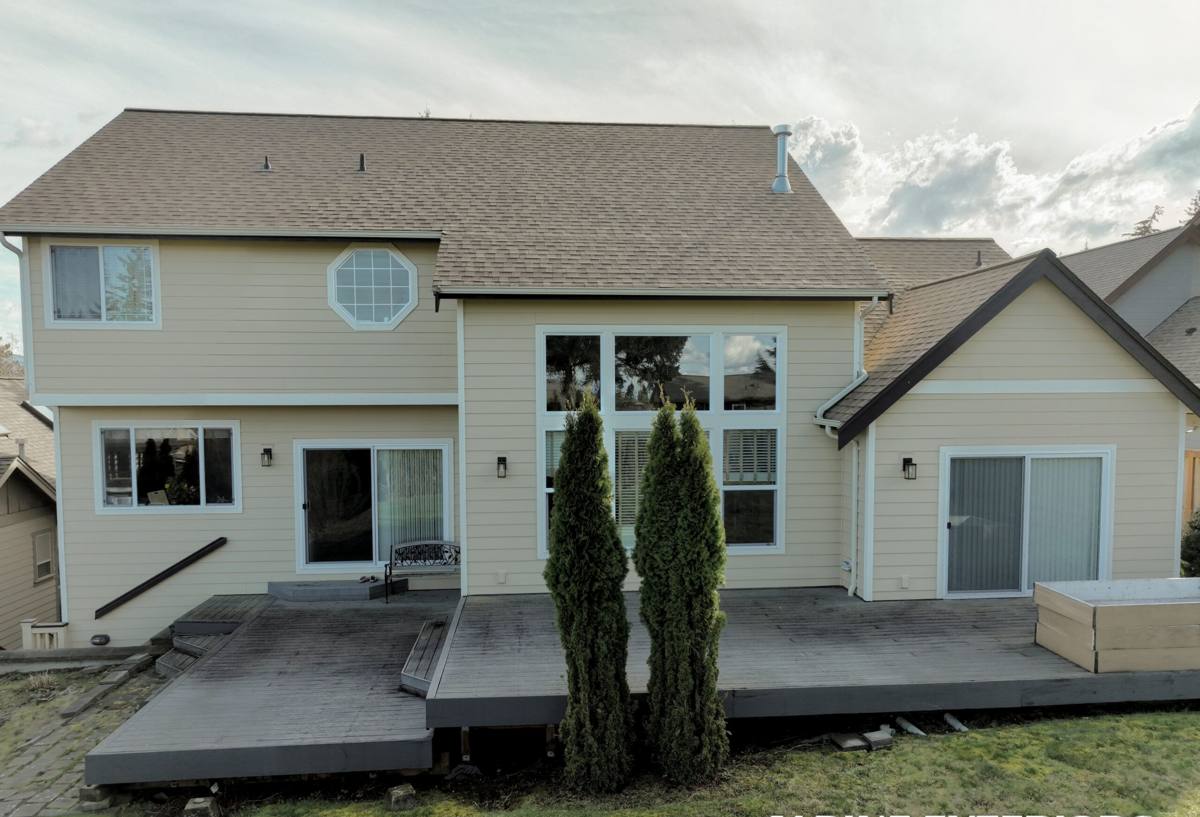
Signs a Big Lake Deck Needs Repair, Not Just Cleaning
Homeowners often assume a mossy or gray deck just needs a power wash. Sometimes that's true. But in this climate, surface staining is frequently a sign that moisture has already worked its way into the wood grain or under fasteners. Here's what actually signals a repair need versus a cosmetic one:
- Boards that flex, bounce, or feel spongy when you walk across them
- Screws or nails that have backed out, rusted, or left dark streaks in the wood
- Gaps opening up between deck boards where they used to sit tight
- Soft or discolored wood around post bases, stair stringers, or the ledger board
- Persistent moss or algae in the same spots every year, even after cleaning
- Railings that wobble or posts that shift when leaned on
- Any area where standing water pools after rain instead of draining off
Any one of these on its own might be minor. Several together, especially near the house connection or on the shaded side of the deck, usually mean it's time for a proper inspection rather than another round of cleaning.
Why the Ledger Board Gets Special Attention
The ledger board — where the deck attaches to the house — is the single most common failure point on decks in wet coastal and lake climates. It's constantly exposed to water running off the house siding or roof, and if flashing was installed poorly or has failed over time, water gets trapped between the ledger and the house framing where nobody sees it until the deck starts to separate. We check this connection on every repair visit, even when it's not the reason someone called us.
What a Correct Deck Repair Actually Involves
A repair done right isn't just swapping out the board that looks worst. It starts with figuring out why that board failed in the first place, because if the underlying cause — trapped moisture, poor drainage, undersized flashing, inadequate ventilation under the deck — isn't addressed, the replacement board will fail the same way in a few years.
Our approach on a Big Lake repair typically includes:
- Probing suspect boards, joists, and posts with an awl to find soft wood that isn't visible from the surface
- Checking every joist hanger and structural connector for rust, cracking, or loosened fasteners
- Inspecting the ledger-to-house connection and flashing condition
- Confirming posts are still sound at grade level, where ground moisture and splash-back do the most damage
- Replacing only what's actually failed — sound wood doesn't need to come out
- Re-fastening with corrosion-resistant hardware rated for exterior and treated-lumber contact
- Addressing drainage or airflow issues under the deck that caused the original damage
That last point matters more here than in drier parts of the state. A deck with poor ventilation underneath — blocked by skirting, dense landscaping, or grade that slopes the wrong way — will trap moisture against the framing no matter how many boards you replace on top.
Decking Materials Around Big Lake: How They Actually Hold Up
Most of the decks we work on around Burlington and Big Lake are one of a few material types. Each has different failure patterns in this climate, which changes how we approach repair.
| Material | Common Failure Point Here | Repair Approach |
|---|---|---|
| Pressure-treated lumber | Checking, splitting, and rot at fastener points and ground contact | Board-by-board replacement is usually straightforward; check framing underneath for the same damage |
| Cedar | Graying and surface softening if never sealed; moss retention in shaded areas | Often salvageable with cleaning and refinishing if structural wood is still sound |
| Composite decking | Fastener pull-through, moisture intrusion at cut edges, mold in low-airflow areas | Usually board replacement rather than repair; structural framing below still needs full inspection |
| Older wood/plastic composite blends | Flaking, moisture absorption, and swelling at butt joints | Case-by-case; some early-generation composites don't hold up as well as current products |
We don't push one material over another as a blanket rule. The right call depends on the deck's exposure, how much shade it gets, and what the homeowner wants to maintain long-term. What we won't do is patch failing composite decking with mismatched material or bury rotten framing under new boards — that just delays a bigger repair.
Our Deck Repair Process
We keep this straightforward because most homeowners just want to know their deck is safe and will hold up through another Skagit County winter.
- On-site inspection — we walk the whole deck, probe suspect areas, and check the structure underneath, not just the surface
- Honest assessment — we tell you what's failing, what's still sound, and what caused the damage
- Written estimate — clear scope, so you know exactly what's being repaired and why
- Repair work — matched materials where possible, corrosion-resistant fasteners, and attention to the drainage or ventilation issue that caused the original failure
- Final walkthrough — we show you what was done and flag anything worth watching going forward
Repair or Replace? What Actually Drives That Decision
Not every damaged deck needs to be torn out. But some do, and the honest answer depends on a few specific factors rather than just the deck's age.
| Factor | Leans Toward Repair | Leans Toward Replacement |
|---|---|---|
| Framing condition | Joists and posts still solid, only surface boards damaged | Rot has reached the joists, beams, or posts |
| Extent of damage | Isolated to a few boards or one area | Widespread across the deck surface and structure |
| Ledger connection | Sound, well-flashed, attached correctly | Failing or improperly flashed from the original build |
| Age of structure | Under 15-20 years with good maintenance history | Older structure built to outdated code or fastening standards |
| Cost comparison | Repair cost is a fraction of full rebuild | Repair cost approaches what a rebuild would run |
We'll always tell you honestly which side of that line your deck falls on. A repair that's really a band-aid on a structural problem isn't a service we're willing to sell, because it just means another call in a year or two.
Why Hiring a Crew That Already Works Big Lake Matters
Deck problems in this area follow patterns — which sides of a house take the worst weather, which framing details from certain build eras tend to fail first, how much airflow a deck actually needs given the shade and moisture around a lake property. A crew that repairs decks throughout Burlington and the surrounding Skagit County communities has already seen how these houses and structures age, which means less time spent diagnosing and more time spent fixing the actual problem.
It also means we're not guessing about material behavior in this specific climate. Products that perform fine in a drier part of the state don't always hold up the same way here, and we make recommendations based on what we've actually seen last — and fail — locally.
Maintaining a Repaired Deck Through Another Wet Season
A repair holds up longer with a bit of basic upkeep, especially given how long the moss season runs here:
- Sweep debris and leaves off the deck regularly so moisture doesn't stay trapped against the boards
- Keep gutters and downspouts clear so runoff isn't dumping directly onto the deck or ledger area
- Clean moss and algae before it builds up thick enough to hold water against the surface
- Check and re-tighten railing and stair connections once a year
- Reseal wood decking on the manufacturer's recommended schedule, not just when it looks dry
- Trim back vegetation that's shading the deck and slowing evaporation after rain
None of this is complicated, but skipping it is how a small repair today turns into a bigger one in a few years.
Get a Free, No-Pressure Estimate
If your deck near Big Lake has soft spots, moss that won't quit, or connections that feel less solid than they used to, it's worth getting an honest look before another wet Skagit County season sets in. We'll walk the deck, tell you straight what's going on, and give you a clear estimate — no pressure, no upsell. Use the form below to get started.