 Burlington
 Deck Replacement Built for Blanchard's Weather, Not Just Any Deck
Blanchard sits in the part of Skagit County where the weather doesn't split neatly into "wet season" and "dry season" — it's more like a long wet season with a short break in the summer. Homes here get a steady mix of salt-tinged air off the water, driving rain that comes in sideways during fall and winter storms, and enough shade and moisture on wooded lots to keep moss and algae active for most of the year. A deck built or repaired without that reality in mind will look fine for a season or two, then start failing from the inside out — long before the surface boards show obvious wear.
Replacing a deck the right way in this area means treating the climate as a design input, not an afterthought. That affects everything from how the framing is flashed to which fasteners go into the ledger board to how the decking itself sheds water and resists moss growth. This page walks through what that looks like specifically for a deck replacement in Blanchard, not a generic deck project anywhere in the country.
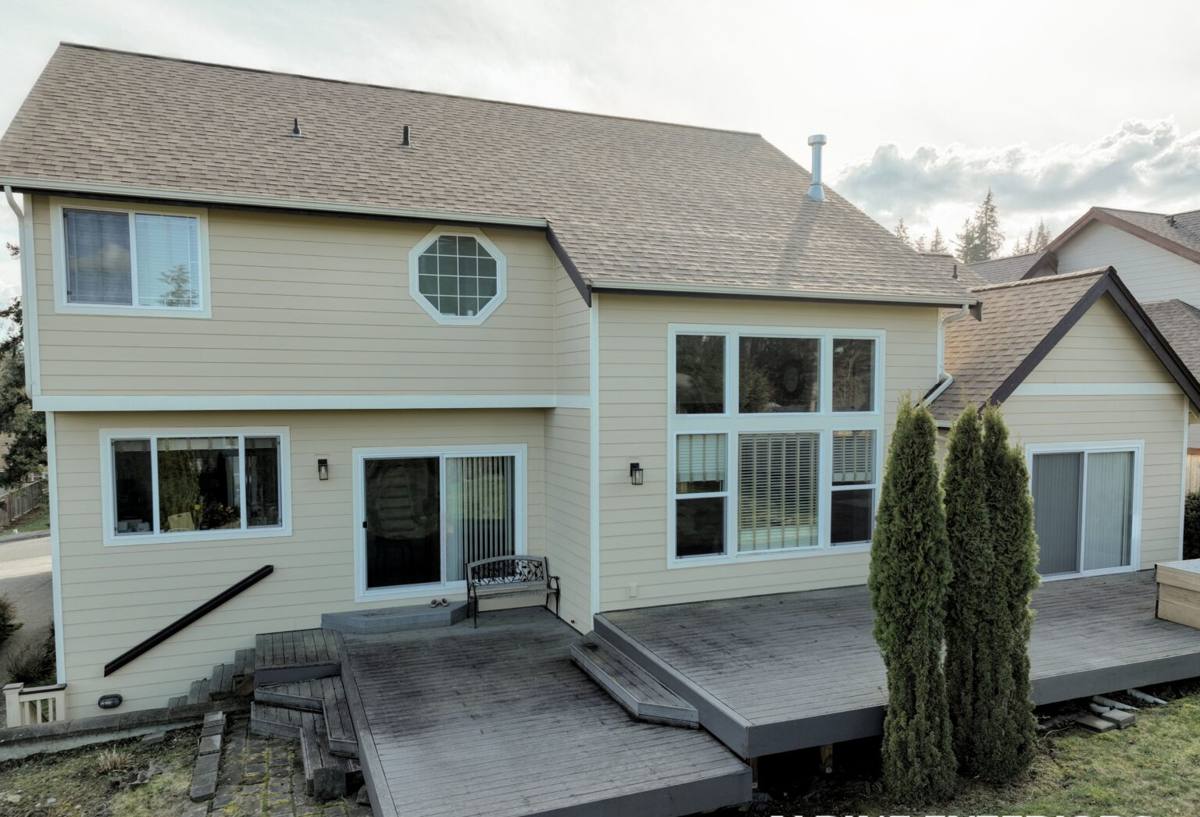
What Skagit County Weather Actually Does to a Deck Over Time
Most deck failures we see aren't sudden. They're the slow result of moisture doing what moisture does when it isn't managed correctly.
Salt Air and Metal Fasteners
Homes close enough to the water to get salt-laden air see faster corrosion on exposed fasteners, brackets, and hardware than homes further inland. Once a nail or screw starts rusting, it loses holding strength and can stain the surrounding wood or composite decking. This is one of the most overlooked causes of a deck that "feels loose" well before it looks old.
Driving Rain and Hidden Rot
Rain that comes in at an angle finds every gap in flashing, every unsealed cut end, and every spot where a ledger board meets the house without a proper water barrier behind it. The damage that matters most is usually invisible from the top of the deck — it's happening in the ledger connection, the joists, and the posts, which is exactly where deck failures become safety issues.
Moss, Algae, and a Long Growing Season
Shaded, tree-covered lots — common on the wooded and elevated parcels around Blanchard — stay damp longer after each rain. That keeps moss and algae active on horizontal wood surfaces for much of the year. Beyond the slip hazard, moss holds moisture against the board surface, which accelerates rot in wood decking and can dull or stain lower-grade composite products over time.
Signs a Blanchard Deck Needs Replacement, Not Just Repair
Not every aging deck needs a full teardown. But there's a point where patching boards is just delaying a bigger, more expensive failure. Signs it's time for a real replacement:
- Soft, spongy, or spring-back spots when you walk across the decking
- Visible rot or dark staining where the ledger board meets the house
- Rust streaks running down from fasteners or metal connectors
- Persistent moss or algae that comes back within weeks of cleaning
- Railings or posts that wobble under normal pressure, not just heavy load
- Gaps opening up between boards, or boards cupping and pulling away from joists
- A deck original to a home more than 20–25 years old, especially with untreated or unknown-grade lumber in the frame
If you're only seeing one or two of these and the framing underneath is sound, targeted repair can make sense. Once rot has reached the structural members, repair usually just delays a full rebuild while adding cost.
What a Correct Deck Replacement Actually Involves
A deck replacement done right in this climate is a structural project, not a surface swap. The parts that don't show are the parts that determine how long the new deck lasts.
Ledger Board and Flashing
The connection between the deck and the house is the single most common failure point in this region's weather. A correct install uses proper flashing that directs water away from the house structure, not just a bolted board with caulk as the only water management. This is the detail that prevents slow, hidden rot at the wall.
Framing and Footings
Joists, beams, and posts need to be sized correctly for the deck's span and load, and footings need to sit below frost depth and bear on solid, undisturbed soil. On sloped or wooded lots, this sometimes means adjusting footing placement to avoid tree roots or drainage paths — something that's easier to plan for when the crew has worked similar lots in the area before.
Fasteners and Hardware
Given the salt air and rain exposure common around Blanchard, fastener choice matters more here than in drier inland areas. Stainless steel or high-grade coated fasteners rated for exterior and ground-contact use cost more upfront but avoid the corrosion staining and loosening that cheaper fasteners develop within a few wet seasons.
Decking Surface and Drainage
The decking itself needs a slight slope away from the house and enough of a gap between boards to let water and debris pass through rather than pool. Poor drainage under the decking is one of the main reasons moss and algae come back quickly even after cleaning.
Choosing a Decking Material for This Climate
There's no single "best" decking material — the right choice depends on how much maintenance you want to do and what trade-offs you're comfortable with. Here's how the common options actually perform in a Skagit County setting.
| Material | How It Handles This Climate | Maintenance | Typical Lifespan |
|---|---|---|---|
| Pressure-treated wood | Affordable, but needs consistent sealing to resist rot and moss in a wet climate | Annual cleaning and periodic re-sealing | 10–15 years with upkeep |
| Cedar | Naturally rot-resistant and handles moisture well, but still needs finish maintenance to keep that resistance | Regular cleaning, occasional re-staining | 15–20 years with upkeep |
| Capped composite | Strong resistance to moisture absorption and moss staining; performs well in damp, shaded conditions | Occasional washing, no sealing or staining | 25+ years |
| PVC decking | Fully synthetic, does not absorb moisture, very resistant to moss and algae staining | Low — periodic washing only | 25–30+ years |
We install a range of these depending on the homeowner's budget and priorities. What we steer people away from is the lowest-tier composite decking, which can trap moisture at the core and struggle with mold or discoloration faster than either solid wood or a quality capped composite in a wet, shaded environment. That's an installation and moisture-behavior issue, not a brand judgment — it's why we're upfront about which products hold up under Skagit County conditions and which ones ask for more maintenance than most homeowners expect.
Our Deck Replacement Process
The process is the same discipline whether it's a small platform deck or a large multi-level structure — the scale changes, the steps don't.
- On-site assessment. We check the framing, ledger connection, footings, and current decking to determine what's actually reusable versus what needs to come out.
- Plan and quote. You get a clear breakdown of scope, material options, and what's involved — no vague allowances that turn into surprise costs mid-project.
- Permitting. Most deck replacements in unincorporated Skagit County require a permit, especially for elevated decks or any structural rebuild. We handle that process as part of the project.
- Demolition. Full removal of the old decking and, where needed, the framing — done carefully to protect landscaping and the area around the house.
- Framing and flashing. This is where the long-term durability gets built in: proper ledger flashing, correctly sized joists and beams, and footings set to code.
- Decking and railing installation. Installed with attention to drainage, board spacing, and fastener choice appropriate to the site's exposure.
- Final walkthrough. We go over the finished deck with you, including basic care guidance specific to the material installed.
Timing the Work Around the Moss Season
We plan Blanchard deck replacements around the region's wet pattern where possible. Framing and structural work go faster and hold up better when they're not fighting saturated ground or ongoing rain, and there's real value in getting a new deck's protective details — flashing, sealed cuts, proper drainage — in place before the next long wet stretch rather than during it.
Permits and Local Code Considerations
Deck replacement projects in this part of Skagit County typically involve a few recurring code items worth knowing about before you start:
- Elevated decks generally require a building permit, and any structural rebuild (not just a surface swap) usually does too
- Guardrail height and baluster spacing have specific code requirements once a deck is above a certain height
- Footing depth requirements exist to keep posts stable through freeze-thaw cycles and wet-season ground movement
- Decks attached to the house need proper ledger attachment and flashing detail to pass inspection, not just to hold up over time
We handle the permit process as a normal part of the job rather than treating it as an extra step, so the finished deck is both code-compliant and genuinely built to last.
Why It Matters That We Already Work in Blanchard
A lot of what makes a deck last in this area isn't exotic — it's just consistently applying the right details for local conditions instead of a one-size-fits-all approach. A crew that already works Blanchard and the surrounding Skagit County area knows which lots tend to stay damp longest, where salt air exposure is more of a factor, and how the wet season affects scheduling and curing times for footings and finishes. That local pattern recognition shows up in fewer callbacks and a deck that's still solid well past the point where a generic build would be showing problems.
It also means we're not guessing at permit requirements or code details specific to this jurisdiction — we've been through the process here before, which keeps the project moving instead of stalling on paperwork.
Get a Straightforward Estimate
If your deck is showing any of the warning signs above, or you're just planning ahead before it becomes a bigger problem, we're happy to take a look and give you an honest read on repair versus replacement. There's no pressure and no obligation — just a clear assessment and a straightforward quote based on your home and your budget. Use the form below to request a free estimate.