 Burlington
 Bow sits in the low farmland and shoreline flats west of Burlington, one of the more open, wind-exposed stretches of Skagit County. There are fewer trees and fewer neighboring rooflines out here to break up weather before it reaches a house, which means a Bow property tends to take salt air, driving rain, and moss pressure more directly than a home tucked into town. Fiber cement siding is built to handle that kind of exposure, but only if it's specified and installed with this climate in mind. This page covers what that actually looks like for a home in Bow — what the local conditions demand, what a correct job involves, how our process works, and why it matters that our crew already works this specific part of the county.
What Bow's Exposure Does to a Wall System
Three things combine on an open, low-lying property like the ones common around Bow: salt-laden air moving in off the water, wind-driven rain that hits walls sideways instead of falling straight down, and a moss season that runs long because this part of the valley doesn't get much of a dry stretch to recover in between storms. None of these are dramatic on their own. They work slowly, and a wall system that isn't built for them shows the wear years before it should.
Salt Air and Corrosion
Salt-laden air corrodes exposed metal faster than it would further inland — fasteners, flashing, and trim hardware are all at risk if they're not rated for it. Corrosion at a fastener head or a flashing seam doesn't just look bad; it's often the first point where a wall assembly starts letting water in, because a corroded fastener no longer seats or seals the way it did on day one.
Driving Rain and Seams
Wind-driven rain doesn't behave like ordinary rainfall. It gets pushed sideways and upward into laps, seams, and any gap that wouldn't matter in calmer weather. On an exposed lot with less windbreak than a house in a built-up neighborhood, that pressure is higher and more constant. The quality of the flashing and lap detail behind the siding matters more here than the siding material itself.
A Moss Season That Doesn't Let Up
Low, damp, shaded ground is exactly where moss thrives, and a good share of the land around Bow fits that description for much of the year. Moss doesn't damage an inorganic material like fiber cement directly, but it holds moisture against a wall surface for long stretches, and if that moisture finds its way into an under-sealed joint or a cut edge that wasn't properly treated, that's where a real problem starts.
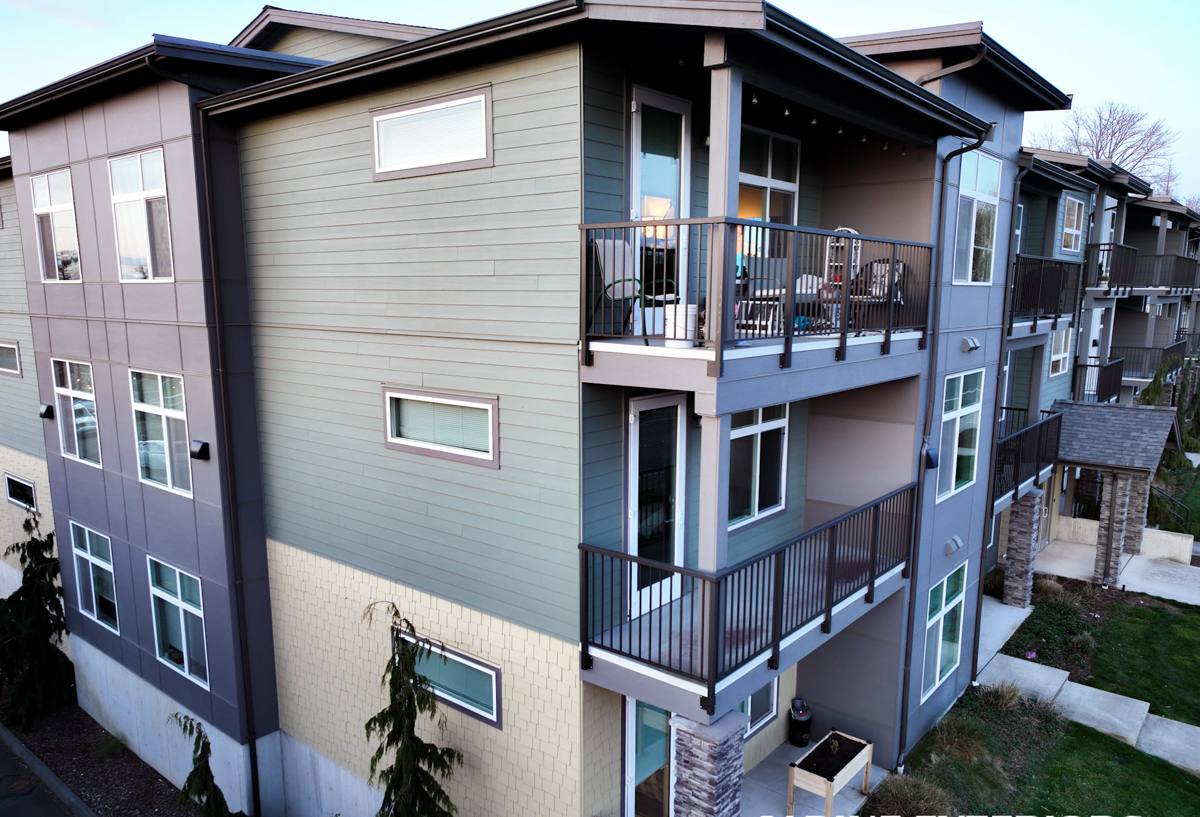
Why We Install Only James Hardie Fiber Cement in Bow
We install one siding product, full stop: James Hardie fiber cement. We don't carry vinyl, LP SmartSide, Cemplank, Allura, primed spruce, or cedar. That's not because those products have no merit — vinyl is affordable and low-maintenance in milder conditions, engineered wood installs quickly and takes paint well, cedar has real natural character. Each one also carries a trade-off we've decided doesn't hold up well on a stretch of Skagit County this exposed.
Vinyl can go brittle with age and temperature swings, and its seams and J-channels are exactly the kind of gap that wind-driven rain works into over time. Engineered wood and primed spruce both have an organic wood-strand or solid-wood core, which means every cut edge, fastener hole, and joint has to be perfectly sealed and stay that way for the life of the siding — a hard standard to hold on every job, every year, in a climate that doesn't give a wall much time to dry out between storms. Cedar is genuinely attractive, but it's organic too, and it asks for real, ongoing upkeep — refinishing, sealing, moss treatment — to keep performing on an open, salt-exposed lot.
Fiber cement handles the core problem differently because there's no organic substrate for moisture to work into, and it doesn't feed moss or mildew growth the way wood-based products can. James Hardie also builds its HZ5 product line specifically for regions with heavier moisture exposure like the Pacific Northwest, rather than selling one generic formulation everywhere in the country. Paired with a factory-applied ColorPlus finish — cured under controlled conditions instead of painted on-site in whatever weather shows up that week — it holds color and resists cracking longer than a field-applied finish typically manages out here.
What a Correct Fiber Cement Job Involves on a Bow Home
Fiber cement is only as good as the installation behind it, and that's especially true on an exposed lot. A correct job accounts for the specific way wind, rain, and moisture move across a given wall — not just a generic spec sheet.
- Proper clearance from grade, decks, and patios so the bottom edge of the siding never sits in standing moisture
- Flashing integrated at every window, door, roofline transition, and penetration — not caulked over after the fact as a patch
- Fastener spacing and type matched to the HZ5 product line and rated for corrosion resistance in salt-exposed air
- Cut edges primed and sealed on-site, since factory finish doesn't extend to a field cut unless it's treated
- Joint and seam treatment adjusted for sun-exposed versus shaded, moss-prone wall faces on the same house
- Kick-out flashing at roof-to-wall intersections, so water is diverted away from the siding instead of running behind it
Where Shortcuts Show Up First
On a sheltered, in-town lot, a missed detail can go unnoticed for years. On an open property like the ones around Bow, the same shortcut tends to surface faster — a fastener that wasn't rated for corrosion starts bleeding rust within a season or two, an unsealed cut edge at a window return lets moisture in behind the first hard storm, a missing kick-out flashing sends water straight down the wall instead of off the roof. None of these are visible on move-in day. They show up later, and by the time they do, the fix is bigger than it would have been to do it right the first time.
Our Process for a Bow Fiber Cement Project
- On-site assessment. We walk the property, look at existing siding condition, sheathing, and any signs of past moisture intrusion, and talk through what the house actually needs.
- Product and profile selection. We help you choose the Hardie plank, shingle, or panel profile and ColorPlus color that fits the home, using the HZ5 line appropriate to this climate.
- Tear-off and prep. Old siding comes off, and we check the sheathing and weather-resistant barrier underneath for damage before anything new goes up — problems found here get addressed, not covered over.
- Flashing and moisture barrier work. This is the step that determines whether the job holds up — every window, door, penetration, and roofline transition gets flashed and integrated with the barrier correctly.
- Installation to spec. Siding goes up with the fastener pattern, clearance, and joint treatment matched to the product line and this specific property's exposure.
- Final walk-through. We go over the finished work with you, register the manufacturer warranty, and make sure you know what to watch for on your specific house going forward.
Fiber Cement Compared to Other Siding Options
| Factor | Vinyl | Engineered Wood | Cedar | James Hardie Fiber Cement |
|---|---|---|---|---|
| Salt air / corrosion resistance | Can become brittle over time | Vulnerable at unsealed edges | Vulnerable without upkeep | Inorganic, engineered HZ5 line for this climate |
| Moisture / rot risk | Low material risk, but seams leak | Real risk at cut edges and fasteners | Real risk without regular sealing | No organic core to rot |
| Moss and mildew | Doesn't feed growth, but traps moisture in seams | Organic surface can support growth | Organic surface can support growth | Doesn't feed growth |
| Finish durability | Fades and chalks with UV/salt exposure | Field-applied paint, recoat schedule | Needs periodic refinishing | Factory-baked ColorPlus finish |
| Ongoing maintenance | Low, but limited repair options | Moderate to high | High | Low when installed correctly |
Cost Factors for Fiber Cement Siding in Bow
We don't publish blanket pricing, because the real cost drivers are specific to the house in front of us and it wouldn't be an honest number otherwise. The factors that move a project up or down are consistent enough to lay out plainly.
| Factor | How It Affects Cost |
|---|---|
| Existing sheathing or moisture damage | Repairs found during tear-off add scope before new siding can go up |
| Home size and wall complexity | More corners, gables, and penetrations mean more flashing and labor time |
| Siding profile | Lap siding is generally more straightforward than board-and-batten or shingle profiles with heavier trim |
| Site access and exposure | Open, rural lots can simplify staging but may require corrosion-rated fasteners and hardware throughout |
| Scope bundling | Combining siding with trim, fascia, or window flashing work can reduce overlapping setup costs |
Why a Crew That Already Works Bow Matters
A crew that works this stretch of Skagit County regularly knows how differently an open, water-facing wall ages compared to a sheltered one a few lots away — and adjusts fastener choice, flashing detail, and joint treatment accordingly. That judgment comes from doing this work repeatedly on properties like these, not from reading a general spec sheet written for the whole country. It also means someone local is easy to reach if a warranty question comes up or a flashing detail needs a second look years down the road, instead of chasing down a crew that's moved on somewhere else.
What to Check Before Hiring for Siding Work in Bow
- Manufacturer training or certification on James Hardie products specifically, not siding in general
- A clear, specific explanation of how flashing will be handled at every window, door, and roofline transition
- Confirmation that fasteners and hardware are rated for salt-exposed, corrosion-prone conditions
- Proper Washington State licensing, bonding, and insurance you can verify before signing anything
- A written scope of work and both the manufacturer's material warranty and the contractor's workmanship warranty
- Actual experience on open, exposed Skagit County properties, not just a general service-area claim
Maintaining Fiber Cement Siding in Bow's Climate
Fiber cement is low-maintenance, not maintenance-free, especially on an exposed lot. Keeping gutters clear ahead of the wet season prevents overflow from soaking siding and trim at the eaves. Checking shaded or low-lying wall sections for early moss growth and clearing it before it spreads keeps moisture from sitting against the surface for long stretches. Every year or two, it's worth a look at caulked joints, cut edges, and fastener heads for any early sign of corrosion or a gap opening up — small things that are easy to fix early and more expensive to ignore. A contractor who installed the work correctly should be able to tell you exactly what to watch for on your specific house.
If you're weighing fiber cement siding for a home in Bow, we're happy to take a look and give you a straight, no-pressure assessment of what your house actually needs. Reach out for a free estimate and we'll walk the property with you and talk through what we see.