 Burlington
 Conway Sits in One of Skagit County's Toughest Spots for Siding
Conway is low, flat, and close to the water. The community sits in the Skagit River delta, near where the river meets Skagit Bay, which means homes here take on a combination most inland Skagit County properties don't deal with: salty marine air drifting in off the Sound, driving rain that comes in sideways during winter storms, and a damp, shaded growing season for moss and algae that can run eight or nine months out of the year. None of that is unique to any one house on any one street — it's the baseline climate for the area, and it's exactly what siding on a Conway home has to survive, year after year.
Cheap or poorly installed siding doesn't fail gradually in a place like this. It fails at the seams first — caulk lines crack, paint lifts at end cuts, moisture works behind panels that were never properly flashed, and moss gets a foothold in shaded, damp-prone areas that never fully dry out between storms. By the time it's visible from the yard, there's often already damage to the sheathing or framing underneath. That's the real cost of the wrong material or a rushed install: not the siding itself, but what it lets happen behind it.
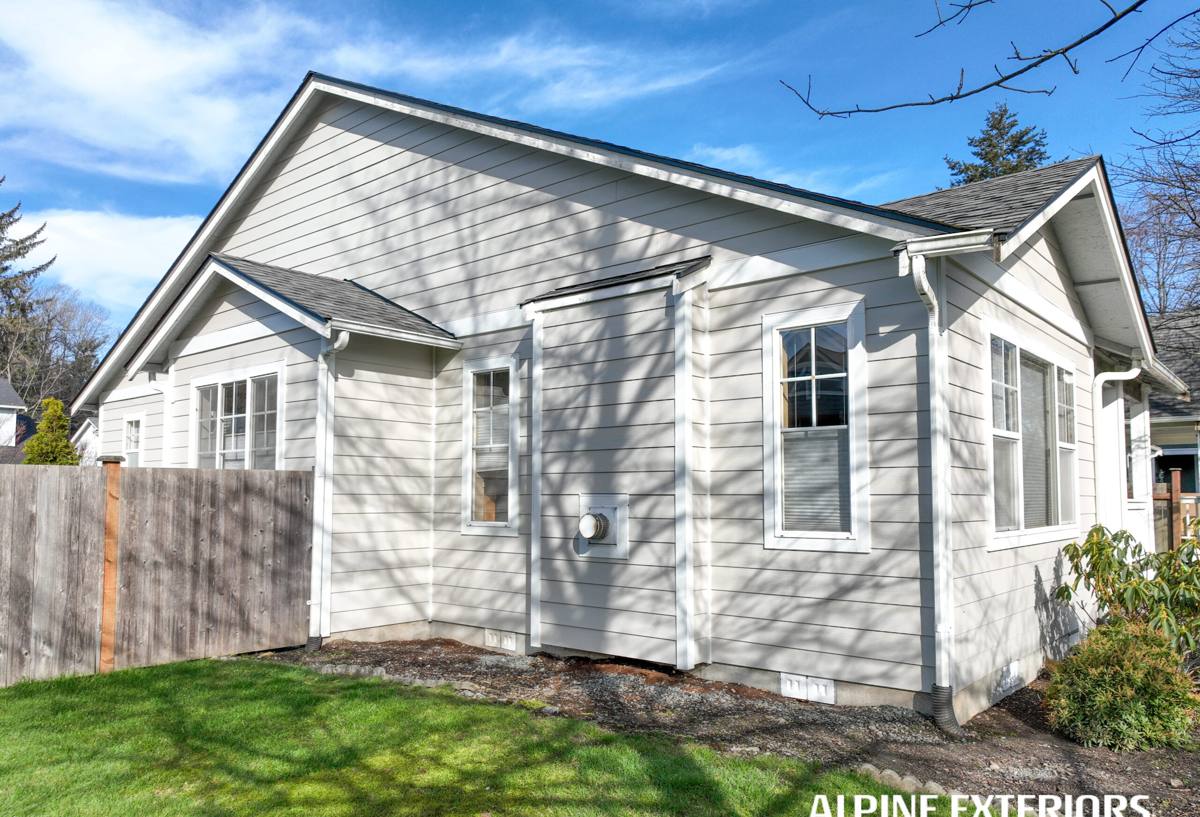
Why We Only Install James Hardie in This Climate
We install James Hardie fiber cement exclusively — not vinyl, not LP SmartSide, not cedar or primed spruce — and Conway's conditions are a big part of why. Hardie's HardieZone system is engineered for specific climate zones, and this part of Washington falls into the HZ10 zone, which accounts for exactly this kind of wet, marine-influenced weather. The boards are manufactured to resist moisture absorption, they don't swell or rot the way wood-based products can, and the factory-applied ColorPlus finish is baked on and warranted against fading and flaking in a way field-applied paint on other materials simply isn't.
Salt air is hard on any exterior material. It accelerates corrosion on fasteners and hardware, and it breaks down finishes that aren't formulated to handle it. Fiber cement itself doesn't corrode, and Hardie's ColorPlus coating is designed to hold its color and adhesion through exactly this kind of exposure. Combined with the right stainless or coated fasteners and correctly sealed penetrations, it's the most durable option we're willing to put our name behind in a Conway-type environment.
Moss and algae are a different problem — they're biological, not chemical — but the surface matters. A dense, factory-finished fiber cement surface gives moss and algae less to grip and holds up to periodic cleaning far better than bare wood, vinyl that can crack under a pressure washer, or the joints and edges on some engineered wood products where moisture and organic growth like to collect.
What This Means for Product Selection
For most Conway homes, that means specifying HardiePlank lap siding in a HZ10-rated profile, with HardieTrim boards and, where the architecture calls for it, HardiePanel for accent areas. We also pay close attention to color choice here — darker ColorPlus finishes hide the light haze of airborne salt and pollen better between cleanings, while lighter colors show streaking sooner, especially on north- and west-facing walls that stay damp the longest.
What a Correct Installation Actually Involves
The siding itself is only part of the job. Most of the long-term performance of a Hardie install comes from what happens underneath it and around it — the parts nobody sees once the project is done. In a wet, salt-exposed area like Conway, cutting corners here is what leads to the moisture problems homeowners eventually notice as bubbling paint, soft trim, or a musty smell along an exterior wall.
Sheathing and Moisture Barrier
Before any new siding goes up, we check the condition of the existing sheathing. Given how much rain this area gets, it's common to find some soft spots or old moisture staining behind aging siding, especially around windows, doors, and low corners near grade. We repair or replace damaged sheathing before installing a new weather-resistive barrier, and where conditions call for it, we install a rainscreen gap behind the siding so any moisture that does get past the outer layer can drain and dry instead of sitting against the wall.
Flashing and Clearances
Flashing at windows, doors, and roof-to-wall intersections is where most siding failures actually start, not in the field of the siding itself. We flash every penetration and horizontal transition to shed water down and out, and we hold to Hardie's minimum clearances — typically at least 6 inches above grade, 2 inches above roofing, and consistent gaps at deck and porch connections — so water can't wick up into the bottom edge of the siding, which is the first place it will rot if that clearance is ignored.
Fastening and Finish Details
We fasten to Hardie's published specifications for the HZ10 zone, use fasteners rated to resist corrosion in a coastal-influenced environment, and pre-finish or field-seal cut edges so raw fiber cement isn't left exposed to standing moisture. Caulking is used sparingly and correctly — at trim joints and penetrations, not as a substitute for proper flashing, which is a shortcut that fails within a few wet seasons here.
Comparing Siding Options for a Conway Home
Homeowners in this area often ask why we won't quote vinyl or engineered wood alongside Hardie. Here's an honest side-by-side of how these materials typically hold up under Conway's specific conditions:
| Material | Salt air / marine exposure | Moss and moisture over time | Finish durability |
|---|---|---|---|
| James Hardie fiber cement | Non-corroding material; factory finish resists salt haze buildup | Dense surface resists organic growth; cleans well | Factory ColorPlus finish, longer field life before repainting |
| Vinyl siding | Can become brittle and prone to cracking with UV and temperature swings | Seams and laps trap moisture and grime; limited pressure-washing tolerance | Color is through the material but fades; cannot be repainted easily if damaged |
| Engineered wood (LP SmartSide) | Wood-based core is more vulnerable if edges or fasteners fail | Prone to swelling and edge damage if moisture gets in over time | Field-applied or factory finish, but wood substrate limits long-term moisture tolerance |
| Cedar / primed spruce | Natural material requires ongoing sealing to resist salt and moisture | Susceptible to rot and moss without regular maintenance | Repainting/restaining on a recurring cycle is required |
This isn't a knock on every use case for those products — vinyl and engineered wood both have a place elsewhere. It's why, for the climate we actually build in, we standardized on one material rather than installing something we don't think holds up as well here.
How We Approach a Conway Project
Assessment First
Every project starts with a walk-around of the home, checking existing siding condition, trim, window flashing, and any visible moisture damage, especially on the sides of the house that face prevailing weather off the water. We also look at grade clearance and drainage around the foundation, since that affects how the new siding needs to be detailed at the bottom courses.
Installation
Once the scope is set, our crew handles tear-off, sheathing repair where needed, weather barrier and rainscreen installation, and the Hardie install itself — lap siding, trim, and any panel accents — fastened and flashed to spec throughout.
Final Walkthrough
We finish with a walkthrough covering caulking, paint touch-up on cut edges, and a review of basic care so the finish holds up through the wet season ahead. Warranty paperwork is registered so the coverage on both material and finish is documented from day one.
What Drives Cost on a Conway Siding Project
| Cost factor | Why it matters here |
|---|---|
| Sheathing condition | Rot repair behind old siding is more common in homes with long-term moisture exposure near the delta |
| Home size and wall complexity | More corners, dormers, and trim detail mean more flashing and cut work |
| Siding profile and accessories | Lap width, trim style, and any panel accents affect material cost |
| Access and site conditions | Rural lots, fencing, landscaping, or limited driveway access can affect labor time |
| Color and finish selection | Standard ColorPlus colors are typically more cost-effective than custom or premium finishes |
We give straightforward, itemized estimates rather than a single lump number, so homeowners can see what's driving the price before committing.
Signs a Conway Home May Need New Siding Soon
- Paint that's peeling, bubbling, or chalking, especially on walls facing the water or prevailing wind
- Soft or spongy spots when you press on siding near the bottom courses or below windows
- Persistent moss or dark staining that comes back quickly after cleaning
- Visible gaps, warping, or cupping in lap boards
- A musty smell along an exterior wall inside the home
- Caulk that's cracked or pulled away at trim and window joints
Any one of these on its own isn't necessarily an emergency, but they're worth having looked at before the next wet season, since problems behind the siding tend to get more expensive the longer they sit.
Why It Matters That We Already Work in Conway
A lot of siding problems in this area trace back to installers applying a generic approach without accounting for what this specific stretch of Skagit County actually deals with — the salt exposure, the flat drainage, the long stretches of damp shade that keep moss going most of the year. A crew that already works Conway and the surrounding Burlington area knows to check grade clearance more carefully on low lots, knows which wall orientations take the worst of the weather, and isn't guessing at flashing details for the first time on your house.
We also know the practical side of working out here — permitting through Skagit County, coordinating around rural access and weather windows, and building a schedule that accounts for the wetter months rather than fighting them. That local familiarity doesn't show up as a line item on an estimate, but it shows up in how the job actually holds up five and ten years later.
If your Conway home is due for new siding or you're weighing options after storm damage or a remodel, we're happy to walk the property, look at what's actually going on, and put together a straightforward, no-pressure estimate. There's a form below to get that conversation started.