 Burlington
 Why Conway Homes Are Hard on Siding
Conway sits low in the Skagit River delta, close enough to Skagit Bay and the tidal flats that salt-laden air is a fact of life, not an occasional nuisance. Add in Skagit County's long wet season, driving rain that comes sideways off the water, and shaded, moisture-holding lots where moss and algae never really stop growing, and you have a climate that is genuinely rough on exterior building materials. Siding here doesn't just get rained on — it sits in damp air for months at a stretch, and whatever's on the wall has to shed water, resist rot, and hold its finish through all of it.
This isn't a generic "Pacific Northwest is wet" problem. Homes closer to the delta and open farmland around Conway take more wind-driven moisture and more salt exposure than homes further inland or up in the hills. That matters when you're choosing what to put back on the wall, and it matters even more in how the job gets installed — flashing, gaps, and caulk lines that would be forgiving in a drier climate become the first place a Conway home fails.
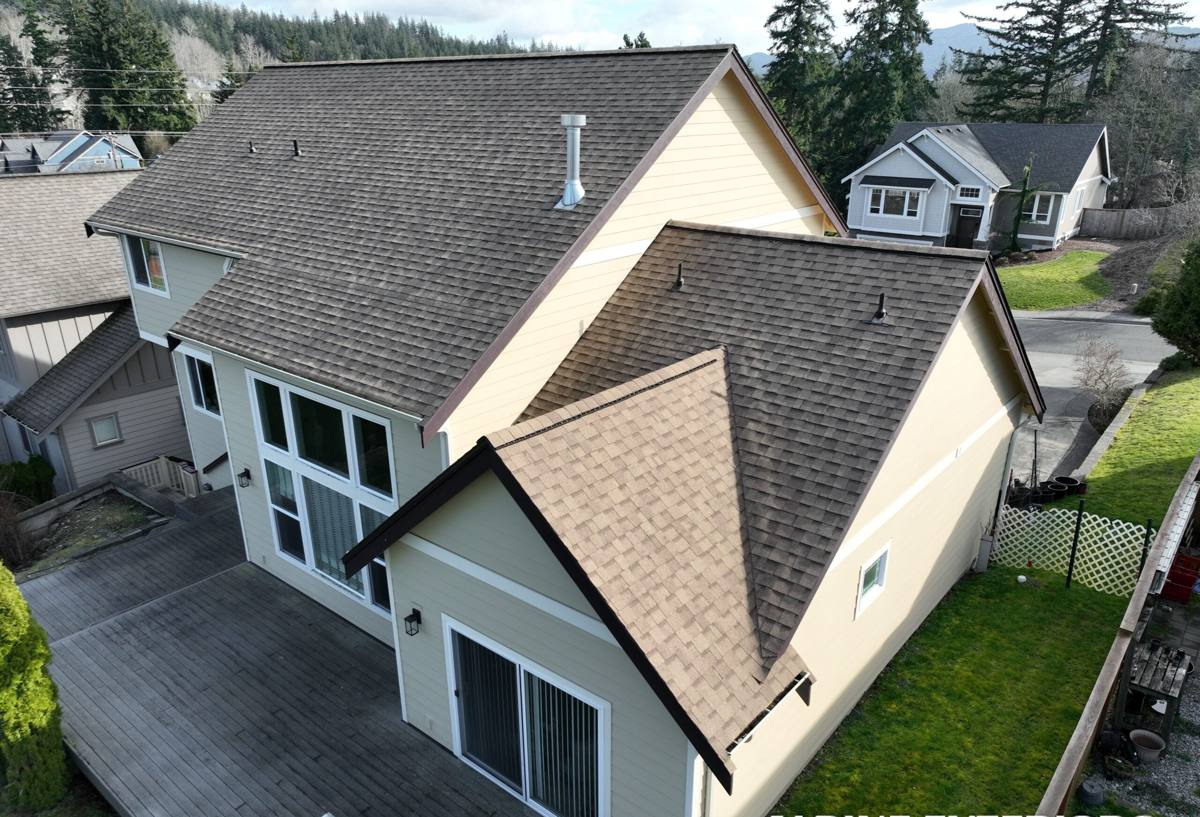
Signs a Conway Home Needs Siding Replacement
Most siding failures in this area show up slowly, then all at once. By the time paint is visibly peeling, the substrate underneath has often been wet for a while. Here's what we look for on Conway homes specifically:
- Soft or spongy spots when you press on the siding, especially near the bottom courses and around window sills
- Persistent black or green streaking that comes back within weeks of being cleaned — a sign the material itself is holding moisture, not just collecting surface grime
- Cupping, warping, or visible seams opening up between boards or panels
- Paint that's failing in patches rather than fading evenly, which usually points to moisture pushing out from behind the siding
- Bubbling or delamination, especially on the north and west-facing walls that get the least sun to dry out between storms
- Visible gaps at trim, corners, or butt joints where caulk has shrunk or failed
Any one of these on its own might be a minor fix. Several at once, especially combined with moss buildup that keeps reappearing, usually means the siding system as a whole is past the point where patching makes sense.
Why "Just Pressure Wash It" Isn't a Fix
Moss and algae keep coming back in Conway because the conditions that grow them — shade, moisture, mild temperatures most of the year — aren't going away. Washing removes the growth but does nothing for the moisture retention underneath if the siding material itself is porous or already compromised. On some products, aggressive pressure washing does more harm than good, driving water into seams and behind panels. Cleaning is maintenance; it's not a substitute for replacing siding that's already failing structurally.
What a Correct Siding Replacement Involves
Replacing siding is not simply pulling off old boards and nailing up new ones. Done right, especially in a climate like Conway's, the work underneath the visible siding matters as much as the siding itself:
The Water Management System
Every wall needs a continuous drainage plane — a water-resistive barrier installed correctly, lapped the right direction, with flashing integrated at every window, door, and penetration so water is directed out and down, never trapped behind the cladding. This is where most siding failures actually start, not with the siding material itself. A house wrapped correctly with mediocre siding will usually outlast a house with premium siding wrapped poorly.
Substrate Inspection
Before anything new goes up, we check the sheathing underneath the old siding for rot or water damage. In a delta climate like this, it's common to find soft sheathing behind sections that looked fine from outside. Any damaged wood gets replaced — covering rotten sheathing with new siding just delays a bigger problem.
Fastening and Clearances
Correct fastener type, spacing, and depth affect how well siding holds up to wind-driven rain and how long the finish lasts. Ground clearance and proper flashing at the base of the wall keep splashback and standing moisture away from the bottom courses, which are almost always the first place we see failure on older homes in this area.
Why We Install Only James Hardie Fiber Cement
We don't install vinyl, LP SmartSide, cedar, or other fiber cement brands like Cemplank or Allura. That's a deliberate standard, not a marketing line, and it's worth explaining honestly rather than just asserting it.
Vinyl is inexpensive and low-maintenance in the sense that it doesn't need painting, but it's a petroleum-based product that expands and contracts with temperature swings, can crack in impacts, and in a wind-driven-rain climate like Conway's, water can get behind panels at seams and laps if installation isn't precise — and vinyl doesn't stop that water once it's behind the wall the way a properly detailed fiber cement system does. Cedar is a beautiful, genuinely traditional material, but it's an organic product in a climate that stays damp for months; it needs ongoing sealing and maintenance to resist the rot and moss growth that this exact area is known for, and skipping that maintenance schedule catches up fast. LP SmartSide is an engineered wood product — treated and reasonably durable, but wood-based products still depend on an unbroken factory finish and careful field sealing of every cut edge to keep moisture out, and cut edges are exactly where problems start in wet climates. Other fiber cement brands can be reasonable products, but we've standardized on one system so our crew installs it the same correct way every time, and so the warranty and finish are consistent across every job we do.
James Hardie fiber cement is non-combustible, dimensionally stable, and doesn't rot, feed pests, or need repainting on the schedule wood-based sidings do. The ColorPlus factory finish is baked on under controlled conditions, which holds color and resists the fading and moss staining bare-primed products struggle with here. Hardie's HZ5 product line is engineered specifically for climates with more moisture exposure, which fits Skagit County's coastal-influenced weather better than a generic siding spec. It comes with a strong, transferable manufacturer warranty backing the material itself, on top of our own installation warranty.
Hardie vs. Other Siding Options in Conway's Climate
| Factor | James Hardie Fiber Cement | Vinyl | Cedar | LP SmartSide |
|---|---|---|---|---|
| Moisture/rot resistance | Does not rot; engineered for wet climates (HZ5) | Won't rot itself, but traps water behind panels if seams fail | Organic; needs regular sealing to resist rot and moss | Treated engineered wood; vulnerable at unsealed cut edges |
| Salt air exposure | Stable, factory-sealed finish resists salt-driven fading | Can become brittle over time; color fades | Weathers unevenly near salt air | Finish can degrade faster near coastal exposure |
| Fire resistance | Non-combustible | Combustible, can melt/warp near heat | Combustible | Combustible |
| Maintenance | Occasional wash; no repainting on factory-finish color | Low, but cracks/warps are not repairable | Regular sealing/staining required | Periodic inspection of seams and cut edges |
| Typical lifespan installed to spec | Multiple decades with warranty backing | 20-30 years, variable | 20-30 years with diligent maintenance | 25-30 years with maintenance |
Our Process for a Conway Project
- On-site assessment — we walk the exterior, check for soft sheathing, moisture damage, and problem areas specific to the home's exposure and shading
- Written scope and estimate — what's being replaced, what products and colors, and what the water management details will be, no vague line items
- Tear-off and substrate repair — removing old siding and repairing any damaged sheathing or framing found underneath before anything new goes up
- Water-resistive barrier and flashing — installed and lapped correctly at every window, door, and penetration
- James Hardie installation — fastened, spaced, and clearanced to manufacturer spec
- Trim, caulking, and final detailing — the finish work that determines how the job looks and performs for the next several decades
- Walkthrough — we go over the finished work with the homeowner before calling the job done
Why a Crew That Already Works Conway Matters
A lot of siding problems in this area come down to installers applying a generic install spec to a climate that doesn't forgive shortcuts. A crew that regularly works Conway and the surrounding Skagit County delta knows which walls take the worst of the wind-driven rain, where salt air exposure is worse, and where moss and algae growth tends to be most aggressive — and adjusts flashing details and clearances accordingly rather than treating every wall the same. That local pattern recognition is the difference between siding that looks right on install day and siding that's still performing correctly ten and twenty years out.
Local scheduling also matters practically — being able to get a crew back out quickly if a question comes up after the job, and working with a company that isn't driving in from out of the area for a one-off job, means faster response and more accountability.
What to Expect After Installation
Properly installed Hardie siding in Conway's climate needs very little upkeep: occasional washing to keep moss and algae from taking hold, and a visual check after major storms for any caulk or trim issues, which is standard for any exterior. You won't be on a repainting cycle the way you would with cedar or a primed wood product, because the ColorPlus finish is factory-applied and warranted separately from the installation. If anything does need attention, our installation warranty covers our workmanship, and Hardie's own warranty backs the material.
If your Conway home is showing moss that keeps coming back, paint that's failing in patches, or siding that feels soft in spots, it's worth having someone look at it before those small problems become bigger, more expensive ones. We offer free, no-pressure estimates — walk the property with us, get a straight assessment of what's actually going on, and decide from there.