 Burlington
 Building a Deck That Actually Holds Up on Fir Island
Fir Island sits low in the Skagit River delta, diked farmland wrapped by tidal sloughs and open water on nearly every side. That's a beautiful place to put a deck — open sky, good light, water views in more than one direction — but it's also one of the toughest microclimates around Burlington to build outdoor structures in. The combination of salt-touched air coming off Skagit Bay, driving rain that blows in sideways off the water, and a long, damp moss season means a deck built to a generic spec sheet will show its age fast. A deck built for Fir Island specifically holds up for decades instead of years.
This page is about that one job — deck building for Fir Island homes — not a general overview of what we do everywhere in Skagit County. The framing choices, fastener selection, and drainage detailing below are specific to what this stretch of low-lying, wind-exposed, salt-air ground actually does to lumber, metal, and finishes over time.
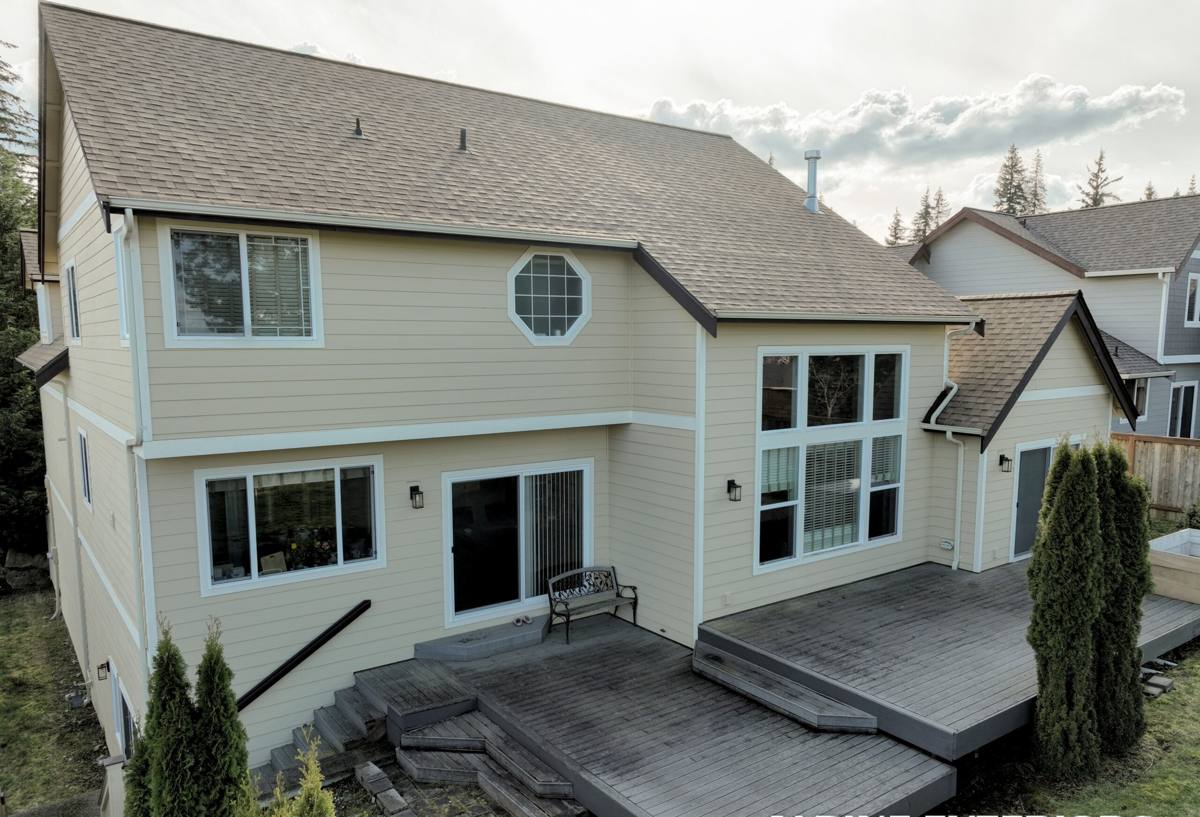
What Fir Island's Climate Actually Does to a Deck
Every material decision on a Fir Island deck traces back to three environmental facts: salt in the air, a lot of rain, and shade-and-moisture conditions that grow moss aggressively for much of the year.
Salt Air and Corrosion
Being near open tidal water means airborne salt settles on everything outdoors — including deck hardware. Standard zinc-coated fasteners and connectors that would be fine twenty miles inland can start showing rust streaks and pitting within a couple of seasons out here. Once a fastener corrodes, it loses holding strength long before it looks obviously bad, which is the real danger — a ledger bolt or joist hanger that looks "a little rusty" may already be compromised.
Driving Rain and Water Intrusion
Storms coming off the water don't just fall straight down — wind-driven rain gets pushed sideways into ledger boards, post bases, and any horizontal surface that isn't properly flashed or sloped. Water that would run off harmlessly on a calm-weather deck instead gets forced into joints, fastener holes, and end grain. Over time this is what causes ledger rot at the house connection, which is the single most common structural failure point on older decks in this area.
Moss, Algae, and the Long Wet Season
Skagit County's fall-through-spring dampness, combined with Fir Island's low elevation and open exposure to moisture off the delta, gives moss and algae a long window to establish on deck boards, especially in shaded corners or under overhangs where surfaces don't dry out between rains. Beyond looking bad, a mossy deck surface is genuinely slick — it's a fall hazard on stairs and near doorways, and moss holds moisture against the board surface, accelerating rot in untreated wood.
What a Correctly Built Deck Needs to Address
- Corrosion-resistant fasteners and structural hardware rated for coastal or marine-grade exposure, not standard interior-grade coatings
- Proper ledger flashing and a positive water break between the house wall and the deck framing
- Footings sized and set for Fir Island's soft, high-water-table delta soil, not generic footing depth
- Decking material and gap spacing that lets water and debris pass through instead of pooling
- A surface texture and finish that resists moss growth without becoming slick when wet
- Guardrail and stair hardware that won't loosen as fasteners age
Foundation and Framing Choices for Delta Ground
Fir Island is diked agricultural land with a naturally high water table — that's part of what makes it good farmland, and part of what makes deck footings tricky. Footings that aren't set deep enough or that sit in ground that stays saturated for weeks at a time can shift over a few wet seasons, which shows up later as a deck that's developed a slight lean or squeaky, uneven boards. We check soil conditions on-site rather than assuming a standard footing depth will work, and we won't cut that corner to save a day of labor — it's the part of the job nobody sees once the decking goes down, and it's the part that determines whether the deck is still solid in fifteen years.
Ledger attachment gets the same level of attention. On a house exposed to driving rain, the ledger board — where the deck ties into the structure — is the single spot most likely to trap water if it's flashed poorly. We flash it so water sheds away from the house rather than behind the ledger, and we use through-bolts rather than lag screws wherever the framing allows, since bolted connections hold up better to years of expansion, contraction, and moisture cycling.
Decking Material Comparison for Fir Island Conditions
There's no single "best" decking material for every house — it depends on budget, how much upkeep you want to do, and how exposed the deck is to weather. Here's how the main options actually perform under Fir Island's specific conditions.
| Material | Moisture & Rot Resistance | Moss Resistance | Maintenance | Typical Lifespan |
|---|---|---|---|---|
| Pressure-treated fir/pine | Good if sealed and re-sealed regularly | Low — needs periodic cleaning/treatment | Annual cleaning, re-sealing every 1-2 years | 10-20 years with upkeep |
| Cedar | Naturally decent, but softer and less durable than treated lumber over time | Moderate — still needs cleaning | Regular cleaning and periodic oil/finish | 15-20 years |
| Composite decking | Very good — doesn't absorb water like wood | Better, but can still grow surface algae in shaded/damp spots | Occasional washing, no sealing/staining | 25-30+ years |
| PVC/capstock boards | Excellent — essentially non-absorbent | Best of the group | Occasional washing only | 25-30+ years |
We steer most Fir Island homeowners toward composite or capstock boards for anything exposed to standing moisture or heavy salt air, simply because they don't take on water the way wood does — that's a moisture-behavior tradeoff, not a knock on wood decking done right. Real wood still has a place, especially where a homeowner wants the natural look and is willing to keep up with sealing on a schedule. What matters more than the brand name on the board is whether the framing underneath, the fastener choice, and the drainage detailing are correct — a premium composite board over a poorly flashed, undersized frame will fail at the frame, not the decking.
Our Deck-Building Process on Fir Island Jobs
- On-site assessment: We look at drainage, sun/shade exposure, soil condition, and how the deck will tie into the existing structure before we quote anything.
- Design and material selection: We walk through decking, railing, and hardware options with honest tradeoffs — cost, maintenance, and how each performs in this specific location.
- Permit handling: We pull the required permits and build to current code for footing depth, guardrail height, stair geometry, and structural connections.
- Foundation work: Footings are set to account for Fir Island's soil and water table, not a one-size-fits-all depth.
- Framing with corrosion-resistant hardware: Joists, ledger, and connectors are installed with fasteners rated for the salt-air exposure this area sees.
- Decking and railing installation: Boards are set with correct spacing for drainage and expansion, and railing is installed to code height and load requirements.
- Final walkthrough: We go over the finished deck with you, including what maintenance (if any) the material you chose will need going forward.
Permits, Setbacks, and Code Basics
Deck construction in Skagit County generally requires a building permit once the structure exceeds a certain height or size, and any deck attached to the house has to meet current guardrail, stair, and structural connection requirements. Fir Island's diking district status can also bring additional considerations depending on exact location and any flood-zone designations that apply to a given property. We handle the permit application and inspection process as part of the job — you shouldn't have to be the one chasing down what's required, and skipping this step is how homeowners end up with a deck that's a problem at resale time.
Maintenance That Actually Matters on Fir Island
How much upkeep a deck needs depends heavily on the material you chose, but a few things apply to almost every deck out here given the local conditions.
- Clean moss and algae off the surface at least once a year, ideally before the wet season sets in — a soft-wash approach is gentler on boards than pressure washing
- Check fastener heads and railing connections annually for early rust or looseness, especially on wood decks with exposed hardware
- Keep gutters and downspouts clear so runoff isn't dumping extra water directly onto or under the deck
- Re-seal wood decking on the schedule the product calls for — skipping a cycle is when moisture starts getting into the grain
- Make sure deck boards still have clear drainage gaps — debris buildup between boards traps moisture against the framing below
- Watch for soft spots near the ledger board or post bases, which are early signs of moisture getting where it shouldn't
Why It Matters That We Already Work Fir Island
A lot of deck problems out here don't come from bad workmanship in a general sense — they come from a crew applying standard, inland-spec building practices to a location that doesn't behave like standard ground. Footing depth that's fine in dry, well-drained soil elsewhere in Burlington isn't automatically fine on diked delta land with a high water table. Fastener grades that hold up fine away from the water corrode faster here. A crew that's already built decks on Fir Island has seen where the water actually goes during a real storm, knows which corners of a lot tend to stay soggy longest, and has already made the fastener and flashing mistakes on someone else's job — not yours. That local track record is worth more than a lower bid from a crew building to a generic checklist.
If you're planning a new deck or need an honest look at whether an existing one is holding up the way it should, we're glad to come out, walk the site, and give you a straight assessment. The estimate is free, there's no pressure attached to it, and you'll get a clear answer on what your specific lot and conditions actually call for — just fill out the form below to get started.