 Burlington
 Why Fir Island Windows Wear Out Faster
Fir Island sits low, flat, and close to open water where the Skagit River meets Skagit Bay. That location is what makes the farmland so good and what makes the windows on the houses out there age faster than windows twenty minutes inland in Burlington or Mount Vernon. Salt-laden air drifts in off the bay and settles on glass, vinyl, and hardware. Wind has nothing to slow it down before it hits a house, so driving rain gets pushed sideways into gaps that would stay dry on a more sheltered lot. And the long gray stretch from fall through spring keeps everything damp long enough for moss and mildew to take hold on sills, tracks, and exterior trim.
None of that means windows on Fir Island are doomed — it means they need to be selected and installed with that exposure in mind from the start. A window that's rated fine for a subdivision in a wind-sheltered part of Skagit County isn't automatically the right call for a place that takes weather straight off the water.
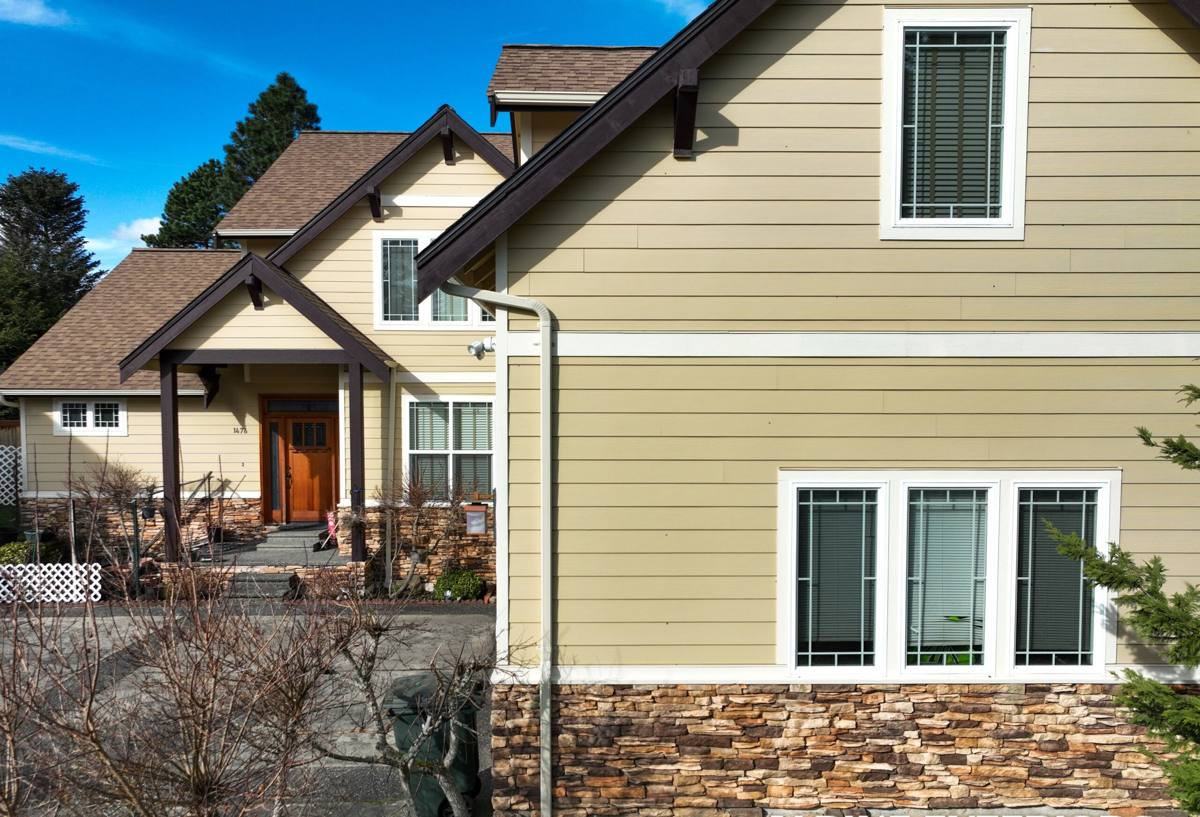
What Salt Air and Driving Rain Actually Do to a Window
Salt Exposure
Salt is corrosive to exposed metal hardware — hinges, cranks, locks, and some low-grade aluminum spacer bars inside the glass unit. Over years, salt film also etches into unprotected finishes and dulls them faster than plain rainwater would. It's not dramatic, it's cumulative — the difference shows up as pitting, stiff hardware, and cloudy-looking edges around year eight or ten instead of year fifteen or twenty.
Wind-Driven Rain
On an exposed lot, rain doesn't just fall on a window — it's pushed into it horizontally during a storm. That means every seam, every piece of flashing, and every bead of sealant is doing real work, not just sitting there for looks. A window that's slightly under-flashed or caulked instead of properly flashed will eventually let water track behind the trim and into the wall cavity, and you won't see it until there's a stain or soft spot showing up inside.
Moss and Sustained Moisture
Moss doesn't damage glass, but it holds moisture against wood sills, trim, and cladding around a window opening far longer than bare material would. That constant damp is what rots wood trim and de-laminates cheap composite sills over time. Keeping moss off the areas right around your windows is a small maintenance habit that protects a much bigger investment.
What "Energy-Efficient" Actually Means Out Here
Energy efficiency isn't a single number — it's a combination of factors, and which ones matter most depends on which direction your windows face and how exposed the wall is. For most Fir Island homes, we're balancing four things:
| Factor | What it does | Why it matters here |
|---|---|---|
| U-Factor | Measures heat loss through the window — lower is better | Keeps heating bills down through our long, damp winters |
| Solar Heat Gain Coefficient (SHGC) | Measures how much solar heat passes through the glass | Less critical here than in sunnier climates, but still affects west-facing rooms |
| Air Leakage Rating | Measures how much air passes through the assembled window | Directly tied to wind-driven rain resistance — a tight air seal is also a tight water seal |
| Condensation Resistance | Measures how well the glass resists interior fogging | Important for homes running heat against constant outdoor humidity |
For most homes on Fir Island, we lean toward double or triple-pane units with a low U-factor and a strong air-leakage rating over units optimized purely for solar performance. The bigger win locally is keeping conditioned air in and wind-driven moisture out, not blocking summer sun that's rarely intense enough here to be the main concern.
Frame Material: What Holds Up in This Exposure
| Frame Material | Salt/Moisture Resistance | Maintenance | Our Take |
|---|---|---|---|
| Vinyl | Good — won't corrode or rot | Low — occasional rinse to clear salt film | Solid, cost-effective choice for most Fir Island replacements |
| Fiberglass | Very good — dimensionally stable, resists warping | Low | Worth the upgrade cost on the most exposed, wind-facing walls |
| Aluminum | Fair — prone to pitting and corrosion near salt air unless marine-grade | Moderate | We steer clients away from standard aluminum in this specific exposure — it's a maintenance and longevity trade-off, not a defect claim |
| Wood / Wood-Clad | Weak on exposed elevations unless clad and well-maintained | High | Fine on sheltered elevations, but we're honest that it's more upkeep out here |
None of these materials are "bad" — the right choice depends on which wall of the house we're talking about, how exposed it is to prevailing wind and rain, and how much upkeep you want to sign up for. We'll walk that trade-off with you room by room rather than pushing one material for the whole house.
Installation Details That Matter More Here Than Elsewhere
The window unit itself is maybe half the job. The other half is how it's flashed and sealed into the wall, and on an exposed lot like Fir Island, that half is where failures actually happen. Our install standard includes:
- Proper flashing sequence (sill pan, side flashing, head flashing) shingled correctly so water sheds outward at every layer, not just caulked over gaps
- A sloped sill pan under every new window so any water that does get past the exterior sheds back out instead of pooling against the frame
- Compatible sealants and flashing tapes — mixing incompatible products is a common cause of premature seal failure in wet climates
- Backer rod and sealant at the exterior trim joint, not sealant alone, so the joint can flex with temperature and moisture changes without splitting
- Shimming and squaring the unit before fastening, so the sash operates smoothly and seals evenly for the life of the window
Skipping any one of these steps might not show a problem for a year or two. On a wind-exposed lot near open water, it tends to show up sooner rather than later.
Our Process
1. On-Site Assessment
We look at each window opening individually — sun and wind exposure, current condition of the trim and sheathing behind it, and whether there's any sign of past water intrusion. Not every window on a house needs the same treatment.
2. Product Recommendation
We'll recommend frame material and glass package based on that assessment and your budget, and explain the trade-offs honestly rather than upselling the most expensive option across the board.
3. Removal and Inspection
When we pull the old window, we check the sheathing and framing underneath for rot or hidden moisture damage before anything new goes in. This is often the point where a homeowner learns whether past leaks have been doing quiet damage.
4. Install and Flash
Full flashing and sealing sequence as described above, with attention to the specific elevation and wind exposure of that opening.
5. Final Check
We test operation, check the seal, and walk the exterior trim with you before we consider the job done.
Why It Matters That We Already Work Fir Island
A crew that mostly works sheltered subdivisions inland doesn't always think about sill pan slope or flashing sequence the same way — because most of the jobs they see don't punish a shortcut the way an exposed lot near Skagit Bay will. Working regularly in Burlington and out toward Fir Island means we've seen how salt air, wind-driven rain, and the local moss season actually play out on real houses over years, not just at the moment of installation. That's the difference between a window that looks right on install day and one that's still sealed tight in a decade.
Keeping New Windows Performing Long-Term
A good install cuts your maintenance down, but it doesn't eliminate it entirely in this climate. A simple seasonal routine keeps things in good shape:
- Rinse frames and glass periodically to clear salt film, especially on wind-facing elevations
- Keep moss and organic debris cleared from sills and the trim immediately around window openings
- Check that weep holes (the small drainage openings at the base of the frame) stay clear of debris so water can drain out
- Operate locks and cranks a few times through the off-season so hardware doesn't stiffen up from disuse
- Look for any soft spots or discoloration on interior or exterior trim after a hard winter storm season
What Drives Cost
| Factor | Impact on Cost |
|---|---|
| Frame material (vinyl vs. fiberglass vs. wood-clad) | Fiberglass and clad wood run higher than standard vinyl |
| Glass package (double vs. triple pane, low-E coatings) | More panes and coatings add cost but improve U-factor and comfort |
| Number and size of openings | Larger and more numerous windows scale cost directly |
| Condition behind existing trim | Hidden rot or sheathing damage found during removal adds repair cost |
| Wall exposure | Highly exposed elevations may warrant upgraded flashing details or materials, adding modest cost |
We give a firm, itemized quote after the on-site assessment — not a ballpark over the phone — because exposure and existing condition vary too much window to window to price accurately sight unseen.
If your windows out on Fir Island are fogging, sticking, drafty, or just showing their age, we're happy to take a look and give you a straightforward, no-pressure estimate. Use the form below to get started.