 Burlington
 Why Conway's Setting Is Tough on Siding
Conway sits low in the Skagit River delta, close enough to Skagit Bay and Puget Sound that salt-laden air is a daily fact of life, not an occasional weather event. Add the fog and standing dampness that settle over the flats most mornings, the driving rain that comes off the Sound in fall and winter, and a moss season that can run eight months or more in shaded, north-facing spots, and you have conditions that punish the wrong siding choice fast. This isn't abstract regional weather talk — it's the specific combination of salt exposure, near-constant humidity, and slow-drying shade that defines what actually holds up on a house in this part of Skagit County.
Homes on the delta and along the sloughs near Conway see more sustained moisture contact than siding twelve miles inland in Burlington or Mount Vernon. Wind-driven rain finds every gap in flashing and trim. Salt air accelerates corrosion on fasteners and metal components. And where tree cover or building shade keeps a wall damp longer after a storm, moss and algae get a foothold and don't let go without help. Siding that isn't engineered for this combination doesn't just look tired sooner — it fails structurally sooner, because moisture that gets behind the cladding has nowhere to go and no way to dry out quickly.
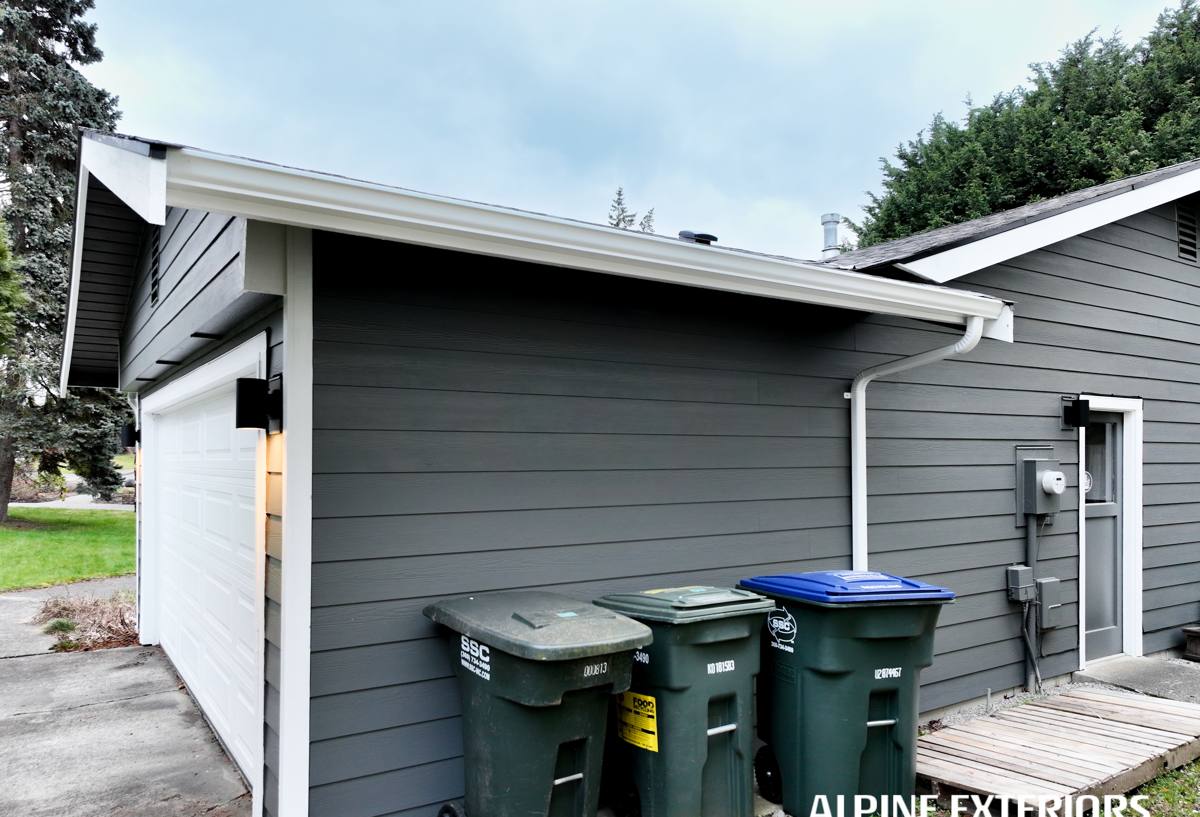
What "Correct" Fiber Cement Installation Means Here
Fiber cement itself is dimensionally stable and doesn't rot, but a fiber cement job is only as good as the water management behind it. In a delta environment like Conway's, we treat several details as non-negotiable, not optional upgrades:
Drainage plane and house wrap
Every installation gets a properly lapped weather-resistive barrier with a drainage gap behind the siding. In a location that stays damp as long as Conway does, bulk water and vapor both need a path down and out — not a flat, tight-to-the-sheathing install that traps moisture against the wall.
Flashing at every penetration
Windows, doors, hose bibs, light fixtures, and deck ledgers are the places water actually gets in. Correct flashing — not caulk alone — at each of these is what keeps driving rain from working its way behind the cladding over a winter of storms coming off the Sound.
Fastener and clearance standards
We hold to manufacturer clearance requirements: siding kept off grade, decks, roofs, and other flat surfaces where water and debris collect. In salt air, we're also deliberate about fastener material and coating, since corrosion-prone fasteners are one of the more common causes of early staining and streaking on coastal and near-coastal homes.
Factory-finished paint
Field-painted siding puts the moisture barrier at a cut edge or a job-site paint job that's only as good as the day it was sprayed. A factory-applied finish, cured and baked on before the board ever reaches the site, holds up to UV and salt exposure far more consistently over the long run.
Why We Install Only James Hardie
We standardized on James Hardie fiber cement for every job we do, including here in Conway, and we don't install LP SmartSide, vinyl, Cemplank, Allura, or primed wood siding. That's not a marketing position — it's a decision built around what we've seen hold up in Skagit County's marine climate and what doesn't.
Hardie's HardieZone system lets us spec HZ5 products engineered for the Pacific Northwest's wet, temperate conditions, with a ColorPlus factory finish that's formulated to resist fading and hold color through years of UV and salt exposure. Fiber cement is non-combustible, doesn't provide a food source for moss and algae the way wood does, and carries a transferable warranty that's meaningful because the product has a long track record in exactly this kind of climate. We'd rather install one product very well than offer five and get good at none of them.
How Fiber Cement Compares for a Conway Home
| Factor | James Hardie Fiber Cement | Vinyl | Untreated/Primed Wood |
|---|---|---|---|
| Salt air resistance | Formulated for coastal/marine exposure; factory finish resists fading | Can become brittle and chalky with UV and salt exposure over time | Vulnerable to salt-accelerated wear on exposed grain and joints |
| Moss and algae | Non-organic surface; nothing for moss to feed on directly | Resists organic growth but seams and laps trap grime | Organic material; moss and algae take hold readily in shaded, damp spots |
| Moisture behavior | Dimensionally stable; doesn't swell or rot if water reaches it | Doesn't absorb water but can trap moisture behind loose panels | Absorbs water; swells, cups, and rots without diligent upkeep |
| Fire resistance | Non-combustible | Melts and can contribute fuel in a fire | Combustible |
| Finish longevity | Factory ColorPlus finish, backed by product warranty | Color molded in but fades and can look "plasticky" over time | Needs repainting/restaining on a repeating cycle |
Our Process for a Conway Siding Job
- On-site assessment. We walk the exterior, check existing sheathing and moisture barrier condition, and look specifically at north- and shade-facing walls where moss and slow drying are most likely to have already caused damage.
- Tear-off and sheathing check. Old siding comes off and we inspect what's underneath. If sheathing is soft or the old barrier has failed, that gets addressed before anything new goes up — covering a wet wall with new siding just hides the problem.
- Weather barrier and flashing. New house wrap, properly lapped, with flashing detailed at every window, door, and penetration before the first piece of Hardie plank or panel goes on.
- Installation to spec. Correct fastener pattern, clearances from grade and roof lines, and joint treatment, following James Hardie's published installation requirements — the details that keep a warranty valid and keep water out.
- Trim, caulking, and final detail. Consistent reveal lines and properly sealed joints, because a sloppy caulk line is often where the first leak starts.
- Walkthrough. We go over the finished job with the homeowner before we consider it done.
What Drives Cost on a Job Like This
| Factor | Why It Matters in Conway |
|---|---|
| Existing wall condition | Homes with moisture damage behind old siding need sheathing repair, which adds labor before new siding can go on |
| Home size and complexity | Dormers, multiple gables, and cut-up wall lines take more time to flash and fit correctly |
| Product line and profile | Lap siding, shingle-style panels, and board-and-batten carry different material and labor costs |
| Trim and accessory scope | Fascia, soffit, and trim replacement alongside siding is often more efficient than doing it separately later |
| Access and site conditions | Delta-area lots with soft ground, ditches, or limited equipment access can affect staging and scaffolding time |
We give straightforward, honest ranges once we've actually seen the house — broad quotes without a walkthrough aren't useful to anyone.
Signs Your Current Siding Is Losing the Fight
- Persistent moss or dark algae streaking that comes back within a season of cleaning
- Soft spots, bubbling, or visible swelling, especially on north-facing or shaded walls
- Paint that's peeling or alligatoring rather than just fading
- Warping, cupping, or separating boards, particularly at butt joints and corners
- Rust streaking from fasteners — a common early sign of salt-air corrosion
- Visible gaps at trim and window edges where water could be tracking behind the cladding
Why a Crew That Already Works Conway Matters
A lot of siding problems in this area aren't installation failures in a general sense — they're failures to account for the specific conditions of a delta, near-Sound property. A crew that mainly works drier, more sheltered neighborhoods can do technically fine work and still under-detail flashing or skip the drainage gap that a Conway house actually needs, because the failure mode they're used to seeing is different. Working this area regularly means knowing which walls take the worst of the weather, where moss comes back fastest, and which older homes in the delta are more likely to have moisture already sitting behind the old siding before we ever pull the first board.
Maintenance After Installation
Correctly installed Hardie siding in Conway is genuinely low-maintenance, but "low" isn't "none." A rinse-down once or twice a year on shaded elevations keeps moss and grime from building a foothold, and it's worth a visual check after major windstorms for any loosened trim or caulk that's pulled away. Because the ColorPlus finish is factory-applied and warrantied, you're not on a repainting schedule the way you would be with wood — but a five-minute look at your exterior after a hard winter storm is cheap insurance against a small problem turning into a wet-wall problem.
If your Conway home's siding is showing any of the signs above, or you're planning ahead rather than reacting to a problem, we're happy to take a look and walk you through what we'd actually recommend for your walls — no pressure, no obligation. Use the form below to request a free estimate.