 Burlington
 Building Decks for Sedro-Woolley Homes
Sedro-Woolley sits at the edge of the Skagit Valley, where river-bottom humidity meets the same marine weather pattern that soaks the rest of Skagit County. A deck built here has to handle long stretches of steady rain, short bursts of real heat in July and August, and a moss season that can run from October clear through April. We build and repair decks for homeowners in this area because we're already local — Burlington is a short drive away, and we know the specific ways this climate wears down outdoor structures over a five, ten, or twenty year span.
A deck isn't a one-time purchase you forget about. It's a structure that sits outside year-round, exposed to whatever the valley throws at it. The difference between a deck that looks good and drains properly at year fifteen and one that's rotting at the ledger board by year seven almost always comes down to decisions made during construction — decisions most homeowners never get to see, because they're buried under the decking boards.
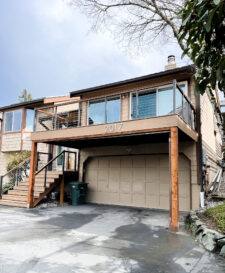
What Skagit County Weather Does to a Deck
Salt air, driving rain, and moss aren't abstract concerns here — they're the three things that will define how your deck ages. Understanding each one helps explain why we build the way we do.
Salt Air and Metal Fasteners
Sedro-Woolley isn't right on the water, but this stretch of the Puget Sound region still carries enough salt-laden moisture inland to accelerate corrosion on standard fasteners and hardware over time. Once a fastener starts to rust, it weakens, and a weakened fastener in a structural connection — like a ledger board bolt or a joist hanger nail — is a real safety issue, not just a cosmetic one.
Driving Rain and Standing Water
Western Washington rain doesn't fall straight down very often. Wind-driven rain gets up under railings, into end-grain cuts, and behind ledger boards if flashing wasn't installed correctly. Wood (and even composite substructure) that stays wet longer than it stays dry is wood that's on a clock. The goal in a good deck build isn't to keep water off — that's impossible outdoors — it's to make sure water that lands on or in the structure has a fast, obvious way out.
Moss, Algae, and Surface Buildup
Long wet seasons with limited direct sun (especially on north-facing or shaded decks under mature trees, common in this area) create ideal conditions for moss and algae growth. Beyond looking bad, moss holds moisture against the decking surface and makes boards slick and genuinely dangerous underfoot, especially on stairs.
What a Correctly Built Deck Looks Like Here
A deck built for Skagit County conditions isn't fundamentally different in shape from a deck anywhere else — it's different in the details that don't show up in a quick estimate. These are the things we treat as non-negotiable on every Sedro-Woolley project:
- Proper ledger board flashing where the deck attaches to the house, so water is directed away from the rim joist rather than trapped against it
- Corrosion-resistant fasteners and structural hardware rated for exterior and ground-contact use, not standard interior-grade hardware
- Joist spacing and blocking that meets or exceeds code for the decking material chosen, since composite and wood decking have different span requirements
- Deck board gaps set correctly for drainage and for the specific material's expansion and contraction in wet-to-dry cycles
- Post bases that keep wood posts off grade contact, reducing rot risk at the point most decks fail first
- Stair and railing connections built to current code, with attention to grip and slip resistance on treads
None of this is exotic. It's standard best practice — but it's also the first thing that gets skipped when a job is priced to be the cheapest bid on the table. Skipping flashing or using the wrong fasteners doesn't show up as a problem on installation day. It shows up in year four or five, as a soft spot near the house or a stair stringer that's started to split.
Decking Material Options for This Climate
There's no single "right" material for every homeowner — it depends on budget, how the deck will be used, and how much upkeep you want to take on. Here's an honest comparison based on how each option actually performs in wet, moss-prone conditions like ours.
| Material | Moisture Behavior | Moss/Algae Resistance | Upkeep |
|---|---|---|---|
| Pressure-treated wood | Resists rot when properly sealed; needs re-sealing over time | Moderate — moss grows readily if not cleaned periodically | Annual cleaning, periodic staining/sealing |
| Cedar | Naturally moisture-resistant, but softer and can gray/weather faster in constant wet | Moderate — same cleaning needs as treated wood | Regular cleaning, occasional oil or sealant |
| Composite decking | Doesn't absorb water or rot; won't warp or splinter | Better resistance, but still needs occasional washing to prevent surface film | Low — periodic washing, no sealing or staining |
| PVC decking | Fully moisture-impervious | Good, though algae can still form on any outdoor surface without cleaning | Low — washing only |
We install all of the above and will walk you through real trade-offs rather than pushing whatever has the best margin. Composite and PVC cost more upfront but save on maintenance labor over the life of the deck — a fair trade for some homeowners and not worth it for others who don't mind the seasonal upkeep on natural wood.
Our Process for a Sedro-Woolley Deck Project
The process is straightforward, but each step matters more here than it would in a drier climate.
1. On-Site Assessment
We look at the site itself — grade, drainage, sun exposure, proximity to trees, and how the deck will attach to the house. A shaded, north-facing deck footprint gets different material and cleaning recommendations than a sunny, open one.
2. Design and Material Selection
We talk through layout, railing style, stairs, and material based on your budget and how you'll use the space. This is also where we flag anything specific to your lot — a steep grade, an older foundation, or existing drainage issues that need to be addressed before decking goes down.
3. Permitting
Most deck projects in Skagit County require a permit, particularly for elevated decks or anything attached to the structure of the home. We handle this as part of the job so you're not chasing paperwork on your own.
4. Structural Build
Footings, framing, ledger flashing, and hardware go in first — this is the part that determines how the deck performs in ten years, even though it's invisible once decking is installed.
5. Decking, Railings, and Finish Work
Decking boards, stairs, and railings go on last, with attention to fastener spacing, board gaps, and a clean, level finish.
6. Walkthrough
We walk the finished deck with you, point out anything you should know for upkeep, and answer questions before we consider the job done.
Maintenance That Actually Matters in This Climate
A well-built deck still needs some seasonal attention here. This isn't a long list, but skipping it shortens the life of any deck material.
- Sweep debris (leaves, needles, seed pods) off the deck surface regularly — trapped organic matter holds moisture and feeds moss growth
- Clean moss and algae off the surface at least once a year, more often on shaded decks, using a deck-safe cleaner rather than a pressure washer set too aggressively (which can gouge wood or damage composite surfaces)
- Check that gaps between deck boards stay clear so water can drain through rather than pooling
- Inspect railings and stair connections annually for looseness — freeze-thaw cycles and constant moisture can work fasteners loose over time
- Re-seal or re-stain wood decking on the manufacturer's recommended schedule, don't wait until it looks obviously worn
Why a Local Crew Matters for This Job
Deck building looks similar everywhere on paper, but a crew that already works in and around Skagit County knows things that don't come from a spec sheet: how deep frost typically reaches in a given winter here, which fastener grades hold up against the regional moisture and salt exposure, and how much sun a given lot orientation actually gets through a Sedro-Woolley winter. That local knowledge shows up in small decisions — flashing details, hardware grade, drainage slope — that add years to a deck's life.
Being based in Burlington also means we're not driving in from out of the area for a callback if something needs attention after the build. That matters for warranty work and for the kind of follow-up questions that come up in year two or three, long after a distant contractor has moved on to other regions.
Getting a Fair Estimate
Deck pricing depends on size, material, elevation, and site conditions like grade and access — anyone quoting a firm number without seeing your property is guessing. What we can tell you upfront is that the biggest cost differences usually come down to material choice (wood versus composite or PVC) and structural complexity (a simple ground-level deck versus a multi-level deck with stairs and elevated framing). We'll walk your site, explain what your specific lot needs, and give you a written estimate that reflects the real conditions — not a generic number pulled from a average.
If you're planning a new deck or need an honest look at an aging one in Sedro-Woolley, we're happy to come take a look. Reach out through the form below for a free, no-pressure estimate.