 Burlington
 Why Edison Homes Wear Out Siding Faster Than You'd Expect
Edison sits in one of the more demanding pockets of Skagit County for exterior siding. You're close enough to the bay to pick up salt-laden air moving in off the water, low enough in the valley to catch driving rain pushed by marine westerlies, and shaded enough through the fall and winter months that moss gets a long, uninterrupted season to establish itself on north-facing walls, fence lines, and rooflines. None of that is unusual for this part of the county — but it adds up to a harder environment for siding than most manufacturers design around, and it's why so many Edison homes show siding failure well before the rest of the house looks tired.
Salt air is corrosive to exposed metal fasteners and trim. Driving rain finds every gap in a weather-resistant barrier that wasn't lapped correctly. And moss doesn't just look bad — it holds moisture against a wall surface for weeks at a time, which is exactly the condition that rots wood-based siding and delaminates poorly-bonded composite products. A siding replacement done for Edison needs to be specified and installed with all three of those realities in mind, not treated as a generic re-side.
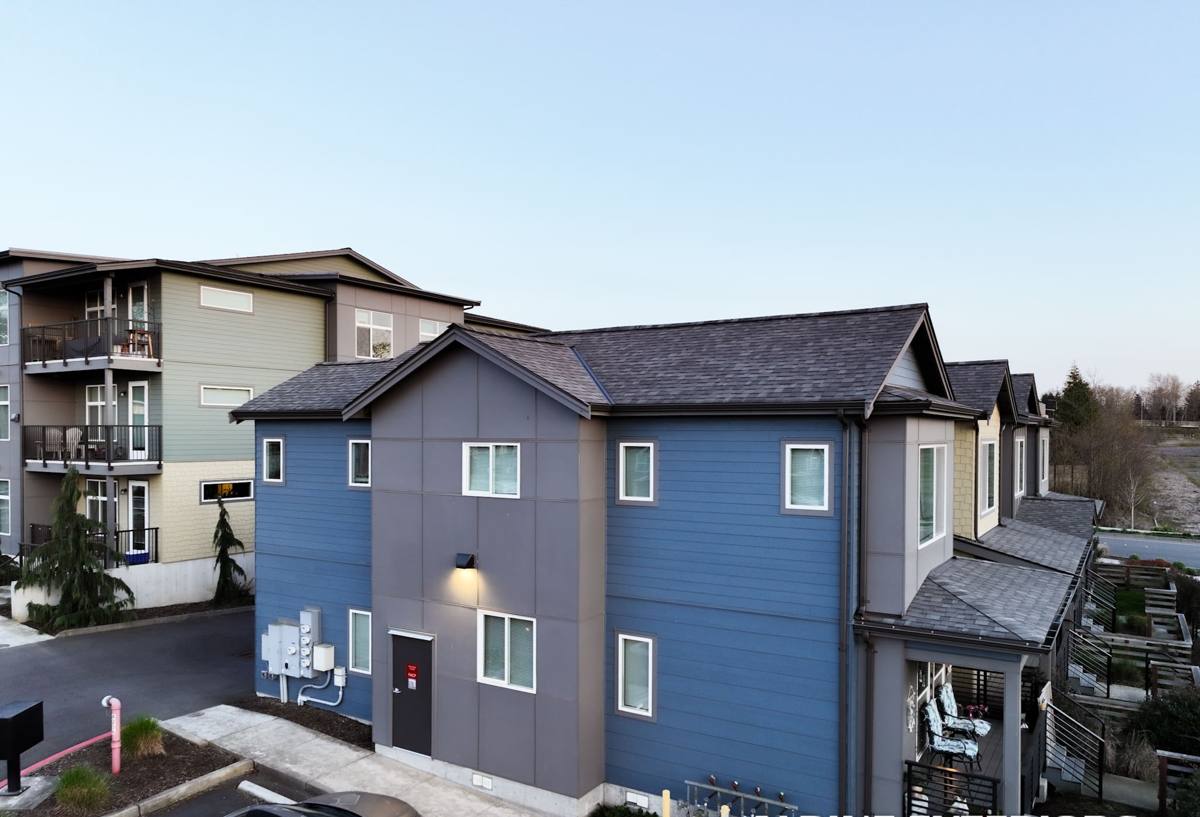
What "Correct" Looks Like for a Siding Replacement Here
Behind the Siding Matters as Much as the Siding Itself
Most siding failures we get called out to inspect in this area aren't failures of the siding material — they're failures of what's underneath it. A proper replacement starts with a full tear-off to bare sheathing so we can actually see the condition of the wall, not just the face of the old siding. From there:
- Any water-damaged or rotted sheathing gets cut out and replaced — never covered over
- A new weather-resistant barrier is installed with correct shingle-style lapping, top over bottom, so gravity moves water out and down instead of behind it
- Flashing is integrated at every window, door, deck ledger, and roof-to-wall intersection — this is the single most common place we find water intrusion on older Edison homes
- Fastening follows the manufacturer's schedule for this climate zone, not a shortcut pattern
- Proper clearances are kept at grade, decks, and roof lines so the new siding isn't sitting in standing moisture from day one
Skip any one of those steps and it doesn't matter how good the siding product is — you've built the same failure back into the wall.
Ventilation and Drainage Planes
In a marine climate like this, a wall system needs somewhere for incidental moisture to go. We build in a drainage plane so that any water that does get past the siding face — from wind-driven rain, ice, or condensation — has a path down and out rather than sitting against the sheathing. This is a detail that's easy to skip and impossible to see once the siding is up, which is exactly why it's worth asking your contractor about directly before work starts.
Salt Air, Rain, and Moss: Three Separate Problems, One Wall
| Climate factor | What it does to siding | What the replacement needs |
|---|---|---|
| Salt-laden air off the bay | Corrodes exposed steel fasteners and cheap trim hardware over time | Corrosion-resistant fastening and trim details, especially on the water-facing elevations |
| Driving, wind-pushed rain | Forces water sideways into laps, seams, and butt joints | Correct overlap, sealed joints where specified, and a continuous weather-resistant barrier |
| Long moss season on shaded walls | Holds moisture against the surface for extended periods, accelerating rot in wood-based products | Siding material that doesn't feed moss the way wood fiber can, plus attention to shade/airflow at install |
Why We Install James Hardie Fiber Cement — and Nothing Else
We're a Hardie-only siding crew, and Edison's climate is a good illustration of why. We don't install vinyl, LP SmartSide, Cemplank, Allura, or primed wood siding, and it's not because those products don't have a place in the market — it's because after years of doing exterior work in Skagit County's salt air and rain, we standardized on the one product line that holds up here without asking the homeowner to babysit it.
How Hardie Compares in This Climate
| Product | How it holds up to salt air, rain, and moss |
|---|---|
| James Hardie fiber cement | Non-combustible, dimensionally stable, factory-baked ColorPlus finish resists fading and doesn't feed moss growth the way organic materials can |
| Vinyl | Won't rot, but expands and contracts with temperature swings and can crack or warp; seams are a common entry point for wind-driven rain |
| LP SmartSide / engineered wood | Wood-strand core is vulnerable at cut edges and fastener penetrations if the factory seal is compromised — a real risk in a climate this wet |
| Cedar / primed spruce | Natural material that needs ongoing refinishing to resist moisture; long moss seasons shorten the maintenance interval significantly |
Hardie's HZ5 product line is engineered specifically for climates with freeze-thaw cycling and sustained moisture exposure, which describes Skagit County's marine climate closely. The factory-applied ColorPlus finish means the color and the moisture protection are baked on before the boards ever reach a job site — not brushed on in the field where weather and technique both introduce variables. Combined with a strong transferable warranty, it's the product we're comfortable standing behind on Edison homes long after the crew has moved on to the next job.
Our Process for an Edison Siding Replacement
- On-site assessment — we look at the whole wall system, not just the visible siding, and check for the flashing and moisture issues that are common in this area
- Written scope — you get a clear plan covering tear-off, sheathing repair (if needed), weather barrier, flashing details, and the Hardie product and color selected
- Tear-off and inspection — old siding comes off, sheathing is inspected and repaired before anything new goes up
- Weather-resistant barrier and flashing — installed and lapped correctly at every penetration and transition
- Hardie installation — installed to manufacturer fastening specs, with attention to clearances at grade, decks, and rooflines
- Final walkthrough — we go over the finished work with you before calling the job complete
Signs Your Edison Home Needs Siding Replacement, Not Just a Repair
- Soft or spongy spots when you press on the siding, especially on north- or west-facing walls
- Persistent moss or dark staining that comes back within a season of cleaning
- Paint that's bubbling, peeling, or won't hold regardless of how often it's redone
- Visible gaps, warping, or cracked boards at corners and butt joints
- Rusted or corroded fasteners and trim visible from the ground
- Rising energy bills that point to a wall system no longer sealing the way it should
What Drives Cost on a Siding Replacement Here
| Cost factor | Why it matters in Edison |
|---|---|
| Sheathing condition | Homes with hidden moisture damage from long-term moss or flashing failures may need sheathing repair before new siding goes on |
| Wall complexity | Dormers, multiple stories, and cut-up elevations take more time and material to flash and fit correctly |
| Product selection | Hardie's lap, shingle, and panel lines and ColorPlus color options carry different material costs |
| Access and site conditions | Rural lots, setbacks, and staging space affect labor time |
We give straight, itemized estimates rather than a single lump number, so you can see what's driving the price and where there's room to make choices.
Why It Matters That We Already Work This Area
A crew that mainly works drier inland climates can install siding by the book and still get it wrong for Edison, because "by the book" often assumes less sustained moisture exposure than this area actually sees. Knowing how far moss creep tends to travel up a shaded wall, how salt air behaves on exposed hardware near the water, and how driving rain finds weak laps in this specific microclimate isn't something you get from a manual — it comes from doing the work here repeatedly and seeing what holds up and what doesn't. That local track record is a big part of why homeowners in Burlington and the surrounding Skagit County communities call us instead of a crew that's never worked this stretch of coastline before.
Ready to Talk About Your Siding?
If your Edison home is showing any of the wear signs above, or you're just planning ahead, we're happy to take a look and give you a straight, no-pressure assessment. Use the form below to request a free estimate, and we'll walk the property with you and explain exactly what we see.