 Burlington
 Roofing in Blanchard's Salt-Air, High-Moisture Climate
Blanchard sits in a pocket of Skagit County shaped by its closeness to Samish Bay and the lower slopes of Blanchard Mountain. That combination gives homes here a roofing environment that's noticeably harder on materials than what you'd find further inland. Moist air moving off the bay carries salt that settles on exposed surfaces, driving rain comes in sideways during winter storms, and the tree cover and shade from the mountain keep roof surfaces damp long after a storm has passed. That dampness is what feeds moss.
None of this means asphalt shingle roofing is a bad choice for Blanchard — it's still one of the most practical, cost-effective options available, and it performs well here when it's installed correctly for the conditions. The issue isn't the material category, it's whether the installation accounts for what this specific location does to a roof over the course of a Skagit County winter. A shingle roof put on the same way you'd put one on in a dry inland climate will wear faster here. One built for this environment will hold up.
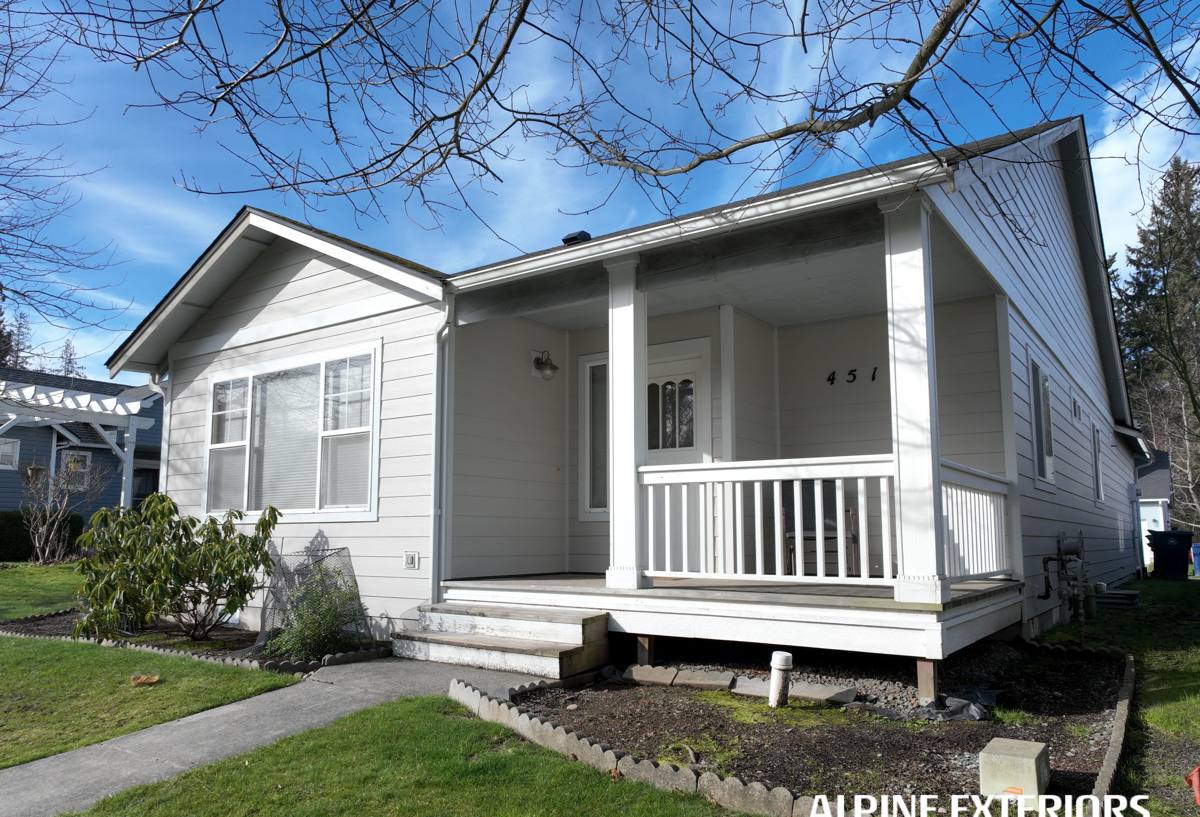
What Asphalt Shingle Roofing Needs to Look Like Here
Underlayment and Water Protection
With the amount of driving rain Blanchard gets, the underlayment layer matters as much as the shingles themselves. We use synthetic underlayment rather than older felt products because it holds up better under prolonged moisture exposure and doesn't degrade as quickly when a roof stays damp for days at a stretch, which happens often in this area between fall and spring. Along eaves, valleys, and anywhere water tends to pool or back up, we install self-adhering ice-and-water membrane. It's cheap insurance against the kind of wind-driven rain that gets up under shingle tabs.
Flashing Details
Most roof leaks don't come from the shingle field failing — they come from flashing that was skipped, undersized, or reused when it should have been replaced. Chimneys, skylights, sidewall intersections, and any roof-to-wall transition need properly formed metal flashing, not just a bead of sealant. In a climate that stays wet as long as Blanchard's does, sealant-only fixes fail faster than they would somewhere drier.
Ventilation
A shingle roof needs balanced intake and exhaust ventilation to let moisture escape from the attic space. Without it, warm moist air condenses against the underside of the roof deck, which rots sheathing from the inside and shortens shingle life from below at the same time salt air and rain are working on it from above. We check ventilation on every Blanchard job — it's frequently the missing piece on older homes in this area that never had it addressed during a prior re-roof.
Signs a Blanchard Roof Needs Attention
Because moss and moisture damage build up gradually, a lot of homeowners don't notice a problem until it's already affecting the roof deck underneath. Here's what we tell people in this area to watch for:
- Moss growth along ridges, in valleys, or on the shaded north-facing slope of the roof
- Granules collecting in gutters or at downspout outlets
- Shingle edges curling up or tabs that look cupped rather than flat
- Dark streaking that isn't moss — often algae staining, which is cosmetic but worth noting
- Soft or spongy spots when walked, which usually means deck damage underneath
- Daylight visible through the roof deck from inside the attic
- Rusted or lifting flashing around chimneys, vents, or skylights
- Interior ceiling stains, especially after a heavy wind-driven storm
Any one of these on its own isn't necessarily an emergency, but moss and granule loss in particular tend to accelerate — a roof that's losing granules is losing UV and weather protection, and that speeds up everything else.
Our Asphalt Shingle Roofing Process
We keep the process straightforward and we walk homeowners through each stage before work starts, not after.
- Inspection and assessment. We get on the roof, check the deck condition, existing ventilation, flashing, and how much moss or moisture damage is present before recommending repair versus full replacement.
- Tear-off and deck check. Old roofing comes off down to the deck so we can actually see what's underneath — this is where we find soft or rotted sheathing that needs to be replaced before new roofing goes on.
- Deck repair. Any damaged sheathing gets replaced. Installing new shingles over a compromised deck just hides a problem that will resurface.
- Underlayment and ice-and-water membrane. Installed to the standard described above, with extra attention to eaves and valleys given how much rain this area sees.
- Flashing. New or properly integrated flashing at every penetration and transition point.
- Ventilation correction. Intake and exhaust balanced as part of the job, not treated as an optional add-on.
- Shingle installation. Installed to manufacturer specification for nailing pattern and exposure — installation errors here are a common cause of premature failure and warranty denial.
- Final walkthrough. We go over the finished roof and the site cleanup with the homeowner before calling the job done.
Shingle Options and What Drives Cost
Asphalt shingles come in a few tiers, and the right choice for a Blanchard home usually comes down to how much moss and moisture resistance you want built in versus straight upfront cost.
| Shingle Type | Typical Lifespan | Moss/Algae Resistance | Best Fit For |
|---|---|---|---|
| 3-tab (standard) | 15–20 years | Lower, unless algae-resistant granules specified | Budget-conscious re-roofs, secondary structures |
| Architectural / dimensional | 25–30 years | Better with algae-resistant (AR) granule option | Most Blanchard homes — better wind and wear performance |
| Premium/designer | 30+ years | Highest with AR granules | Homes prioritizing longevity and appearance |
Beyond the shingle tier itself, a few factors move the price on any given job:
| Cost Factor | Why It Matters |
|---|---|
| Roof pitch and access | Steeper roofs and limited access take longer and require more safety setup |
| Deck condition | Rotted or damaged sheathing found during tear-off adds material and labor |
| Number of penetrations | Each chimney, vent, and skylight needs its own flashing work |
| Layers of existing roofing | Multiple layers add tear-off time and disposal cost |
| Ventilation upgrades | Adding intake or exhaust vents where none existed is additional work |
We give homeowners a real range during the estimate rather than a number pulled out of thin air before we've actually seen the roof.
Moss Prevention Isn't a One-Time Fix
Given how much shade and moisture Blanchard gets from its position near the mountain and the bay, moss prevention has to be an ongoing part of roof care, not a single treatment. Zinc or copper strips installed near the ridge help suppress regrowth as rain carries trace metal down the roof slope, and they're a reasonable addition on shaded roofs. But strips alone don't replace periodic soft washing or manual moss removal — they slow regrowth, they don't stop it entirely. We're upfront with homeowners that a roof in a moss-prone spot like this needs a maintenance rhythm, not a one-and-done approach.
Why It Matters That We Already Work in Blanchard
A roofing crew that regularly works Blanchard and the surrounding Burlington area already knows what this specific stretch of Skagit County does to a roof — the moss pattern on shaded north slopes, how far the salt air off Samish Bay actually reaches, and which older local homes were built without adequate attic ventilation because that wasn't standard practice when they went up. That's the kind of knowledge that shows up in the details of a job — where we pay extra attention to flashing, how we plan ventilation, and what we flag during inspection — rather than something we have to learn on your roof for the first time.
It also matters for accountability. A local crew is easy to reach if a question comes up after the job, and we're not disappearing to the next region over once the roof is done.
Maintenance After Your New Roof Is Installed
A correctly installed asphalt shingle roof in Blanchard still needs periodic attention to get its full lifespan out of the local climate:
- Clear gutters and downspouts at least twice a year so water isn't backing up under the eaves
- Keep overhanging branches trimmed back to reduce shade and debris buildup on the roof surface
- Have moss growth removed before it spreads rather than waiting until it covers a large area
- Schedule a visual inspection after major windstorms to catch lifted or damaged shingles early
- Check attic ventilation periodically, especially if insulation work or other renovations have been done since installation
None of this is complicated, but skipping it is one of the most common reasons a roof that should last 25-30 years starts showing problems well before that in this climate.
If you're in Blanchard and dealing with moss buildup, granule loss, or just want an honest read on where your roof stands, we're happy to take a look. We offer free, no-pressure estimates — use the form below to get started.