 Burlington
 Composite Decking in Bow: Built for What Skagit County Actually Throws at It
Bow sits close enough to Samish Bay and the open water of Skagit County that homes here deal with a different kind of weather load than a deck fifty miles inland. Salt-laden air moves in off the water, rain comes in sideways more often than straight down, and the shoulder seasons stay damp long enough that moss gets a real foothold on anything that doesn't drain or dry properly. A deck built without those conditions in mind will show it within a few seasons — not with a dramatic failure, but with the slow stuff: soft spots, gray streaking, slick boards, and hardware that stains before it should.
Composite decking, installed correctly, handles that environment better than most alternatives. But "composite" isn't one product, and "installed correctly" isn't automatic — the framing underneath, the fastening pattern, and the flashing details matter as much as the boards themselves. This page covers what a composite deck actually needs to hold up in Bow, what our process looks like, and why local experience changes the outcome.
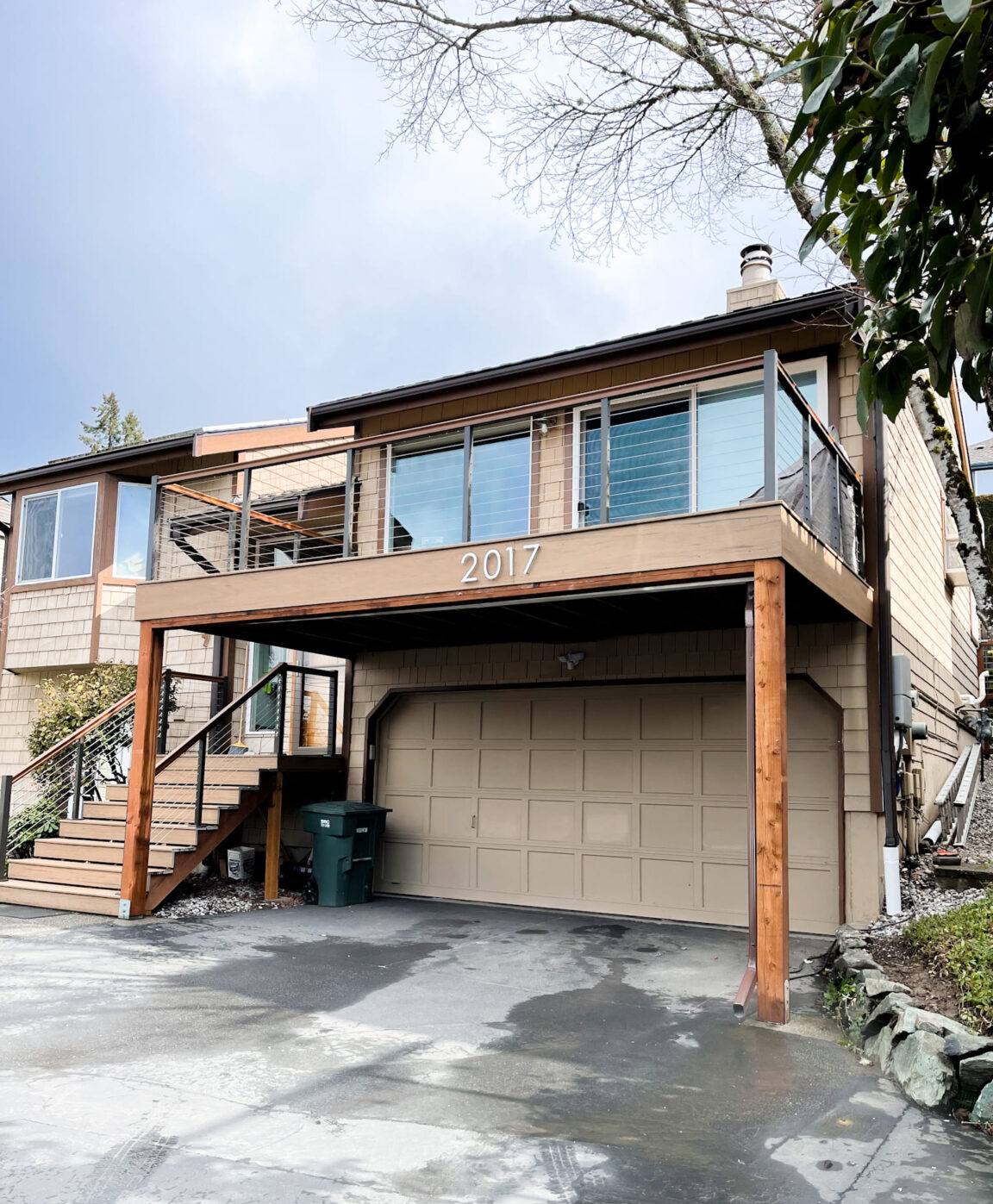
What Bow's Climate Does to a Deck Over Time
Three conditions do most of the damage locally, and they compound each other:
- Salt air: airborne salt accelerates corrosion on any exposed metal fastener, bracket, or ledger connector. It also settles into porous surfaces and holds moisture longer than it would inland.
- Driving rain: wind-driven rain gets pushed under rail caps, into end grain, and behind ledger boards where a standard flashing detail might get away with less protection in a calmer climate.
- Long moss season: shaded decks, north-facing decks, and anything under tree cover stay damp for extended stretches from fall through spring. Moss and algae aren't just cosmetic — they hold moisture against the board surface and make walking surfaces genuinely slick.
None of these are dramatic on their own. Together, over several winters, they're exactly what separates a deck that still looks and performs well at year ten from one that's already showing rot at the ledger or fastener corrosion by year five.
Why Composite Makes Sense for This Particular Spot
We install wood, composite, and PVC decking depending on the site and the homeowner's priorities, and we're upfront that composite isn't automatically the right call for every project. But for a coastal-influenced, high-moisture location like Bow, composite earns its higher upfront cost in a few specific ways:
It doesn't absorb water into the board the way wood fibers do, so it isn't feeding rot from the inside the way a wood deck can once the sealant film wears thin. It doesn't need annual staining or sealing to keep performing, which matters a lot when the maintenance window between rainy stretches is short. And modern capped composite boards resist the surface staining that salt air and organic debris cause on wood — though "resist" doesn't mean immune, which we'll get into below.
The trade-off is real and worth saying plainly: composite costs more upfront than pressure-treated wood, it can get warm underfoot in direct summer sun (less of an issue here than in drier climates), and if it's ever damaged, you're usually replacing a board rather than sanding and refinishing a spot. For most Bow homeowners planning to stay in the house long-term, the lower maintenance burden outweighs those trade-offs.
What a Correct Composite Installation Actually Involves
Framing and Ground Clearance
Composite boards are only as good as what's underneath them. In a damp climate, we pay close attention to joist spacing (often tighter than the manufacturer's minimum spec for coastal or shaded sites), proper ground clearance for airflow, and use of moisture-resistant or coated framing lumber. Composite decking doesn't rot, but the joists under it still can if airflow underneath is blocked by poor grading or tight skirting.
Fastening and Hardware
Given the salt air, we use stainless steel or coated fasteners rated for coastal exposure rather than standard hardware that can corrode and streak the board surface within a couple of seasons. Hidden fastener systems are used where the product line supports them, both for appearance and because fewer surface penetrations means fewer points where water can sit.
Flashing and Ledger Attachment
Where the deck attaches to the house, the ledger board and flashing detail is the single most common failure point we see on older decks in this area — not the decking material itself. Driving rain finds gaps in a poorly flashed ledger connection and gets behind the siding, which is a much bigger and more expensive problem than a worn deck board. We flash this connection to shed water away from the house wall, not just at the ledger, but at any point where rail posts or structures penetrate the decking surface.
Board Spacing and Drainage
Gapping between boards is set to allow water to drain through rather than pool, and we account for the wetter local climate by not tightening that gap purely for appearance. A deck that looks slightly better on a dry day but drains poorly all winter is the wrong trade-off here.
Composite vs. Wood vs. PVC: How They Compare in This Climate
| Factor | Composite | Pressure-Treated Wood | PVC/Cellular |
|---|---|---|---|
| Moisture resistance | Strong — capped boards shed water well | Moderate — depends on ongoing sealing | Excellent — fully synthetic core |
| Moss/algae resistance | Good, but still needs periodic cleaning in shaded spots | Poor — porous surface holds moisture | Good, similar cleaning needs to composite |
| Upfront cost | Mid-to-high | Lowest | Highest |
| Ongoing maintenance | Occasional wash, no staining | Annual sealing/staining recommended | Occasional wash |
| Fastener/hardware sensitivity | Moderate — requires coastal-rated hardware | Low tolerance for wrong fasteners (tannin staining) | Low |
| Typical lifespan here | 25-30+ years with correct install | 10-15 years before major repair/replace | 30+ years |
PVC often outperforms composite on pure moisture resistance, but it's a different look and feel underfoot, and costs more. For most Bow projects, capped composite is the practical middle ground — significantly more durable than wood in this climate without the full PVC price jump.
Our Process for a Bow Composite Deck Project
The process is straightforward, but we don't skip steps just because a homeowner is eager to get started:
- On-site assessment: we look at sun/shade exposure, drainage, existing framing condition (if replacing an old deck), and how exposed the site is to wind-driven rain off the water.
- Product and layout discussion: we talk through board options, color (darker boards show less streaking from organic debris but run warmer), and rail systems, matching the recommendation to how the deck will actually be used.
- Written estimate: scope, materials, and timeline in writing before any work starts — no verbal-only agreements.
- Demo and framing (if needed): old decking removed, framing inspected and repaired or upgraded as needed, especially at the ledger connection.
- Flashing and structural work: the parts that don't show but determine whether the deck lasts.
- Decking, rail, and hardware installation: following manufacturer spec plus our own adjustments for local exposure.
- Final walkthrough: we go over basic care with the homeowner before we consider the job done.
Living with a Composite Deck Through a Skagit County Winter
Composite is low-maintenance, not no-maintenance. In a moss-prone environment like Bow, a couple of habits go a long way:
- Sweep debris (fir needles, leaves, seed pods) off the deck regularly in fall — trapped organic matter under debris is what feeds moss and algae growth on any decking material.
- Rinse the deck a few times a year with plain water, and use a soft-bristle brush with mild soap on shaded or north-facing sections where growth shows up first.
- Check that gaps between boards stay clear so water keeps draining through rather than sitting on the surface.
- Inspect rail post connections and any exposed hardware once a year for early corrosion, especially after a stretch of storms.
- Keep gutters and downspouts near the deck clear so runoff isn't dumping extra water directly onto or under the structure.
Why It Matters That We Already Work This Area
A crew that mostly installs decks in drier inland climates will often use standard fastener specs, standard flashing details, and standard board gapping straight out of the manufacturer's general guidelines — which are written for a wide range of conditions, not specifically for a Skagit County site exposed to salt air and driving rain. That's how you end up with corroded hardware in year three or a ledger leak that shows up as siding damage two years after the deck was "finished."
Working in Bow and the surrounding Burlington area regularly means we've seen which details actually matter locally versus which ones are just manufacturer boilerplate. That shows up in fastener selection, in how tight we cut board gaps, and in where we spend extra time on flashing that a generalist crew might treat as optional.
Get a Straight Answer on What Your Bow Deck Project Needs
Every property is a little different — sun exposure, tree cover, proximity to the water, and the condition of any existing structure all change the right approach. If you're planning a new composite deck or replacing an aging one in Bow, we're happy to take a look and give you a clear, no-pressure estimate based on what your specific site actually needs. Use the form below to get started.