 Burlington
 Why Bow's Climate Is Hard on Siding
Bow sits close enough to Samish Bay and Padilla Bay that salt-laden air is a constant companion, not an occasional visitor. That air carries fine salt particles that settle on exterior surfaces, and combined with the driving rain that comes off the water during fall and winter storms, it creates conditions that push ordinary siding materials past their limits. Add in a moss season that, in this part of Skagit County, can run nine months out of the year on shaded north and west walls, and you have a climate that punishes any siding product with a weak point in its finish, its fasteners, or its water management.
None of this is unique to Bow in a dramatic sense — it's the same maritime Pacific Northwest pattern found across Skagit County — but Bow's proximity to open water intensifies it. Homes here see more wind-driven rain hitting walls at an angle, more salt exposure on fasteners and trim, and more sustained dampness feeding moss and algae growth than homes further inland around Burlington proper. A siding installation done for Bow needs to account for all three at once.
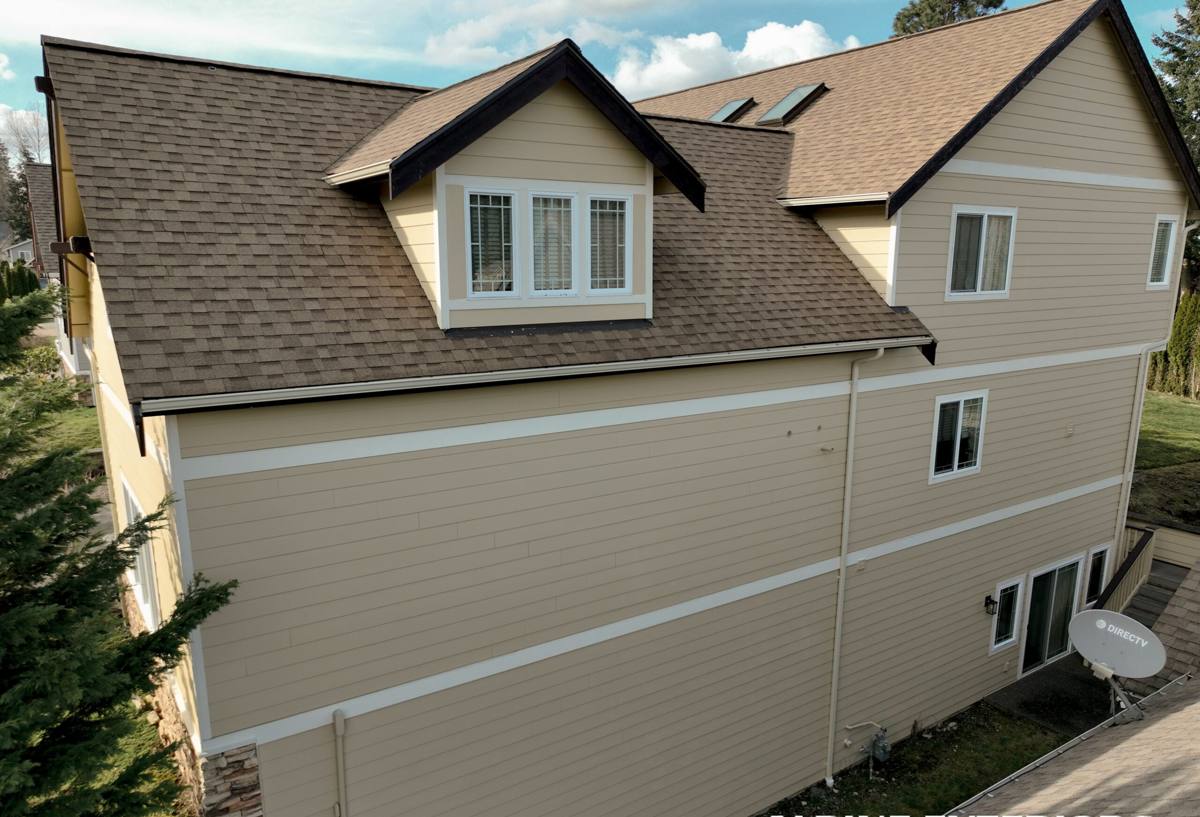
What a Correct Installation Actually Involves
Siding is a system, not a single layer. The board or panel you see is the last of several components working together, and in a climate like Bow's, every one of those components matters.
The Water Management Layer
Behind the siding, a correctly installed water-resistive barrier (housewrap or building paper) has to be lapped properly, taped at seams, and integrated with window and door flashing so that any water that gets past the siding — and in driving rain, some always does — drains back out instead of soaking into the sheathing.
The Rainscreen Gap
In high wind-driven-rain zones like Bow, a small air gap (a rainscreen) between the back of the siding and the water-resistive barrier lets any moisture that penetrates the cladding dry out instead of sitting against the wall. This is one of the details that separates a durable installation from one that looks fine for a few years and then starts showing rot or paint failure at the seams.
Flashing and Trim
Every window, door, deck ledger, and roof-to-wall transition is a place water wants to get in. Flashing has to be installed in the correct shingle-lap order — each piece overlapping the one below it — so gravity moves water outward and down, never into the wall cavity.
Fastening
James Hardie specifies fastener type, spacing, and placement based on the local wind exposure zone. Bow's open exposure to water means fastening details matter more here than in a sheltered inland lot, and it's not a place to cut corners with whatever nail happens to be on the truck.
Why We Only Install James Hardie Fiber Cement
We don't install LP SmartSide, vinyl, Cemplank, Allura, primed spruce, or cedar. That's a deliberate standard, not a marketing line, and it comes down to how those products perform over time in exactly the conditions Bow deals with.
Vinyl expands and contracts significantly with temperature swings and can crack or warp under sustained wind loading — a real factor on exposed lots near the water. Wood-based products (cedar, primed spruce, and engineered wood siding like LP SmartSide) depend entirely on their finish and edge-sealing to keep moisture out; once that finish is compromised by driving rain and constant dampness, wood fiber is exactly the kind of material that swells, rots, and feeds moss and mildew. Other fiber cement brands may be reasonable products, but we've standardized on one manufacturer, one factory finish system, and one set of installation specifications so that every job we do is consistent and backed by a single warranty structure we understand completely.
James Hardie fiber cement is non-combustible, doesn't expand and contract the way vinyl does, and holds its factory-applied ColorPlus finish far longer than field-applied paint on wood products. It's not immune to moss or salt exposure — nothing sitting outside in Bow is — but it tolerates sustained moisture without the rot risk that wood-based sidings carry, and it holds paint and caulk lines better than vinyl over the long haul.
Choosing the Right Hardie Product Line for Bow
James Hardie makes climate-engineered HZ product lines, and the version sold in the Pacific Northwest (HZ5) is formulated for regions with sustained moisture exposure rather than dry, hot climates. For Bow specifically, that HZ5 formulation is the baseline — not an upgrade — because of how much of the year this area spends wet.
| Product | Typical Use | Why It Fits Bow |
|---|---|---|
| HardiePlank lap siding | Primary wall cladding | Most common profile here; handles wind-driven rain well with proper lap and flashing |
| HardiePanel vertical siding | Accent walls, gables, modern facades | Clean lines that hold up to coastal wind exposure |
| HardieTrim boards | Corners, window and door trim, fascia | Resists the moisture wicking that rots wood trim near the water |
| HardieShingle panels | Accent gables, Craftsman-style detailing | Decorative texture without the rot risk of real wood shingle |
Our Installation Process, Step by Step
- On-site assessment — we walk the exterior, check current siding condition, sheathing where accessible, and note exposure direction (which walls take the most wind-driven rain and shade-driven moss).
- Removal and sheathing check — old siding comes off and we inspect the sheathing underneath for rot or soft spots before anything new goes up.
- Water-resistive barrier and flashing — housewrap, taped seams, and flashing at every penetration, installed in proper shingle-lap order.
- Rainscreen installation — furring or a rainscreen product creates the drainage gap behind the siding.
- Hardie installation — boards or panels installed to manufacturer fastening spec for this wind exposure zone, with correct joint treatment and caulking.
- Trim, caulk, and final finish check — corners, trim boards, and paint touch-up at cut edges so factory finish integrity is maintained everywhere.
- Walkthrough — we go over the finished exterior with you before calling the job done.
Common Mistakes We See on Older Bow-Area Homes
When we tear off older siding in this area, a handful of problems show up again and again:
- Missing or reversed flashing laps at windows, letting water track behind the siding instead of out over it
- No rainscreen gap, leaving siding sitting directly against a damp barrier with nowhere to dry
- Wood trim with failed paint left unaddressed for years, leading to soft, rotted corners
- Fasteners driven too high or too low on lap siding, causing splitting or loosening over time
- Caulk used to patch gaps that should have been solved with proper flashing instead
Signs Your Bow Home May Need New Siding
- Persistent moss or algae staining that returns within weeks of cleaning
- Soft spots, bubbling, or visible warping, especially on north and west-facing walls
- Paint that's peeling or alligatoring faster than a normal repaint cycle would suggest
- Visible gaps at corners, trim, or lap joints
- A musty smell or visible staining on interior walls that share an exterior wall
Cost Factors for a Bow Siding Project
| Factor | Why It Affects Cost |
|---|---|
| Home size and wall complexity | More corners, gables, and dormers mean more cutting, trim, and flashing detail |
| Current siding removal | Tear-off and disposal of old material adds labor beyond a simple install |
| Sheathing repair | Rot found during tear-off has to be addressed before new siding goes on |
| Product line and profile | Lap width, panel style, and trim choices vary in material cost |
| Access and site conditions | Steep lots, limited driveway access, or tall walls affect scaffolding and labor time |
We give exact numbers only after seeing the home in person — anyone quoting a firm price over the phone for a job like this hasn't actually looked at your walls.
Maintenance in a Salt Air, High-Moss Climate
Hardie siding is low-maintenance compared to wood or vinyl, but "low-maintenance" doesn't mean "no maintenance" in a place like Bow. A yearly rinse-down to clear salt residue and early moss growth, along with a periodic check of caulk lines at trim and window flashing, goes a long way toward protecting the factory finish and catching small issues before they become expensive ones.
Why a Crew That Already Works in Bow Matters
Siding installation isn't just a product — it's a set of judgment calls made on-site: how much rainscreen gap a particular wall needs, which flashing detail handles a specific window setback, how fastener spacing should adjust for a wall that takes the brunt of storms coming off the water. A crew that's done this work throughout Skagit County and specifically around Bow has already made those calls on homes with the same exposure, the same moss patterns, and the same driving-rain angles yours deals with. That local repetition is what keeps a siding job from becoming a five-year problem instead of a decades-long solution.
If you're considering new siding for a home in Bow, we're happy to take a look and give you a straightforward, no-pressure estimate — just fill out the form below.