 Burlington
 Guemes Island Homes Face a Different Set of Problems Than Mainland Burlington
Guemes Island sits out in the salt water north of Skagit County, reachable only by ferry from Anacortes, and that isolation shapes everything about how a home ages there. Wind off the water carries salt spray onto siding, roofs, and trim year-round. Rain comes in sideways more often than it falls straight down, especially on the west- and south-facing walls that catch weather off the Strait. And because so many island lots sit under fir and cedar canopy or tucked into shaded draws, moisture lingers on north walls and under eaves long after a storm has passed. Add all that up and you get a siding environment that is measurably harder on a home than a typical inland Burlington or Mount Vernon lot.
Homeowners on the island often discover this the hard way — a wall that looked fine gets soft trim boards, peeling paint, or a green film that keeps coming back no matter how often it's cleaned. None of that is a mystery. It's what happens when a siding material isn't built for salt air, sustained moisture, and a long moss season, or when it's installed without the detailing that this exposure actually requires.
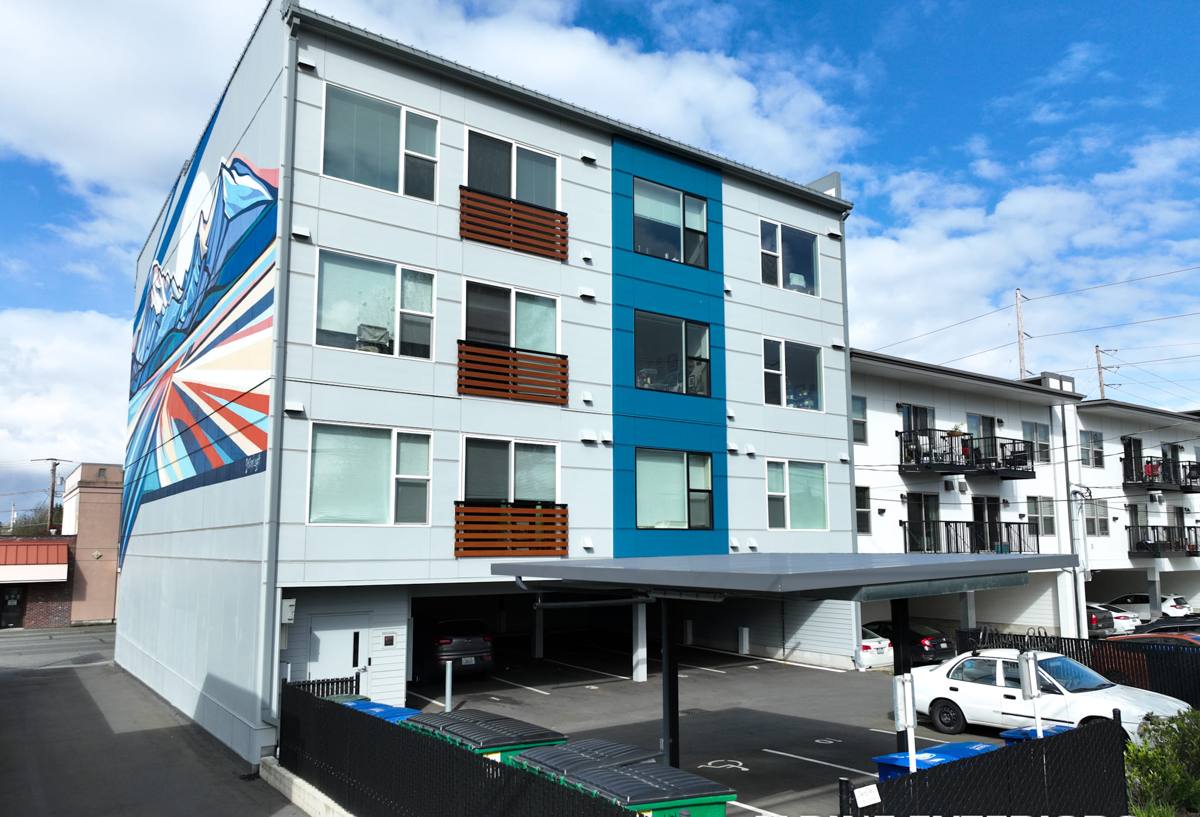
What Salt Air, Driving Rain, and Moss Actually Do to a Wall
These three conditions don't act alone — they compound each other, and understanding how helps explain why some siding choices hold up on Guemes Island and others don't.
Salt Air
Airborne salt is corrosive to exposed metal fasteners, flashing, and trim hardware, and it accelerates the breakdown of paint films on wood and wood-composite products. Over years, salt exposure dries out and embrittles organic siding materials faster than the same product would age even a few miles inland.
Driving Rain
Wind-driven rain doesn't just wet a wall — it forces water sideways and upward at laps, seams, and penetrations that were only ever designed to shed water falling straight down. This is where poor flashing detail or the wrong caulking approach turns a minor design gap into a real leak path.
Moss and Mildew
Shaded, damp walls on wooded island lots stay wet longer between rain events, which is exactly the environment moss and mildew need to take hold. On porous or organic siding materials, that sustained moisture also feeds rot at the surface and, eventually, at the substrate underneath.
Why We Only Install James Hardie Fiber Cement
We've made a deliberate decision as a company to install James Hardie fiber cement siding exclusively — not LP SmartSide, not vinyl, not Cemplank or Allura, not primed spruce or cedar. That's not a marketing position; it's a standard we hold because of what we've seen exposure like Guemes Island's do to alternatives over time.
Fiber cement is a blend of cement, sand, and cellulose fibers, which makes it non-combustible and dimensionally stable in a way wood-based and vinyl products can't match. It doesn't feed moss the way wood fiber does, it doesn't warp or soften when it takes on moisture the way engineered wood can, and it doesn't become brittle in cold, salt-laden air the way vinyl can over a long service life. James Hardie backs its siding with a factory-applied ColorPlus finish, which is baked on and warranted separately from the substrate — that matters directly for salt air exposure, because a factory finish resists fading and chalking far better than field-applied paint has to work against wind-driven salt and UV.
Hardie also builds specific product lines engineered for regional climate zones (their HZ5 product line is formulated for the Pacific Northwest's wet, moderate-freeze conditions), and the company backs correctly installed siding with a strong transferable warranty. For a home that's going to sit exposed to Rosario Strait weather for the next several decades, that combination of non-combustible material, factory finish, and manufacturer accountability is why we don't offer alternatives.
How Fiber Cement Compares for Island Exposure
| Material | Salt Air Resistance | Moisture/Moss Behavior | Long-Term Maintenance |
|---|---|---|---|
| James Hardie Fiber Cement | Strong — non-combustible, stable substrate | Doesn't feed moss; sheds water well when detailed correctly | Occasional wash; factory finish holds color |
| Vinyl Siding | Can become brittle over time in cold, salty air | Won't rot, but traps moisture behind panels if not vented | Low, but panels can warp, fade, or crack |
| LP SmartSide / Engineered Wood | Moderate — treated wood strand product | Vulnerable at cut edges and joints if moisture gets in | Requires vigilant caulking and touch-up paint |
| Cedar / Primed Spruce | Weak — organic material, absorbs salt moisture | Feeds moss and mildew readily in shaded, damp spots | Regular staining, sealing, and moss treatment |
This isn't a claim that other products are defective — vinyl and engineered wood both have legitimate uses in the right setting. It's that for the specific combination of salt spray, driving rain, and a long wet season that Guemes Island homes deal with, we think fiber cement is the more honest long-term choice, and it's the only material we're willing to warranty our workmanship on.
What Correct Installation Looks Like Here
Fiber cement's performance depends heavily on installation detail — this is a product that rewards correct technique and punishes shortcuts, especially in a driving-rain environment. On Guemes Island projects, we pay particular attention to:
- Rainscreen gap: A ventilated air gap behind the siding lets any moisture that does get past the cladding drain and dry out instead of sitting against the wall assembly.
- Flashing at every penetration: Windows, doors, hose bibs, and vents all need proper head flashing and kick-out flashing so wind-driven rain can't find its way behind the siding.
- Clearance from grade and roof lines: Maintaining Hardie's specified clearance above grade, decks, and roofing keeps splash-back and standing moisture away from the bottom edge of the siding, which is where rot problems most often start.
- Fastener placement and corrosion-resistant hardware: Salt air is hard on fasteners; correct nail or screw placement per Hardie's fastening schedule, using corrosion-resistant hardware, avoids the loosened or streaking fasteners that show up on improperly fastened jobs.
- Factory-cut edges wherever possible: Field cuts expose the substrate and require proper sealing; minimizing field cuts and sealing the ones we do make protects the cut edge from moisture intrusion.
Skipping any one of these doesn't usually cause an obvious problem in year one. It shows up three, five, or ten years later as a soft spot, a stain, or a caulk joint that's failed — exactly the kind of deferred problem that's expensive to trace back to an installation shortcut.
Our Process for a Guemes Island Project
Working on the island adds a logistics layer that a mainland Burlington job doesn't have, and we plan around it rather than treating it as an afterthought.
- On-site assessment: We walk the exterior, note exposure direction, existing moisture damage, and any trim or flashing that needs attention beyond the siding itself.
- Material takeoff and staging: Because every trip to the island runs on ferry scheduling, we order and stage materials in full before mobilizing, so the crew isn't making return runs for missing pieces.
- Crew scheduling around ferry capacity: We build the job timeline around ferry sailings and vehicle space rather than assuming mainland-style flexibility, so the schedule we give you is realistic.
- Installation to Hardie's fastening and clearance specifications: Rainscreen, flashing, fastening, and clearances are handled to manufacturer spec, not shortcuts.
- Final walkthrough: We review the finished work with you on-site before we consider the job complete.
What Drives Cost on an Island Job
| Factor | Why It Matters on Guemes Island |
|---|---|
| Ferry access and vehicle space | Crew time and material hauling both run on ferry scheduling, which affects mobilization efficiency |
| Existing damage behind old siding | Wet, wooded lots sometimes hide sheathing or trim rot that isn't visible until removal |
| Home exposure and elevation | Waterfront-facing walls exposed to full wind and salt spray need more careful flashing and detailing than sheltered walls |
| Trim and accessory scope | Fascia, corner boards, and soffit work are often bundled with siding since they take the same weather exposure |
| Existing siding removal | Tear-off and disposal costs vary with the material being removed and how much substrate repair it reveals |
We don't quote broad ranges without seeing the home — exposure, existing condition, and access vary too much from lot to lot on the island for that to be honest. What we can tell you upfront is that we build the ferry logistics into our estimate rather than surprising you with it later.
What to Expect After Installation
Correctly installed James Hardie siding is genuinely low-maintenance compared to the alternatives, but "low-maintenance" isn't "no-maintenance," especially in this climate. A reasonable annual routine looks like:
- Rinse the exterior with a garden hose or low-pressure wash once a year to clear salt residue and organic buildup before it takes hold.
- Walk the perimeter after major windstorms and check for any loose trim, gutters, or flashing that could let water behind the siding.
- Keep vegetation and tree canopy trimmed back from north- and shade-facing walls to reduce the moisture and shade that feed moss growth.
- Check caulked joints around windows and penetrations every couple of years and re-caulk any that have cracked or pulled away.
- Address any impact damage or chips in the finish promptly — Hardie's touch-up products keep small areas protected before moisture can get to the substrate.
Why a Crew That Already Works Guemes Island Matters
Siding installation is unforgiving of guesswork, and an island job adds a layer most contractors never have to think through: getting the right crew, the right materials, and the right equipment across on the ferry, on schedule, without wasted trips. A crew that hasn't worked the island before will learn these lessons on your project — at your expense, in delayed timelines or missed details. We've built our process around the realities of Guemes Island access, and we know which walls on an island home take the worst of the wind and salt before we ever pull a tape measure, because we've seen the pattern on other homes out there.
That local familiarity, paired with installing a single product line to manufacturer spec rather than juggling several materials' different requirements, is what lets us stand behind the work rather than hoping it holds up.
If you're planning a siding project on Guemes Island, we're happy to walk the exterior with you and talk through what your home actually needs. Reach out for a free, no-pressure estimate using the form below.