 Burlington
 Fir Island's Climate Is Harder on Siding Than Most People Realize
Fir Island sits out in the Skagit River delta, low and flat, with open exposure to Skagit Bay and the marine air that moves in off Puget Sound. Homes here don't get the benefit of hills, tree lines, or urban windbreaks the way a lot of inland Skagit County properties do. That means whatever the weather is doing, your siding feels it directly — full force, with nothing to slow it down first.
Three things define this environment for exterior materials: salt-laden air drifting in from the bay, driving rain that hits siding at an angle instead of falling straight down, and a moss and algae season that can run most of the year in the Pacific Northwest. Any one of these will shorten the life of the wrong siding product. Together, they're exactly the conditions that separate siding that holds up for decades from siding that starts failing in year eight or ten.
Salt Air and Moisture Don't Just Affect Coastal Homes
You don't have to be waterfront to feel the effects of salt air. It travels on wind, and Fir Island's open, low-lying geography means there's little to stop it before it reaches a home's siding, trim, and fasteners. Salt air accelerates corrosion in metal components, breaks down poor-quality caulks and sealants faster, and adds to the general moisture load a home's exterior has to manage year-round.
Driving Rain Finds Every Weak Point
Wind-driven rain doesn't behave like a normal shower. It pushes water sideways and upward into laps, seams, and trim joints that were never designed to handle water moving in that direction. On an exposed site like Fir Island, this is a near-constant reality for a good chunk of the year, not an occasional storm event. Siding systems and installation details that work fine in a sheltered neighborhood can fail here simply because the water is coming from more directions, more often.
A Long Moss Season Means Constant Moisture Contact
Skagit County's mild, wet climate supports moss and algae growth for most of the year, and low, open, damp sites like Fir Island tend to see it worse than drier, more elevated ground. Moss holds moisture directly against a wall assembly, and that sustained dampness is what actually causes damage — not the moss itself, but what it traps against the siding and how long it stays wet.
What a Correct Siding Replacement Actually Involves
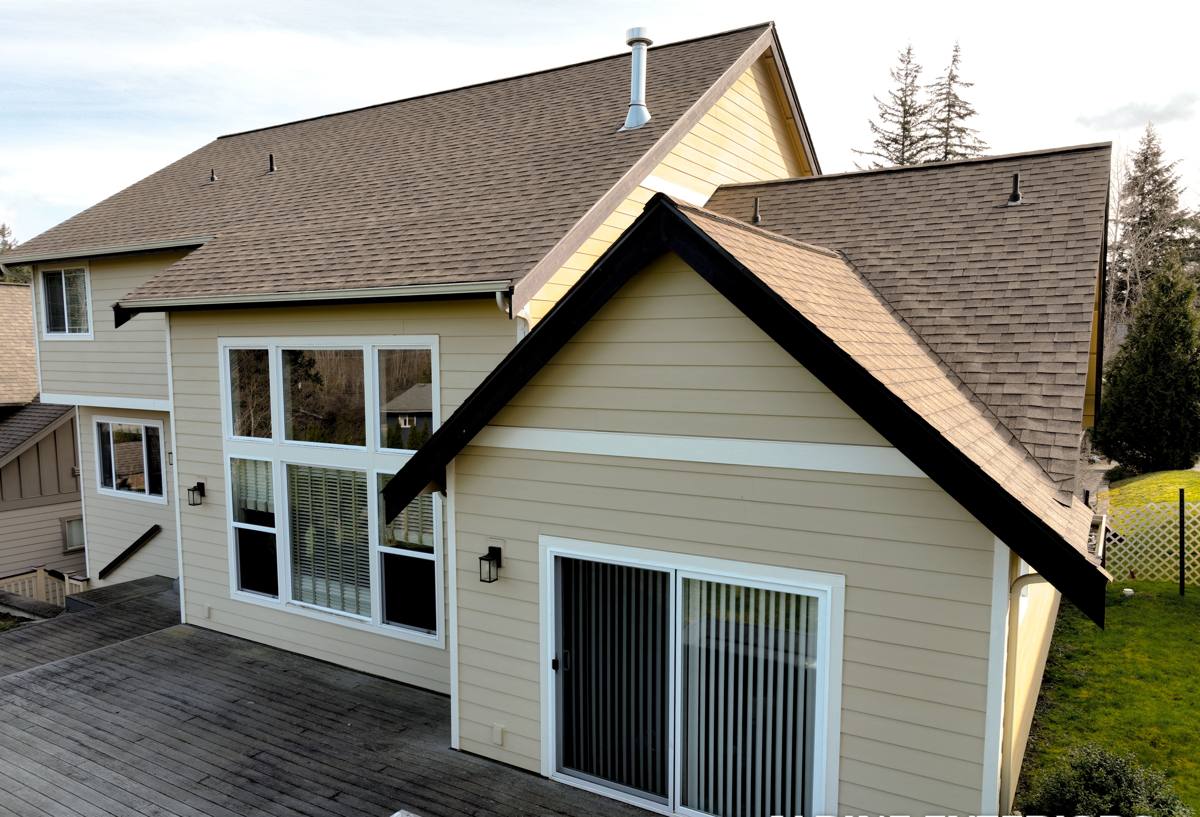
Replacing siding on a Fir Island home is not a cosmetic job. If the water management details underneath the new siding aren't done correctly, the new siding will fail for the same reasons the old siding did — just on a slower timeline. A proper replacement addresses the whole wall assembly, not just what's visible from the curb.
- Full tear-off and inspection: Old siding comes off so the sheathing underneath can be checked for rot, soft spots, and hidden moisture damage before anything new goes up.
- Sheathing repair where needed: Any compromised sheathing gets replaced, not covered over. Installing new siding over damaged sheathing just hides a problem that will keep getting worse.
- A proper weather-resistive barrier: A correctly lapped and sealed housewrap or building paper is the layer that actually keeps bulk water out of the wall — the siding is the first line of defense, not the only one.
- Flashing at every penetration: Windows, doors, hose bibs, vents, and any other wall penetration need correct flashing details so wind-driven rain can't work its way behind the siding.
- Rainscreen or drainage gap where appropriate: On exposed, wet sites, a small air gap behind the siding lets any moisture that does get in dry out instead of sitting against the wall.
- Correct fastening and joint treatment: Fastener pattern, caulking at butt joints, and trim details all matter more in high-exposure conditions than in a sheltered yard.
Why We Install Only James Hardie Fiber Cement
We standardized on James Hardie fiber cement siding for every job we take on, including here on Fir Island, and we don't install vinyl, LP SmartSide, Cemplank, Allura, primed spruce, or cedar. That's not a marketing position — it's a decision based on what actually holds up in this specific climate, year after year.
Non-Combustible Material
James Hardie siding is fiber cement, which is non-combustible. That's a meaningful difference from wood-based or vinyl products, particularly for homeowners thinking about long-term risk, not just day-one appearance.
Engineered for Pacific Northwest Conditions
Hardie's HZ5 product line is climate-engineered for regions like ours — places that deal with sustained moisture, temperature swings, and heavy rain rather than dry heat. That engineering shows up in how the product handles moisture exposure over time, which is exactly the stress Fir Island homes face more than most.
ColorPlus Factory Finish
Hardie's ColorPlus finish is baked on at the factory under controlled conditions, rather than field-applied paint that has to cure in whatever weather shows up that week. A factory finish resists fading and chipping better than most field-applied coatings, which matters in a climate where a home's exterior rarely gets a long dry stretch to properly cure fresh paint.
A Warranty That Reflects Confidence in the Product
James Hardie backs its siding with a strong, transferable warranty. A warranty is only worth something if the manufacturer stands behind the product in the conditions it's actually installed in — and that's a big part of why we trust it for a site as exposed as Fir Island.
How Fir Island's Conditions Compare Across Siding Materials
| Factor | James Hardie Fiber Cement | Vinyl Siding | Wood / LP SmartSide |
|---|---|---|---|
| Moisture & moss resistance | Engineered for sustained wet climates (HZ5 line) | Doesn't absorb water, but seams and gaps can trap moisture behind it | Wood-based core is more sensitive to prolonged moisture contact |
| Salt air durability | Fiber cement composition holds up well to airborne salt exposure | Can become brittle over time with sun and salt air exposure | Fasteners and finish more prone to accelerated wear near salt air |
| Fire resistance | Non-combustible | Combustible, can melt or warp under heat | Combustible |
| Finish durability | Factory-applied ColorPlus finish resists fading and chipping | Color is through the material but can fade and chalk over time | Field-applied paint or primer requires more frequent recoating |
| Maintenance burden | Periodic washing; no repainting for many years | Low maintenance but prone to cracking and warping with age | Regular repainting and moisture monitoring needed |
| Warranty | Strong, transferable manufacturer warranty | Varies widely by product tier | Varies; often shorter on the finish than the substrate |
Our Process on a Fir Island Home
Every home on Fir Island is a little different depending on age, orientation, and how exposed the site is, but the process we follow stays consistent:
- On-site assessment: We walk the exterior, check current siding condition, and look for signs of trapped moisture, rot, or failed flashing before we ever talk product.
- Moisture and sheathing check: Where we suspect hidden damage, we confirm it before tear-off so there are no surprises mid-project.
- Product and color selection: We walk you through Hardie's lines and ColorPlus palette so the final look matches the home and the neighborhood.
- Full tear-off and prep: Old siding comes off, sheathing is repaired as needed, and the weather-resistive barrier and flashing details go in correctly the first time.
- Installation to manufacturer spec: Fastening, clearances, and joint treatment all follow James Hardie's installation requirements — which is also what keeps the warranty valid.
- Final walkthrough and cleanup: We review the finished work with you and leave the site clean.
Living With Moss and Marine Air After Installation
Correct siding and correct installation dramatically reduce moisture problems, but no siding material makes moss and algae growth disappear entirely in this climate. A few habits go a long way on an exposed site like Fir Island:
- Keep gutters clear so water isn't overflowing and running down the siding face.
- Trim back vegetation and landscaping that keeps a wall shaded and damp longer than it needs to be.
- Rinse siding periodically to keep moss and algae from getting established, especially on north-facing or shaded walls.
- Have caulking and trim joints checked every few years — even good materials rely on sealant details staying intact.
Why It Matters to Hire a Crew That Already Works Fir Island
Siding installation isn't one-size-fits-all, and a crew that mostly works drier, more sheltered sites can miss details that matter on a place like Fir Island. Knowing how hard and how often wind-driven rain hits an exposed wall, how much moisture load a low delta site carries through the winter, and how salt air affects fasteners and finishes over time all changes how a job should be detailed — flashing choices, drainage gap decisions, fastener selection, and where extra attention goes.
A crew that already does this work regularly in Skagit County isn't guessing at how a wall assembly will perform here — they've seen how it plays out over years on homes with the same exposure. That local track record is worth more than a lower bid from a crew unfamiliar with what this specific stretch of the county throws at a house.
Signs Your Fir Island Home May Need Siding Replacement
- Soft, spongy, or bubbling spots when you press on the siding
- Persistent moss or algae staining that comes back quickly after cleaning
- Visible warping, cracking, or separation at seams and joints
- Paint that's peeling or bubbling rather than just fading
- A musty smell or visible staining on interior walls that back up to exterior siding
- Siding that's original to a home over 20-25 years old and hasn't been inspected recently
If you're seeing any of these signs on a Fir Island property, or you just want an honest read on where your siding stands, we're happy to take a look. Fill out the form below for a free, no-pressure estimate — we'll walk the exterior with you and tell you straight what we find.