 Burlington
 Fir Island's Exposure Is Different From a Typical Burlington Lot
Fir Island sits low and flat in the Skagit River delta, out where the land opens up toward Skagit Bay. That position matters more than most homeowners realize when it comes to siding. There's little in the way of ridgelines, tree cover, or neighboring structures to break the wind, which means houses out here take a more direct hit from marine air, wind-driven rain, and long stretches of damp, shaded weather than a comparable home tucked into a Burlington subdivision a few miles inland.
None of that is a reason to avoid building or renovating on Fir Island. It's a reason to be deliberate about the exterior materials you choose and how they're installed. Siding here isn't just decorative — it's the first and most exposed line of defense against a climate that doesn't let up for most of the year.
Salt Air and Corrosion
Proximity to open tidal water means airborne salt settles on exterior surfaces more than it does further inland. Salt is hard on unprotected wood, it accelerates corrosion on fasteners and trim hardware, and it can degrade cheaper coatings faster than the manufacturer's warranty documentation assumes. Materials and fastener choices that would be fine in a sheltered inland yard don't always perform the same way this close to the bay.
Driving Rain and Wind-Driven Moisture
With no natural windbreak, rain on Fir Island often arrives at an angle instead of falling straight down. That changes how water moves across a wall assembly. Wind-driven rain finds gaps at butt joints, penetrates poorly lapped trim, and works its way behind siding that isn't flashed correctly at windows, doors, and horizontal transitions. A siding job that would hold up fine on a calm, sheltered lot can fail years earlier out here if the install cut corners on flashing and water management.
Moss, Algae, and Prolonged Dampness
Skagit County's wet season runs long, and low-lying, partially shaded properties like many on Fir Island stay damp longer after a storm than exposed, sun-facing lots. That extended dampness is exactly what moss and algae need to take hold. On untreated wood siding, or on cheaper composite products, that moisture retention also feeds rot at seams and fastener penetrations — often well before the surface staining becomes obvious.
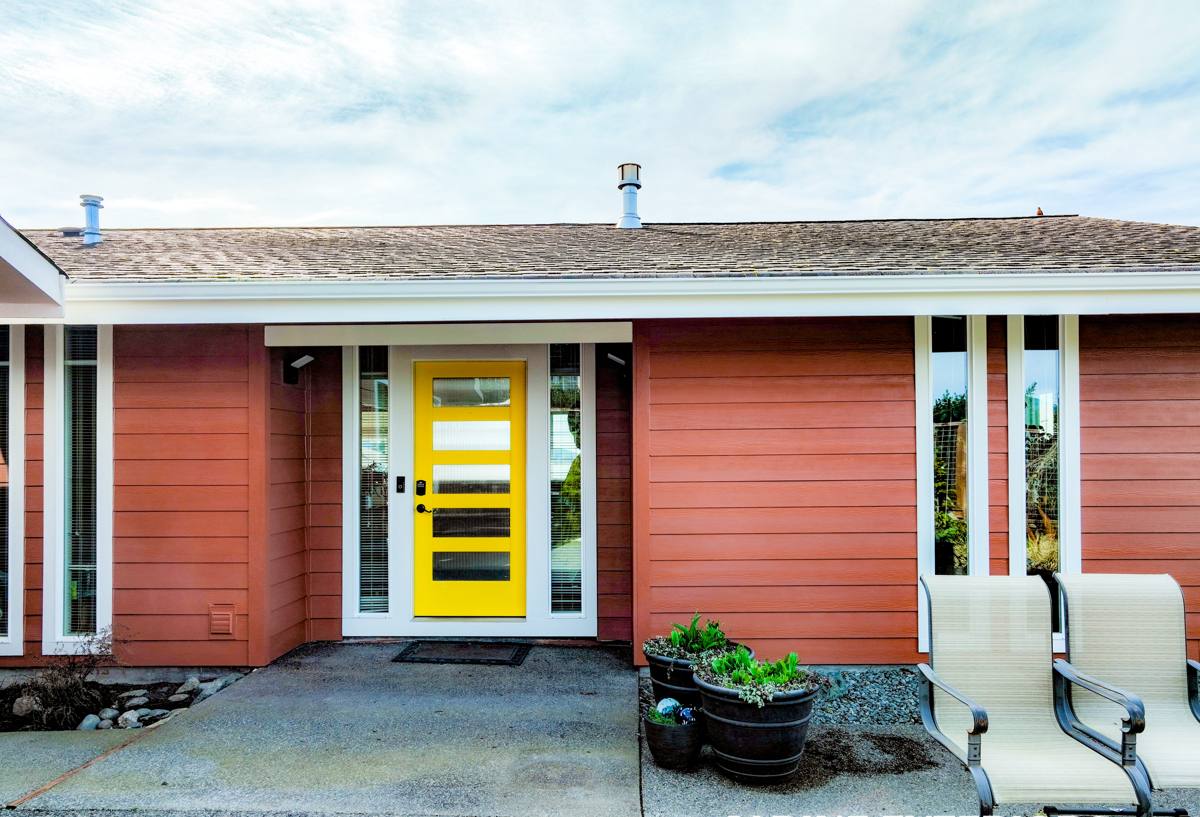
Why We Use Only James Hardie Fiber Cement Here
We don't install vinyl, LP SmartSide, primed wood, cedar, or other fiber cement brands. That's a deliberate standard, not a marketing line, and it matters even more on a site with Fir Island's exposure profile.
Non-Combustible, Moisture-Stable Composition
James Hardie siding is fiber cement — a mix of cement, sand, and cellulose fiber. It doesn't absorb and swell with moisture the way wood-based or engineered-wood siding can, and it isn't fuel for fire the way vinyl or wood products are. In a climate where siding stays wet for extended stretches, dimensional stability under moisture is one of the most important properties a material can have.
ColorPlus Factory Finish
Hardie's ColorPlus finish is baked on at the factory under controlled conditions, with UV-cured layers that resist fading and chipping far better than a field-applied paint job. On a salt-air site, a factory finish that resists coating breakdown is worth more than it would be on a sheltered inland lot, because salt and constant moisture are exactly the conditions that shorten the life of ordinary paint.
HZ5 Climate-Engineered Product Line
James Hardie manufactures different formulations for different climate zones. The HZ5 line is engineered for regions with freeze-thaw cycling and sustained wet weather — which describes the Skagit Valley well. Using the climate-appropriate product line, rather than a generic version, is part of getting this right from the start.
What a Correct James Hardie Installation Requires on Fir Island
Fiber cement siding is only as good as the assembly behind it. Most siding failures we get called out to inspect trace back to installation shortcuts, not the material itself. On an exposed, wind-driven-rain site like Fir Island, these details aren't optional extras — they're the difference between siding that lasts decades and siding that fails at the seams within a few years.
- Correct weather-resistive barrier installed and lapped properly behind the siding, with no gaps at seams
- Flashing integrated at every window, door, and horizontal trim transition — not just caulk substituting for flashing
- Proper clearance at the bottom of the wall so siding doesn't wick moisture from grade, decks, or roofing below
- Manufacturer-specified fastener type, spacing, and embedment depth (undriven or overdriven nails are a common failure point)
- Correct joint treatment at butt seams, with the right sealant rated for movement and moisture, not general-purpose caulk
- Adequate ventilation gap behind the siding where the wall assembly calls for it, so trapped moisture has somewhere to go
- Trim and corner details sealed against wind-driven rain intrusion, not just installed for appearance
Every one of those items is inspectable. If a crew can't explain how they're handling flashing at a window head or fastener spacing on a given wall, that's worth asking about before they start.
Comparing Siding Options for a Site Like This
Homeowners on Fir Island sometimes ask why we won't quote vinyl or engineered wood siding alongside Hardie. The honest answer is in how each material actually behaves under this specific combination of salt air, wind-driven rain, and extended dampness.
| Factor | James Hardie Fiber Cement | Vinyl | Engineered Wood (e.g. LP SmartSide) |
|---|---|---|---|
| Moisture stability | Dimensionally stable; doesn't swell or rot | Doesn't rot, but can warp/buckle and gap at seams | Wood-based core is moisture-sensitive at cut edges and seams |
| Finish durability in salt air | Factory-cured ColorPlus finish resists fading | Color molded through, but can chalk and become brittle over time | Field or factory paint, needs recoating as it weathers |
| Fire performance | Non-combustible | Combustible, can melt/deform near heat | Combustible |
| Maintenance burden | Occasional wash; repaint only if desired decades out | Low maintenance but limited repair options once damaged | Requires ongoing paint/seal maintenance to protect edges |
| Warranty structure | Long, transferable manufacturer warranty when installed to spec | Typically shorter, prorated | Shorter, often voided by moisture damage at edges |
This isn't a claim that other products are worthless — it's why, for the climate we work in day to day, we standardized on one system we can install to spec and stand behind.
Signs Existing Siding on Fir Island Is Losing the Battle
Because moisture problems on this kind of site develop from the inside of the wall assembly outward, the visible symptoms often show up later than the actual damage. Watch for persistent moss or algae bands that keep coming back after cleaning, soft or spongy spots near the bottom courses, staining that spreads from seams and corners, and paint or coating that's chalking, peeling, or blistering faster than it should. Any of these can indicate water is getting behind the siding rather than just sitting on the surface.
How Our Process Works
We start with a site walk that looks at wall exposure, existing moisture damage, and how water currently moves around the structure — gutters, grade, roof runoff, and prevailing wind direction all factor in on an open site like this. From there we plan the weather-resistive barrier and flashing details specific to that wall's exposure, select the appropriate Hardie plank or panel profile and HZ5 formulation, and sequence the install so water management goes in correctly before a single course of siding goes up. We inspect flashing and fastening as we go, not just at the end, because those are the details that are invisible once the siding is on and impossible to fix without tearing it back off.
Why Local Experience on Fir Island Matters
A crew that's worked this specific stretch of Skagit County already knows what wind direction to plan flashing around, how long a wall stays wet after a storm rolls through, and which details on past installs held up versus which didn't. That's not something you get from a general contractor working from a manual written for a different climate. Hiring a crew that already understands Fir Island's exposure means fewer surprises during the job and a longer service life once it's done.
If you're dealing with aging or failing siding on Fir Island, or planning ahead for a home that needs to hold up to salt air and a long wet season, we're happy to walk the property with you and put together a free, no-pressure estimate.