 Burlington
 Why La Conner Decks Wear Out Faster Than the Rest of the Yard
La Conner sits right on the Swinomish Channel, which means most decks in town aren't just dealing with rain — they're dealing with salt-laden air moving off the water almost year-round. That salt air settles into fasteners, hardware, and any exposed end-grain, and it accelerates corrosion in ways that inland Skagit County properties simply don't experience at the same rate. Add in the region's long stretch of driving rain from fall through spring, and a deck here is under near-constant moisture pressure for most of the year.
Then there's moss. La Conner's mix of marine humidity, shade from mature trees, and mild temperatures creates ideal conditions for moss and algae to take hold on horizontal surfaces — and a deck is about as horizontal a surface as a house has. Moss doesn't just look bad. It holds moisture against the wood or composite surface long after a rain has passed, which is exactly the kind of sustained dampness that rots joists, softens ledger boards, and breaks down fastener coatings from the inside out.
None of this means a deck in La Conner is doomed — it means it needs to be built and replaced with these specific conditions in mind, not with a generic approach that would work fine in a drier part of the state.
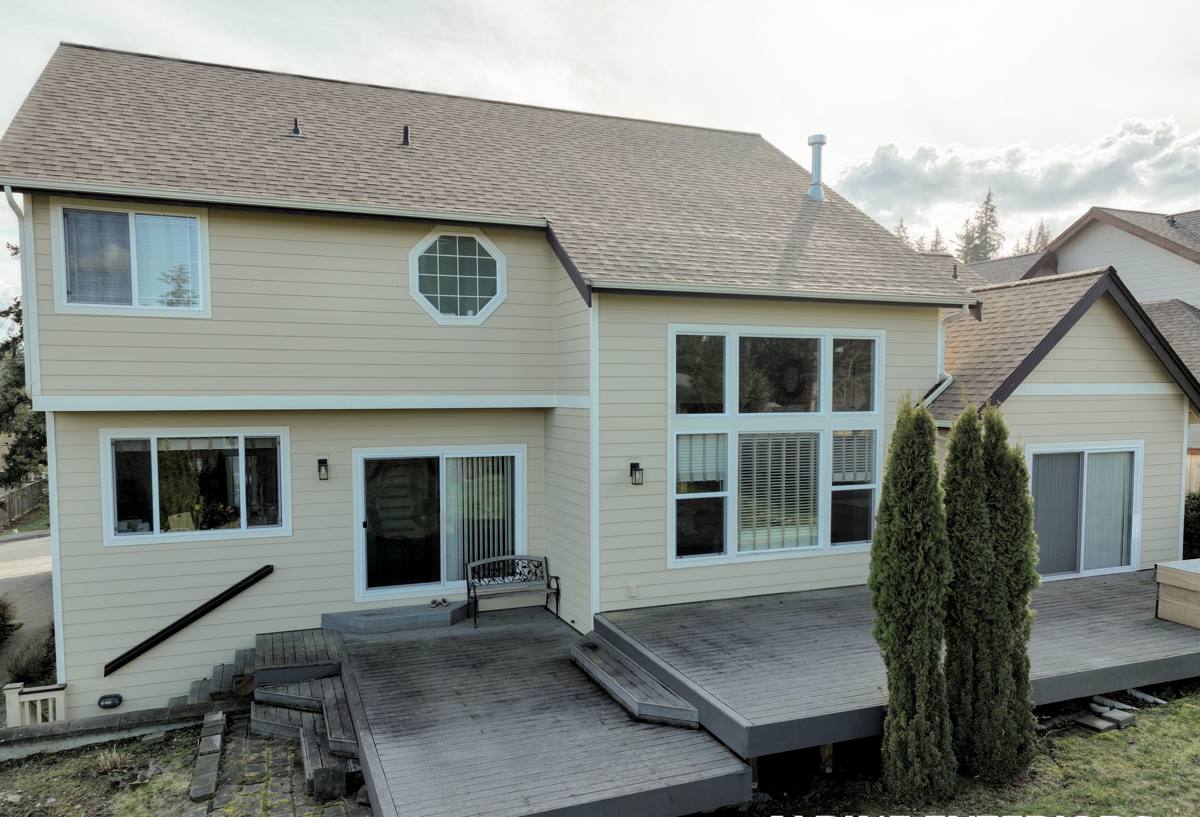
Signs Your Deck Needs Replacing, Not Just Repair
Homeowners often ask us whether a deck can be patched or whether it's time to start over. In our experience working on homes around La Conner, these are the signs that point toward full replacement rather than spot repair:
- Soft or spongy decking boards in more than one or two isolated spots
- Visible rot or discoloration where the deck ledger board meets the house
- Rust streaking from screws or joist hangers, or fasteners that spin freely without biting
- Persistent moss or black staining that returns within weeks of cleaning
- Joists or beams that flex noticeably underfoot, especially near the rim
- Railings that wiggle at the post base — often a sign the post itself is compromised, not just the railing hardware
- A deck older than 15-20 years that has never had ledger flashing added or upgraded
One or two of these on their own might mean a repair is enough. Several at once, especially involving the structural framing, usually means the cost of doing it right piecemeal starts to exceed the cost of a clean replacement.
What a Correct Deck Replacement Actually Involves
The Ledger Connection
The ledger board — where the deck attaches to the house — is the single most important detail on any deck, and it's the spot most likely to fail quietly in a marine climate. A correct replacement includes proper flashing behind and over the ledger, a water-resistive barrier tie-in, and structural fasteners rated for the load, not just deck screws. This is the detail that determines whether your deck stays attached and dry at the house connection for the next 20 years or starts rotting from the inside in five.
Fasteners and Hardware
Given how much salt air moves through La Conner, we don't cut corners on hardware. That means stainless steel or heavy hot-dip galvanized fasteners and connectors rated for coastal exposure, not the standard-grade hardware that's fine 20 miles inland but starts corroding here within a few seasons.
Framing and Footings
Joists, beams, and posts get sized to current code for your deck's actual span and load, not just matched to what was there before — a lot of older La Conner decks were built to standards that have since been tightened up. Footings get checked for frost depth and bearing, especially important on the area's mix of soil types near the water and further inland.
Drainage and Airflow
Low decks and decks close to grade need attention to drainage underneath, so water isn't sitting against joists and posts. Where possible, we build in enough clearance and slope away from the house to keep air moving and moisture from pooling — a detail that matters more here than in a drier climate.
Choosing a Decking Material for La Conner's Climate
There's no single "best" decking material — it depends on how much upkeep you want to do and what you're trying to spend. Here's how the common options hold up specifically against salt air, rain, and moss:
| Material | Moisture & Salt Air Behavior | Moss Resistance | Maintenance |
|---|---|---|---|
| Pressure-treated wood | Good if properly sealed; end cuts need re-treatment | Needs regular cleaning | Annual cleaning, re-staining every 2-3 years |
| Cedar | Naturally moisture-resistant; salt air will still gray it | Moderate; benefits from cleaning | Regular sealing to preserve color and resistance |
| Composite decking | Very good; won't rot or absorb moisture like wood | Still needs cleaning — moss will grow on any horizontal surface | Low; periodic washing |
| PVC/capped composite | Excellent; fully sealed surface resists moisture and salt | Low, but not immune | Lowest; occasional washing |
We'll talk you through the honest trade-offs for your situation — composite and capped products cost more up front but save on the recurring maintenance that a marine climate like La Conner's tends to demand from wood. We won't push a product because it's easier to install; we'll tell you what actually holds up here.
Our Deck Replacement Process
- On-site assessment — we inspect the existing deck's framing, ledger connection, and footings to confirm what's salvageable, if anything, and identify the cause of failure.
- Design and material selection — we walk through decking material, railing style, and layout options based on your budget and how you use the space.
- Permitting — we handle the permit application with Skagit County or the Town of La Conner as applicable, including any required inspections.
- Demolition and disposal — full removal of the old deck, including hauling away old material.
- Framing and structural build — new footings, posts, beams, and joists built to current code and sized for the actual span.
- Decking, railing, and finish work — installation of the chosen decking material, railing system, and any stairs or fascia.
- Final walkthrough — we go over the finished deck with you, including care and maintenance guidance specific to the material you chose.
Permits and Local Considerations Around La Conner
Most deck replacements in and around La Conner require a permit, particularly when structural framing or footings are being rebuilt rather than just the surface decking. Depending on your property's exact location, that permit runs through the Town of La Conner or Skagit County, and setback requirements can differ from what's standard elsewhere in the Burlington area — especially for properties closer to the water or in view of the historic district. We pull the correct permit for your specific address rather than assuming one jurisdiction's rules apply everywhere nearby.
If your property is near the water, there may also be additional considerations around shoreline setbacks. We'll flag anything that applies to your specific lot during the assessment rather than guessing generically.
What Affects the Cost of a Deck Replacement
| Factor | Why It Matters |
|---|---|
| Deck size and shape | Larger and multi-level decks require more framing, material, and labor |
| Decking material | Pressure-treated wood is the lowest up-front cost; capped composite runs highest but lowest upkeep |
| Structural condition | Rotted framing, ledger damage, or bad footings add rebuild scope beyond surface decking |
| Railing style | Cable, glass, and composite railings cost more than standard wood or metal baluster systems |
| Height and stairs | Elevated decks with stairs and additional railing runs add material and labor |
| Permitting requirements | Waterfront-adjacent or historic-district-adjacent properties can involve extra permit steps |
Because of these variables, we don't quote deck replacement costs sight unseen — we'll give you a straightforward number after seeing the actual site and talking through your material choice.
Why Hire a Crew That Already Works in La Conner
A deck built to a generic standard doesn't hold up the same way in La Conner as it does 20 miles inland. Crews unfamiliar with the area sometimes underspec fasteners for salt exposure, skip proper ledger flashing because it "usually" doesn't matter, or use a decking material that looks fine on day one but grows moss within a season because it wasn't chosen with this specific climate in mind. We work throughout Skagit County, including La Conner, and we build with the salt air, rain, and moss pressure factored in from the first framing decision — not as an afterthought.
If your deck is showing its age, or you're just not sure whether repair or replacement makes sense, we're happy to take a look and give you an honest, no-pressure assessment and estimate — no obligation, just a straight answer on what your deck actually needs.