 Burlington
 Why Oak Harbor's Marine Air Is Rougher on Siding Than It Looks
Oak Harbor sits right up against Puget Sound, which means homes there deal with a combination most inland Skagit County properties don't see as often: near-constant salt-laden air, wind-driven rain that hits walls sideways instead of just falling straight down, and long stretches of damp, shaded weather that keep moss and algae active for most of the year. None of that is dramatic on its own, but stacked together over years, it's exactly the kind of exposure that finds every weak point in a siding system — a gap in flashing, a fastener that shouldn't have been used, a caulk joint that was never going to hold.
Salt air is corrosive to exposed metal, which matters for trim, flashing, and fasteners. Driving rain pushes water into places a calmer climate would never test — behind trim boards, around window returns, up under lap edges. And the moss season here isn't a few weeks in late fall; on shaded, north-facing walls it can be a near year-round condition. Siding that's correctly chosen and correctly installed shrugs this off. Siding that isn't shows it early, usually starting at the bottom courses, inside corners, and anywhere water has a path in but no path back out.
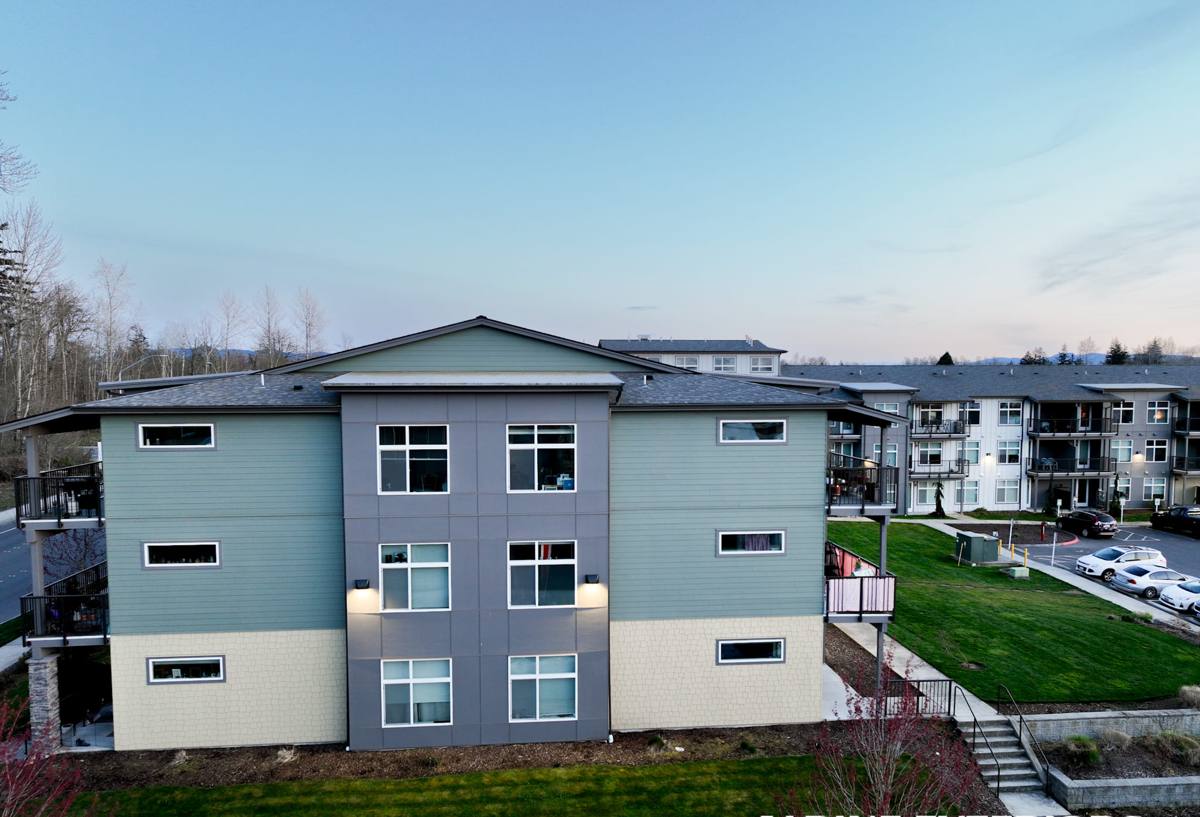
What James Hardie Fiber Cement Actually Solves Here
It doesn't rot, and it doesn't feed the moss problem
Fiber cement is cellulose fiber reinforced cement board — it doesn't have the organic wood content that gives moss, algae, and rot fungus something to work with. That doesn't mean a Hardie wall never gets surface growth in a damp, shaded spot; it can, the same as any exterior surface exposed to that much moisture. But it doesn't decay from it, and a simple rinse restores it instead of a scraping-and-patching job.
It holds up to wet-dry cycling without moving
Wood siding expands and contracts with moisture, and in a climate that swings between soaked and dry as often as this one does, that movement is what eventually opens up paint film and joints. Fiber cement is far more dimensionally stable, so paint and caulk joints stay intact longer instead of being pulled apart by the material underneath them.
ColorPlus finish vs. field-applied paint
Most of what we install uses James Hardie's ColorPlus technology — a finish baked on at the factory rather than rolled or sprayed on site. In a climate where a field-painted wood or fiber cement job often needs attention again within five to seven years, a factory-cured finish that's formulated and warrantied specifically to resist fading and moisture intrusion is a meaningful difference, not a marketing detail.
Choosing the Right Hardie Product Line for This Setting
Not every Hardie product is the right fit for every wall. Part of doing this correctly is matching the product line to the exposure, the home's style, and the specific elevation.
| Product Line | Look | Where It Tends to Fit Best |
|---|---|---|
| HardiePlank Lap Siding | Traditional horizontal lap, smooth or cedar-textured | Most full-wall re-sides; the default workhorse for wind and rain exposure |
| HardieShingle | Staggered or straight-edge shingle profile | Accent gables, dormers, or homes going for a coastal cottage look |
| HardiePanel | Vertical panel, often with batten strips | Modern facades, porch gables, or mixed with lap for visual breaks |
| HardieTrim | Fascia, corner boards, window/door trim | Pairs with any of the above; keeps trim from being the weak point |
James Hardie also makes climate-engineered HZ formulations for different regions. For the Pacific Northwest's wet, moderate climate, the product engineered for higher-moisture zones is what we spec — it's a small distinction most homeowners never hear about, but it's part of why we standardized on Hardie in the first place: the manufacturer actually accounts for a climate like this one instead of selling one formulation everywhere.
What a Correct Installation Involves in This Kind of Exposure
Fasteners and flashing that match the environment
In a salt-air setting, the fastener matters as much as the siding. Corrosion-resistant fasteners rated for the exposure, correct nail placement and depth per Hardie's fastening schedule, and properly lapped flashing at every horizontal transition — window heads, door heads, roof-to-wall intersections — are what keep water from getting behind the cladding in the first place. Get the flashing wrong and no amount of good siding on top of it will matter.
Clearance, gaps, and the drainage plane
Hardie's install specs call for minimum clearances from grade, roofing, decks, and walkways for a reason: siding installed too tight to those surfaces stays wet longer and starts showing problems years before it should. Behind the siding, a properly lapped weather-resistive barrier and attention to the drainage plane give any water that does get past the cladding somewhere to go besides sitting against the wall sheathing.
Caulk in the right places — not as a substitute for flashing
Caulk has a real job on a Hardie installation, but it's a finishing detail, not a waterproofing strategy. Where we see coastal jobs fail early, it's often because a joint that needed real flashing was sealed with caulk instead — and caulk is the first thing that gives out under repeated wetting and UV exposure.
- Fasteners rated for coastal/marine-level exposure, not standard interior-grade hardware
- Flashing lapped correctly at every window, door, and roofline intersection
- Manufacturer-specified clearance from grade, roofs, decks, and walkways
- Weather-resistive barrier installed and lapped before the first course goes up
- Caulk used only where Hardie's installation instructions call for it
- Trim and corner details sealed and primed on all cut edges
How We Approach an Oak Harbor Job
Every job starts with a walk of the exterior, not a quote pulled from a photo. We look at wall orientation relative to the Sound, existing moisture damage, the condition of trim and flashing, and how the current siding has actually held up — that tells us more about what the wall needs than a generic measurement ever would. Where we're tearing off old siding, we check for trapped moisture and soft sheathing before anything new goes up, because covering a wet wall with new siding just hides the problem instead of fixing it. From there it's ordering the correct ColorPlus-matched material, installing to Hardie's fastening and clearance specifications, and a final walk-through before we call it done.
Mistakes We Commonly Find Under Older Siding Near the Water
When we tear off old siding on homes that have taken years of this exposure, a handful of issues show up again and again: fasteners that have rusted and streaked the siding above them, flashing that was undersized or skipped at window and door heads, siding installed tight against decking or grade so it never fully dries out, and caulk applied over gaps that needed proper flashing instead. None of these are visible from the street until they've already caused damage — which is exactly why correct installation up front matters more here than in a milder climate.
Why a Crew That Already Works This Area Matters
We're based in Burlington and work throughout Skagit County, including homes in and around Oak Harbor. That's not just a convenience point — a crew that's already dealt with this stretch of coastline knows which elevations take the worst wind-driven rain, doesn't need to relearn coastal flashing and clearance details on your project, and is still local when you need a warranty question answered or a trim detail checked years down the road. A traveling crew that installs siding correctly once can still leave you without anyone local to call back.
Keeping Hardie Siding Looking Right Through Moss Season
Fiber cement is low-maintenance compared to wood, but "low-maintenance" isn't "no-maintenance," especially in a climate this wet.
- Rinse the exterior annually, focusing on shaded and north-facing walls where moss and algae collect first
- Keep shrubs and trees trimmed back from siding to let walls dry out between rain events
- Clean gutters and downspouts so overflow isn't running down the wall face
- Check caulking at windows, doors, and trim joints once a year and have any failed joints re-sealed promptly
- Avoid high-pressure washing at close range — it can drive water behind laps and joints rather than just cleaning the surface
- Watch for gutters or downspouts that discharge directly onto a wall or foundation, especially on the side facing prevailing weather
What Drives the Cost of Doing This Correctly
| Factor | Why It Matters |
|---|---|
| Home size and number of elevations | More wall area and corners mean more material, trim, and flashing detail |
| Tear-off and disposal of existing siding | Removing and hauling old material adds labor before the new install starts |
| Condition found underneath | Rot or moisture damage discovered during tear-off needs repair before new siding goes on |
| Product line and trim complexity | Lap siding alone costs less to install than mixed lap, shingle, and panel detailing |
| Access and height | Multi-story walls, tight side yards, or steep grade affect staging and labor time |
None of these numbers are meaningful without seeing the actual house, which is why we walk every project before quoting rather than estimating blind.
If you're weighing a siding project on a home in the Oak Harbor area, we're happy to take a look and walk you through what your specific walls actually need — no pressure, no generic quote. Use the form below to request a free estimate.