 Burlington
 Why Samish Island Siding Has to Work Harder
Samish Island sits out on the water in Skagit County, and that location is exactly what makes siding decisions there different from siding decisions a few miles inland in Burlington or Mount Vernon. Homes here take a steady dose of salt-laden air off the bay, driving rain that comes in sideways during winter storms, and a long, damp moss season that can stretch from fall through spring. Any siding material on this stretch of coastline is being tested constantly, not occasionally.
That combination is tougher on a home's exterior than most inland siding jobs ever see. Salt air accelerates corrosion on fasteners and trim metal. Wind-driven rain finds every gap, seam, and undersized flashing detail. And months of shade, moisture, and mild temperatures give algae and moss exactly what they need to take hold on north-facing walls and anything under tree cover. Siding for a Samish Island home isn't just about looks — it's about whether the wall assembly behind it stays dry for the next twenty or thirty years.
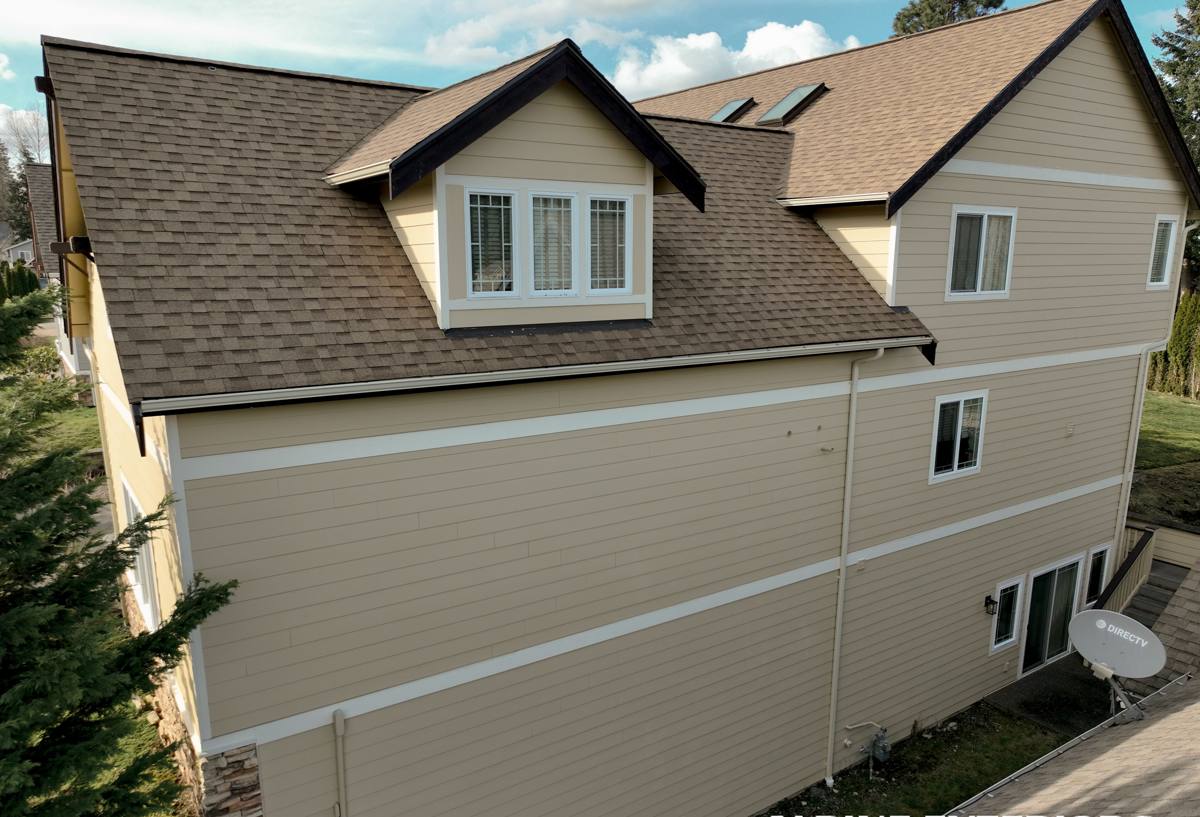
What Salt Air, Rain, and Moss Actually Do to Siding
Salt Air
Airborne salt doesn't just sit on the surface — it works into fastener heads, seams, and any exposed edge where a coating has worn thin. Over years, that accelerates rust on unprotected metal and can degrade finishes that weren't designed for a marine-influenced environment. This matters as much for the fasteners and trim accessories as it does for the siding panel itself.
Driving Rain
Wind off the water pushes rain horizontally into wall surfaces instead of letting it simply run down and off. That means every lap joint, corner, and penetration around a window or vent has to be detailed correctly the first time. A siding job that would hold up fine on a sheltered inland lot can fail early on an exposed waterfront elevation if the water management details are cut short.
Moss and Algae
Shade, moisture, and mild temperatures are a recipe for growth on exterior surfaces. Moss and algae hold moisture against the siding surface longer than clean, dry siding would, which slows drying time after every storm and adds to the cumulative moisture load on the wall over a season.
Why Fiber Cement Fits This Environment
Fiber cement siding is built from cement, sand, and cellulose fibers, which makes it dimensionally stable and resistant to the swelling, warping, and rot that wood-based products are prone to in a wet marine climate. It doesn't absorb water the way wood fiber does, so it holds paint and factory finishes far longer in a climate that punishes coatings. It's also non-combustible, which is a real advantage on properties with tree cover and limited access for emergency response, both common on Samish Island.
We install James Hardie fiber cement exclusively, and specifically their HZ5 product line, which is engineered for climates with more moisture exposure. That's not a marketing distinction — it reflects real differences in how the product is formulated to perform in exactly the conditions Samish Island sees most of the year.
Hardie's factory-applied ColorPlus finish is also relevant here. Because the color coat is baked on in a controlled factory process rather than field-applied, it resists fading and holds up better against the kind of UV and moisture cycling that's constant near open water. That matters more on an exposed waterfront lot than it does on a sheltered inland home.
What a Correct Installation Looks Like Here
The material is only half the equation. On a site like this, installation detail is often what separates siding that lasts thirty years from siding that starts showing problems in five. A correct Hardie installation on Samish Island includes:
- Proper water-resistive barrier and rainscreen or drainage plane behind the siding so any water that gets past the surface has somewhere to go
- Correctly lapped and sealed flashing at every window, door, and roof-to-wall transition — the details most exposed to driving rain
- Stainless steel or hot-dip galvanized fasteners rated for coastal or marine exposure, not standard interior-grade fasteners
- Manufacturer-specified clearances between siding and grade, decks, and roof lines to keep splashback and standing moisture away from the panel edges
- Factory-cut and factory-primed panel edges wherever possible, since a field-cut edge that isn't sealed becomes a moisture entry point
- Caulking and sealant appropriate for the exposure level, applied only where Hardie's specifications call for it — not as a substitute for proper flashing
Skipping any one of these doesn't usually show up right away. It shows up two, five, or ten years later as trapped moisture, rot in the sheathing behind the siding, or premature fastener failure — problems that cost far more to fix than they would have cost to prevent.
Our Process for a Samish Island Project
1. On-Site Assessment
We walk the exterior and look specifically at exposure — which elevations take the most wind-driven rain, where moss and algae are already established, where existing trim or flashing shows signs of wear, and where tree cover is affecting drying time.
2. Product and Line Selection
Based on that assessment, we spec the appropriate Hardie panel profile and HZ product line, along with trim and accessory choices that match the exposure level of each side of the house.
3. Tear-Off and Substrate Check
Removing the old siding lets us actually see the sheathing and framing underneath. This is often the first real look anyone's had at the wall assembly in years, and on a marine-exposed site it's an important step — hidden moisture damage doesn't announce itself from the outside.
4. Water Management First
Before a single piece of siding goes up, we install or verify the water-resistive barrier, flashing, and drainage plane. This is the step that determines how the house performs in a storm, not the finish color.
5. Installation to Manufacturer Spec
Panels, fasteners, and clearances are installed to James Hardie's published specifications for the region, which is also what keeps the manufacturer's warranty intact.
6. Final Walkthrough
We review the completed work with the homeowner, including maintenance expectations specific to a waterfront property.
Comparing Approaches for a Marine-Exposed Home
| Factor | Fiber Cement (James Hardie) | Vinyl | Wood / Engineered Wood |
|---|---|---|---|
| Moisture and rot resistance | High — cement-based, doesn't absorb water like wood fiber | Won't rot, but panels can warp or crack from temperature swings | Vulnerable to rot and swelling in sustained damp exposure |
| Salt air / coastal durability | Strong when paired with corrosion-resistant fasteners | Can become brittle and fade faster under UV and salt exposure over time | Coatings break down faster near salt air, requiring more frequent upkeep |
| Fire resistance | Non-combustible | Combustible | Combustible |
| Finish longevity | Factory-applied ColorPlus finish, long fade resistance | Color is through-body but can chalk and fade | Field-applied paint or stain needs more frequent recoating |
| Maintenance in moss-prone shade | Occasional gentle cleaning recommended | Low maintenance but growth still needs cleaning | Growth combined with moisture accelerates rot if untreated |
Maintenance Expectations After Installation
Even the right product needs some upkeep on a site like this. Homeowners on Samish Island should plan on:
- Periodic gentle rinsing to remove salt residue and organic buildup before it establishes on the siding surface
- Keeping gutters and downspouts clear so roof runoff isn't dumping extra water onto siding and trim
- Trimming back vegetation and tree limbs that shade walls and slow drying time after rain
- Periodic inspection of caulking at trim and penetrations, since sealants are the first thing to wear in a high-exposure marine climate
- Watching for any signs of moss or algae establishing on shaded elevations and addressing it early rather than letting it spread
None of this is heavy maintenance — it's the kind of routine care that keeps a well-installed Hardie system performing for decades in this climate.
Why Local Installation Experience Matters
Siding specifications are written for climate zones, but the real-world exposure on a given lot varies a lot within a single zone. A crew that has worked waterfront properties around Skagit County knows to look for the tell-tale wear patterns on fasteners and trim, knows which elevations on an island lot typically take the worst of the weather, and doesn't need to relearn coastal detailing on the homeowner's dime. That experience shows up in the small decisions — fastener choice, flashing sequencing, clearance details — that don't appear on a spec sheet but determine how the siding actually performs five or ten winters from now.
We're based in Burlington and work throughout Skagit County, including Samish Island, Bow, and the surrounding waterfront communities, so this exposure profile isn't unfamiliar territory for us — it's a normal part of the work.
What This Costs
Every home is different, and a proper estimate depends on square footage, the condition of the substrate once the old siding comes off, trim and accessory choices, and how much of the water management system needs to be built out versus repaired. Broadly, projects in a marine-exposed area like this can run toward the higher end of typical fiber cement pricing because of the added attention to flashing, fastener selection, and drainage details — that's time and material spent protecting the investment, not padding the bill.
If you're weighing a siding project on Samish Island, we're happy to walk the property, look at what your home's exposure actually calls for, and put together a clear, no-pressure estimate using the form below.