 Burlington
 Why Sedro-Woolley Homes Need Siding Built for This Climate
Sedro-Woolley sits in the Skagit River valley, close enough to Puget Sound that homes here deal with salt-tinged marine air on top of everything else Western Washington throws at a house — driving rain that comes sideways off the valley, heavy tree cover that keeps siding shaded and damp for days at a stretch, and a moss season that can run from early fall through late spring. That combination is hard on exterior materials that weren't engineered for it. Wood siding absorbs moisture and swells. Vinyl can warp in temperature swings and offers no real armor against sustained damp. Cheaper composite boards that look fine in a showroom start showing their limits after a few Skagit County winters.
Fiber cement doesn't have those weaknesses. It's a cement-based product reinforced with cellulose fibers, formulated specifically to resist moisture absorption, hold paint and factory finish far longer than wood, and shrug off the freeze-thaw and wet-dry cycling that defines a Sedro-Woolley winter. But "fiber cement" isn't one product — quality and moisture engineering vary a lot between brands, which is why we're specific about what we install.
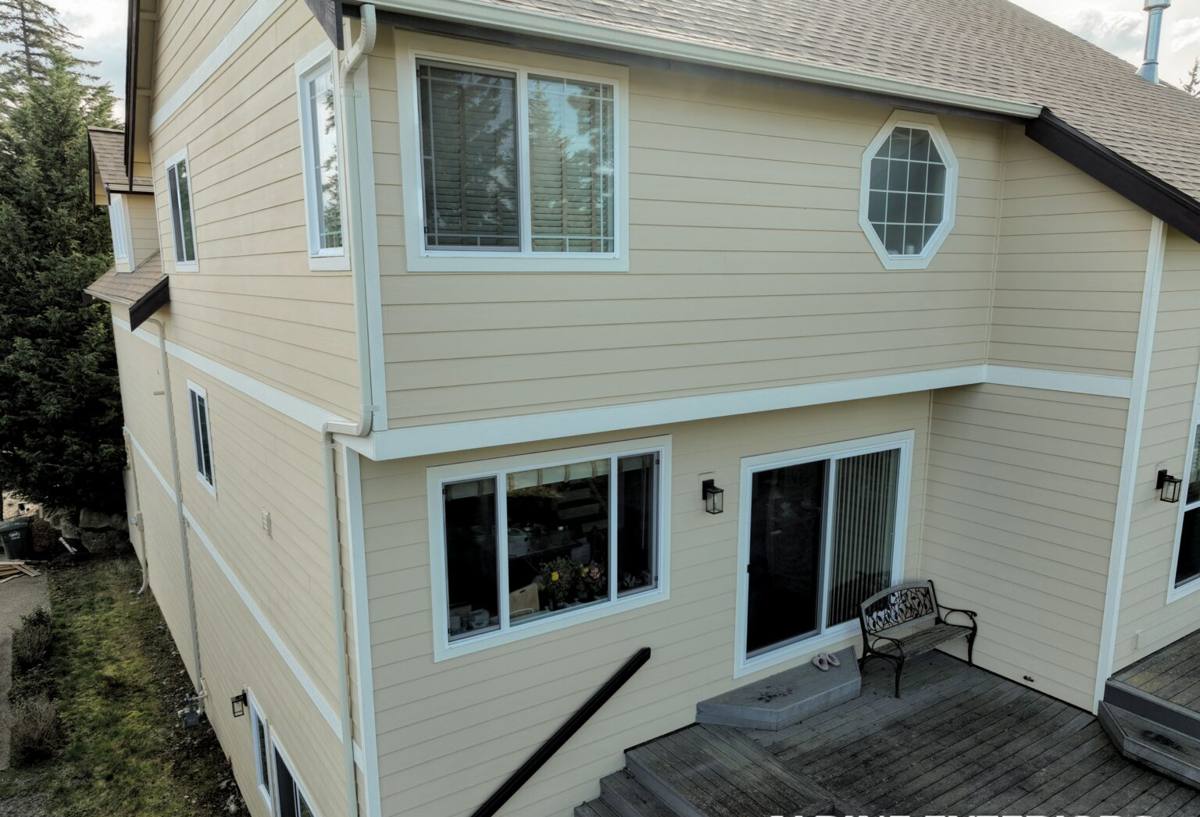
Why We Only Install James Hardie
We install James Hardie fiber cement siding exclusively. We don't install LP SmartSide, vinyl, Cemplank, Allura, primed spruce, or cedar, and we're upfront about why: those products all have legitimate uses, but none of them match Hardie's combination of moisture engineering, factory finish durability, and non-combustible material makeup for a climate like this one.
What Sets Hardie Apart for This Region
- Non-combustible core — fiber cement doesn't feed a fire the way wood-based or engineered-wood siding can, which matters as wildfire smoke seasons have become a regular part of a Pacific Northwest summer.
- HZ5 engineered formulation — Hardie manufactures regional formulas built for specific climate zones. The HZ5 line is engineered for the wetter, colder conditions common across the Pacific Northwest, including moisture cycling and freeze-thaw stress.
- ColorPlus factory finish — a baked-on finish applied under controlled conditions, which holds up to UV and driving rain far longer than field-applied paint, and comes with its own finish warranty separate from the product warranty.
- Track record — Hardie has been manufacturing fiber cement siding in the Pacific Northwest for decades, so there's real, observable performance history in exactly this kind of climate, not just marketing claims.
Products like LP SmartSide use an engineered wood strand core — solid performers in the right application, but wood-based at heart, meaning the long-term moisture story is different from cement. Vinyl is low-maintenance but thin, prone to becoming brittle over time, and it can't take the non-combustible box that Hardie checks. Other fiber cement brands may use similar raw materials, but we've standardized on Hardie because we know its formulation, its warranty structure, and how it behaves once it's on a wall in this exact climate.
What "Correct" Fiber Cement Installation Actually Involves
Fiber cement siding fails early almost exclusively because of installation mistakes, not the material itself. In a place like Sedro-Woolley, where the siding is going to be wet more often than it's dry for a good chunk of the year, the details underneath the boards matter as much as the boards themselves.
The Weather-Resistive Barrier
Everything starts with the water-resistive barrier (WRB) behind the siding. It has to be continuous, properly lapped shingle-style so water sheds down and out, and integrated correctly around every window, door, and penetration. A rushed or gapped WRB is the single biggest cause of hidden moisture damage behind siding that looks perfect from the curb.
Flashing and Drainage
Every horizontal joint, window head, and roof-to-wall transition needs flashing that directs water out and away from the wall assembly rather than trapping it. Given how much rain Skagit County sees in a typical year, a home here needs a drainage plane that actually works — not just siding installed tight to the sheathing with no ventilation gap for moisture to escape.
Fastening and Clearances
Hardie publishes specific fastening patterns, nail types, and minimum clearances (from roof lines, decks, and grade) for a reason — get them wrong and you create entry points for water or stress points that crack boards over time. Boards also need proper gaps at butt joints and around trim to allow for the material's slight expansion and contraction, caulked and finished per Hardie's install guide rather than caulked shut everywhere.
Cuts, Caulking, and Field Touch-Ups
Any field cut exposes raw, unfinished fiber cement edge. Those cuts need to be sealed or primed correctly, and any touch-up paint needs to match ColorPlus finish specs, or that spot becomes a weak point years before the rest of the siding shows wear.
Our Process on a Sedro-Woolley Job
The steps aren't unique to this town, but how we apply them accounts for what a Skagit County home is actually dealing with.
1. Walk the Exterior and Read the Damage
Before we talk products, we look at what's actually happening on the house — where moss is holding moisture against the wall, where past caulking has failed, where sun and shade patterns leave certain elevations wetter longer. That tells us where the WRB and flashing details need the most attention, not just where the old siding is cosmetically worn.
2. Confirm the Wall Assembly
We check what's underneath the existing siding — sheathing condition, existing barrier (if any), and whether there's hidden rot or moisture damage that needs to be addressed before new siding goes up. Covering a moisture problem with new siding just hides it; it doesn't fix it.
3. Install to Spec, Not to Speed
WRB, flashing, fastening, and clearances all follow Hardie's published installation guidelines for our climate zone. We're not choosing shortcuts to move faster through a job — the moss season and rain volume here don't leave room for that.
4. Final Detail Pass
Before we call a job done, we go back over trim, caulk lines, and touch-up paint to make sure every cut edge and joint is properly sealed against the kind of sustained damp Sedro-Woolley sees for a good part of the year.
What Fiber Cement Siding Typically Costs
Every home is different, but these are the main factors that move the number for a Sedro-Woolley project. We give exact figures only after walking the actual house.
| Factor | Why It Matters Here |
|---|---|
| Home size and wall complexity | More corners, gables, and dormers mean more cutting, flashing, and labor time |
| Condition of existing sheathing | Hidden moisture or rot found during tear-off adds repair scope before new siding goes on |
| Siding profile (lap, panel, shingle-style) | Different Hardie profiles have different material and install-labor costs |
| Trim and accessory scope | Corner boards, window trim, and fascia work add to material and labor totals |
| Access and site conditions | Tree cover, slope, and tight lot lines common in this area can affect staging and labor time |
| Color and finish selection | Standard ColorPlus colors vs. premium or custom options can shift material pricing |
Fiber cement costs more upfront than vinyl, but the comparison isn't apples-to-apples once you account for repainting cycles, moisture-related repairs, and how long each material actually lasts in a climate this wet. A correctly installed Hardie system is designed to go decades between major maintenance events.
Living with Fiber Cement Siding in a Moss-Prone Climate
Fiber cement is low-maintenance, not no-maintenance. In a town where moss and mildew growth is a normal seasonal reality, a little homeowner upkeep goes a long way toward protecting the finish and the warranty.
- Rinse siding gently once or twice a year, especially shaded north-facing walls where moss and algae take hold first
- Keep gutters clear so overflow doesn't run down the siding face during heavy rain events
- Trim back vegetation and tree limbs that keep siding shaded and damp longer than necessary
- Inspect caulk lines around windows, trim, and penetrations annually and have gaps resealed before they become entry points
- Avoid pressure washing directly at joints or up under boards — a garden hose and soft brush are enough for most cleaning
- Address any impact damage or chips promptly so the underlying material isn't exposed to moisture
Why Local Installation Experience Matters
Fiber cement installation guidelines exist for a reason, but applying them correctly on a specific house requires understanding how that house sits in its actual environment — sun exposure, tree cover, wind-driven rain patterns, and how moisture moves through a wall assembly in a valley climate like Skagit County's. A crew that has installed siding across this area repeatedly has already seen how these homes weather, where moss tends to establish first, and which details matter most when the siding is going to spend more days wet than dry. That's not something a generic installation checklist replaces.
Signs It's Time to Talk About Replacement
Not every siding problem means a full replacement, but a few signs are worth a professional look sooner rather than later:
- Soft or spongy spots when you press on the siding, especially near the bottom courses or under windows
- Persistent moss or dark staining that keeps returning shortly after cleaning
- Visible warping, cracking, or gaps that have opened up at joints and trim
- Paint that's peeling or bubbling rather than just fading
- Interior signs like musty smells or discoloration on walls that share an exterior with damaged siding
If you're seeing any of these on a Sedro-Woolley home, it's worth having someone look at what's happening behind the siding, not just at the surface.
Get a Straight Answer for Your Home
If you're weighing a siding replacement in Sedro-Woolley, we're happy to walk the exterior with you, point out what we're actually seeing, and give you a clear, no-pressure estimate for a James Hardie installation done to spec for this climate. Use the form below to get started.