 Burlington
 Siding That Has to Work Year-Round in Sedro-Woolley
Sedro-Woolley sits in the Skagit Valley, where the weather doesn't do a homeowner any favors. Winters bring long stretches of driving rain that comes in sideways off the valley, spring and fall stay damp for weeks at a time, and the tree cover and river-valley humidity that make this area beautiful also make it one of the better environments in the state for moss and algae to take hold on a north-facing wall. Add in the salt-tinged air that moves up the valley from Puget Sound and Skagit Bay, and you've got a combination that's genuinely hard on exterior building materials.
We install James Hardie fiber cement siding exclusively — not as one option among several, but as the only siding we put on a home. This page is about what that looks like specifically for a Sedro-Woolley property: what the climate demands, what a correct installation actually involves, and why local experience with this exact set of conditions matters as much as the product itself.
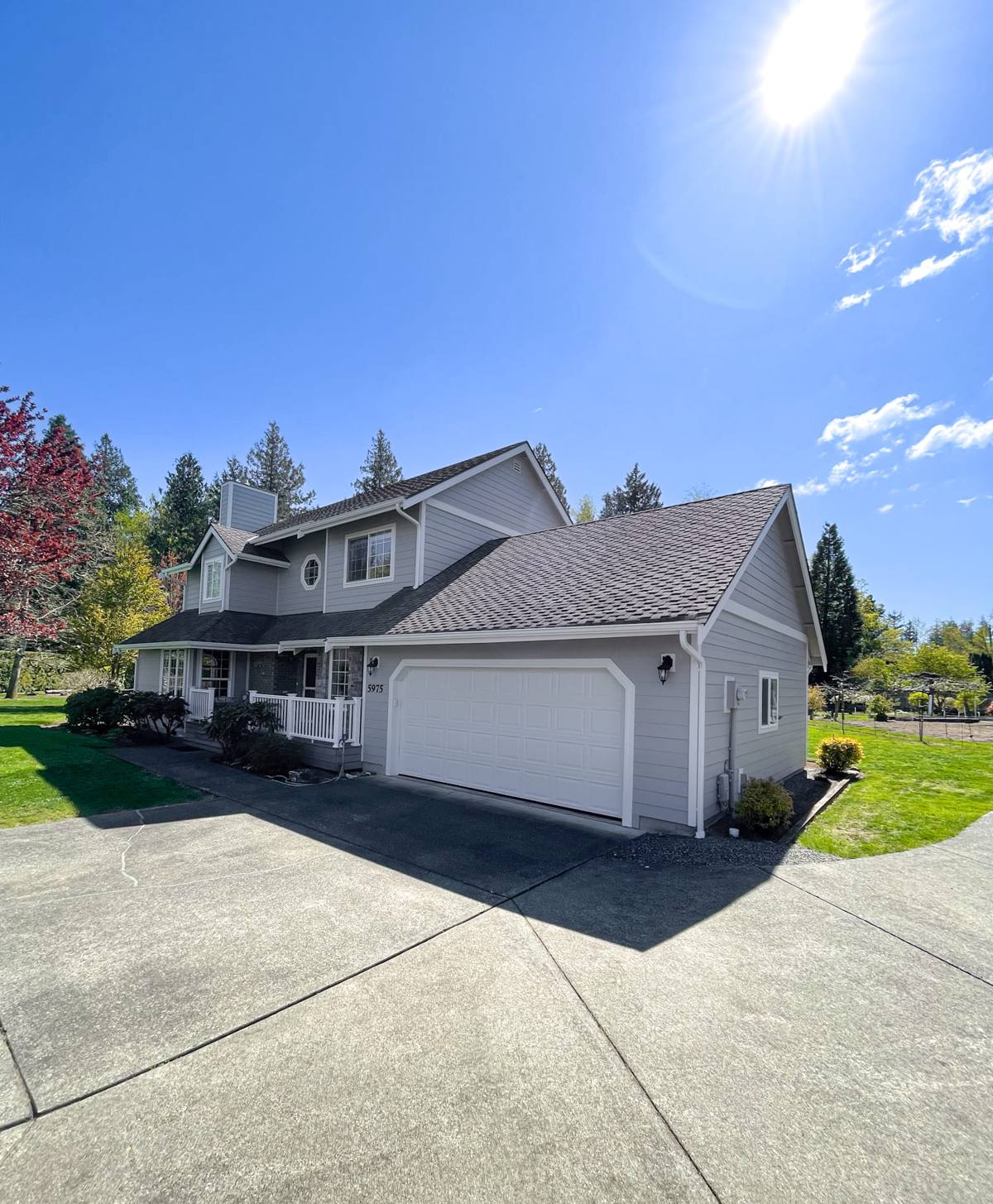
What Skagit County Weather Actually Does to Siding
Moisture That Doesn't Let Up
The problem in this part of Washington isn't any single storm — it's the cumulative effect of siding staying damp for days or weeks at a stretch. Wood-based products (cedar, primed spruce, and engineered wood siding like LP SmartSide) rely on their finish and edge-sealing to keep water out. Once that seal is compromised at a cut edge, a nail hole, or a joint that wasn't caulked correctly, moisture gets in and doesn't dry out quickly in our climate. That's when you start seeing swelling, soft spots, and eventually rot.
Moss and Algae
Shaded walls, gutters that overflow onto the siding below, and the general dampness of a Skagit Valley winter create ideal conditions for moss and algae growth. This is mostly a cosmetic issue on a properly finished surface, but on porous or poorly sealed siding it can hold moisture against the substrate and accelerate deterioration underneath the growth.
Salt-Influenced Air
Sedro-Woolley is inland from the coast, but the Skagit Valley acts as a corridor for marine air moving up from Skagit Bay and the Sound, especially during winter storm patterns. It's not the same salt exposure as a beachfront home, but it's enough over years to accelerate corrosion on lower-grade fasteners and trim, and it adds another reason to use materials engineered for coastal Pacific Northwest conditions rather than a generic siding spec.
Why We Install Only James Hardie
James Hardie's fiber cement siding is engineered specifically for climates like ours. It's non-combustible, it doesn't absorb water the way wood-based products do, and it holds paint and factory finish far longer than wood siding because the material itself is dimensionally stable — it doesn't swell and shrink with every wet-dry cycle the way wood does. For a Sedro-Woolley home dealing with a genuinely long wet season, that stability is the whole point.
Hardie also builds region-specific product engineering into its HZ5 line, which is formulated for the moisture and freeze-thaw patterns of the Pacific Northwest. That's a meaningful difference from siding built to a single national spec — it means the product is designed around exactly the kind of weather Skagit County sees most years.
ColorPlus Factory Finish
Most of what we install uses Hardie's ColorPlus finish — a factory-applied, baked-on finish that's more consistent and more UV- and moisture-resistant than field-applied paint. In a climate where a home spends a lot of the year damp, a finish that doesn't rely on a painter getting perfect conditions on installation day is a real advantage. It also comes with its own finish warranty, separate from the substrate warranty on the siding itself.
What a Correct Installation Involves
Fiber cement siding is only as good as the install behind it. Hardie's own installation instructions are specific for a reason — get them wrong and you can undermine the durability the material is built to provide. For a Sedro-Woolley home, the details that matter most include:
- Proper water-resistive barrier and flashing at every window, door, and penetration — this is the layer doing the real work when wind-driven rain hits the wall
- Correct clearance at grade, decks, and roof lines so siding isn't sitting in standing water or snow load against the bottom edge
- Manufacturer-specified nailing pattern and fastener type — corrosion-resistant fasteners matter more here given the marine air influence
- Properly caulked and sealed joints, or joints designed to shed water without caulk where Hardie's details call for it
- Adequate gaps and sealed end cuts, since a cut edge is the most vulnerable point on any fiber cement board if it's left unsealed
- Ventilation behind the siding where the wall assembly calls for it, to let any incidental moisture dry out rather than sit
Every one of these is a place where a rushed or inexperienced crew can create a callback a few years down the road — often after the crew that installed it is long gone.
Hardie Product Lines for This Kind of Home
| Product | Typical Use | Why It Fits This Climate |
|---|---|---|
| HardiePlank lap siding | Most common wall application, wide plank selection | Dimensionally stable in wet-dry cycling; wide color range in ColorPlus finish |
| HardieShingle | Accent areas, gables, dormers | Adds texture without the moisture vulnerability of real wood shingle |
| HardiePanel | Vertical siding, modern or board-and-batten look | Clean lines for shop buildings, additions, or contemporary remodels |
| HardieTrim | Corners, window and door trim, fascia | Matches the durability of the field siding instead of pairing fiber cement with wood trim that will fail sooner |
Why We Don't Install Vinyl, LP SmartSide, or Cedar Here
We get asked about these regularly, and it's a fair question. Vinyl siding is inexpensive and low-maintenance in the sense that it doesn't need painting, but it's a thin plastic product that can crack in cold snaps, fade over time, and doesn't hold up structurally the way fiber cement does — and in a wind-driven rain event, gaps behind vinyl panels don't do much to stop moisture reaching the wall assembly. LP SmartSide is an engineered wood product, and like any wood-based siding it depends entirely on an intact factory finish and sealed edges to keep moisture out; once that's compromised, it's vulnerable to the same swelling and rot risk as other wood siding, just with a coating between it and the weather. Cedar and primed spruce are honest, attractive materials, but they require ongoing maintenance — refinishing, caulking, and edge sealing — to hold up in a climate this wet, and that's an ongoing cost and time commitment most homeowners don't want to sign up for.
None of these are bad products for every situation. They're just not what we're willing to warranty our workmanship on for homes in a climate that stays wet as long as Skagit County's does. James Hardie's fiber cement gives us a material we trust to perform for decades with normal maintenance, which is why it's the only thing we install.
Our Process for Sedro-Woolley Projects
- On-site assessment — we look at your home's exposure (which walls take the most wind-driven rain, where moss has already established, where trim and flashing show wear) before recommending a scope of work
- Product and color selection — walking through Hardie's plank profiles, textures, and ColorPlus colors for your home
- Removal and inspection — pulling old siding gives us a look at the sheathing and framing underneath, which sometimes reveals moisture damage that needs addressing before new siding goes on
- Water-resistive barrier and flashing installation — the part of the job that determines how the wall performs for the next 30-plus years, done to Hardie's specifications
- Siding installation — following manufacturer fastening, clearance, and joint details throughout
- Final walkthrough — going over the finished work and warranty paperwork with you directly
Why Local Experience Matters
A crew that regularly works in Sedro-Woolley and the surrounding Skagit Valley already knows which details to be careful about here — the flashing at grade for homes on lower ground that stays saturated longer, the extra attention northeast-facing walls need where moss takes hold fastest, and how to sequence a job around the area's rain patterns so the wall assembly isn't exposed longer than it has to be. That's not something you get from a generic install checklist; it comes from doing this work in this valley, on this kind of weather, repeatedly.
Get a Free Estimate
If you're weighing a siding replacement or repair for a Sedro-Woolley home, we're glad to come take a look, walk you through what we're seeing, and give you a straightforward, no-pressure estimate for a James Hardie installation built for this climate. Use the form below to get started.