 Burlington
 Decking Built for How Big Lake Actually Weathers
Big Lake sits in a pocket of Skagit County where lake moisture, marine air pushing in from the Sound, and long stretches of gray, wet weather all combine on the same deck boards. That's a tougher combination than it sounds. Wood decking in this area needs constant upkeep to fight rot and slip-hazard moss, and even a lot of composite decking struggles if it's installed without accounting for how much standing moisture this area holds onto for months at a time. If you're planning a new deck or replacing a tired one at your Big Lake property, the material and the installation details matter more here than they would in a drier part of the state.
We install composite decking around Burlington and the surrounding Skagit County lake and river communities regularly enough to know what fails first in this climate and what holds up. This page walks through what a Big Lake composite deck actually needs, what a correct installation looks like, and how we run the job from estimate to final walkthrough.
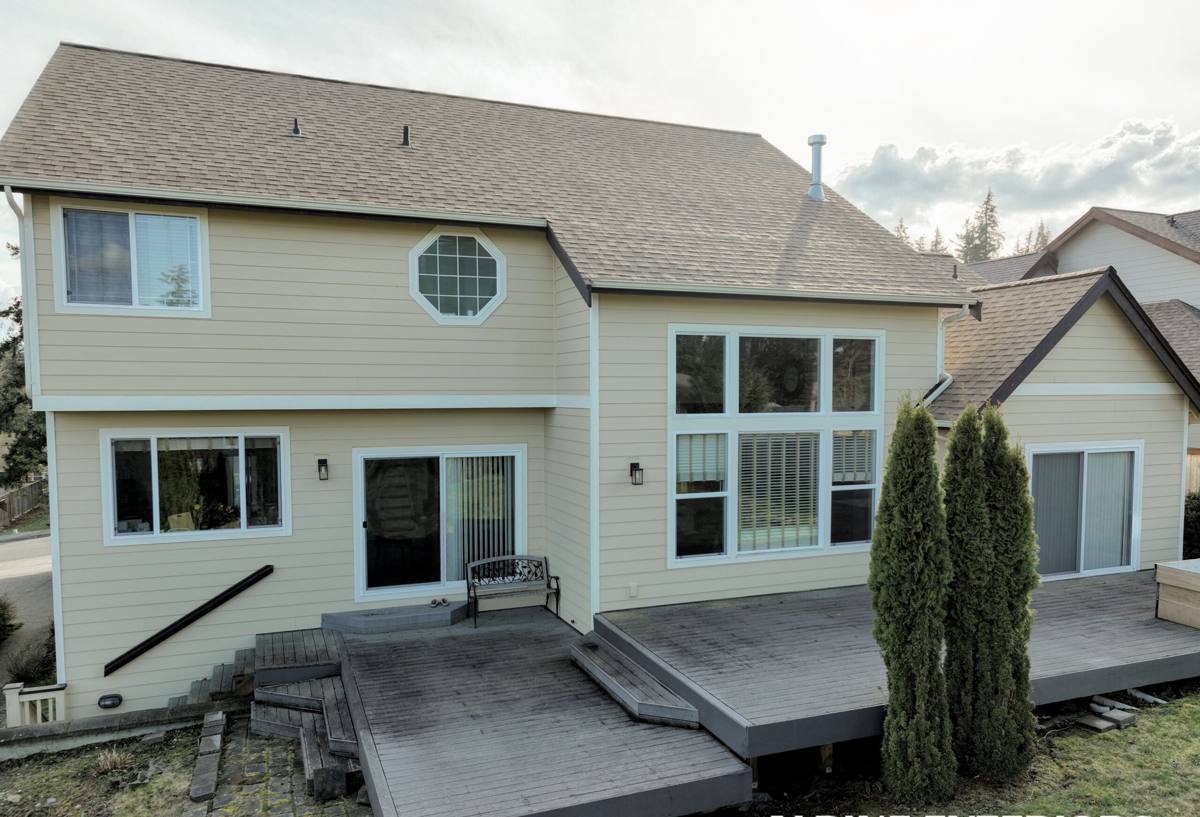
Why Big Lake's Climate Is Hard on Decks
A few things stack up against outdoor living spaces here:
- Persistent moisture near the lake. Homes close to the water deal with higher ambient humidity and morning dew for more of the year than homes further inland, which keeps deck surfaces damp longer after rain.
- Long moss and algae season. Shaded decks near mature trees or on the north side of a house can stay green and slick from fall through spring if the surface and substructure don't drain and dry properly.
- Driving rain off the water. Wind-driven rain doesn't just fall on a deck, it gets pushed sideways under railings, into fastener holes, and against house band boards — the spots where rot usually starts.
- Salt-tinged marine air. Skagit County isn't oceanfront, but the marine influence off the Sound still carries enough salt and moisture into the air to accelerate corrosion on cheap fasteners and hardware over the years.
None of this makes composite decking a bad choice for Big Lake — it actually makes it a better choice than wood, if it's installed correctly. The problems homeowners run into are almost always installation problems, not material problems.
What a Correct Composite Deck Installation Involves Here
Substructure and Drainage First
The framing underneath a composite deck matters as much as the decking itself, maybe more in a climate like this. We use joist tape or a comparable moisture barrier on top of the framing to keep water from wicking into the wood joists through fastener penetrations. Joist spacing gets checked against the manufacturer's span ratings for this climate zone — composite boards can sag or ripple over time if they're spanned too far, and that shows up faster in a consistently damp environment.
Ledger board attachment to the house gets extra attention. This is the single most common failure point on decks near lakes and waterways — a poorly flashed ledger lets water track behind the siding and rot the rim joist from the inside, long before anyone notices a problem on the deck surface.
Airflow Underneath the Deck
Low decks or decks built close to grade near the lake need enough clearance and ventilation underneath to let the substructure actually dry between rain events. We won't build a deck so low to grade that it traps moisture against the framing — it's a shortcut that causes problems within a few years in this climate.
Fastener and Hardware Choice
Given the marine air influence, we use stainless steel or coated fasteners rated for ground contact and corrosion resistance, along with hidden fastener systems designed for the specific composite board profile. Mixing generic hardware store screws into composite decking is a common shortcut that leads to streaking, board damage, and premature failure of the fastener itself.
Surface Grading and Gapping
Board spacing gets set to the manufacturer's spec for expansion and drainage, not squeezed tight for looks. Proper gapping lets water pass through instead of pooling on the surface, which directly reduces how much moss and algae growth you'll deal with each winter.
Choosing the Right Composite Product for a Lakeside Property
Not every composite board is built the same, and the differences matter more here than in a dry climate. We generally steer Big Lake customers toward capped composite boards — meaning the board has a fully wrapped polymer shell around a wood-composite core — rather than uncapped or partially capped boards.
| Feature | Capped Composite | Uncapped Composite |
|---|---|---|
| Moisture resistance | Shell resists water absorption on all sides | Exposed core edges can absorb moisture over time |
| Mold and algae resistance | Smooth, sealed surface sheds growth more easily | Porous surface holds moisture, grows moss faster |
| Fading and staining | Better color retention with UV-stable cap | More prone to graying and staining |
| Upfront cost | Higher material cost | Lower material cost |
| Long-term maintenance | Occasional wash-down | More frequent cleaning to control growth |
Uncapped composite isn't a bad product everywhere, but in a climate that stays damp and shaded for months at a stretch, the extra upfront cost of a capped board usually pays for itself in reduced cleaning and a longer service life. We'll walk through the actual product lines and price points during your estimate rather than push one brand — the right call depends on your budget, sun exposure, and how the deck will be used.
Handling Moss and Slip Risk on Shaded or Lakefront Decks
Moss isn't just cosmetic — it's a genuine slip hazard on stairs and walking surfaces, especially with wet feet coming off a dock or lawn. A few things reduce it long-term:
- Proper board gapping and drainage so water doesn't sit on the surface
- Selecting a composite board with a textured, slip-resistant cap in shaded areas
- Trimming back overhanging branches where possible to let more light and air reach the deck
- A simple seasonal wash-down routine, which we'll walk you through at handoff
Composite decking still needs periodic cleaning in this climate — it just doesn't need sanding, staining, or sealing the way wood does, which is the real maintenance win for lakefront and heavily shaded properties.
What This Typically Costs
Composite decking costs more upfront than pressure-treated wood and less than exotic hardwoods, but the comparison that actually matters is total cost over the life of the deck once you factor in wood's recurring maintenance.
| Cost Factor | What Drives It |
|---|---|
| Deck size and shape | Square footage, number of angles, stairs, and landings |
| Board tier | Uncapped vs. fully capped composite, and the manufacturer line |
| Substructure condition | Whether existing framing can be reused or needs replacement |
| Railing system | Composite, aluminum, or cable railing options |
| Site access and grade | Slope down to the lake, tree removal, or tight access can add labor |
| Fastener and hardware spec | Corrosion-resistant hardware for marine-influenced air |
We give firm, itemized numbers after seeing the site — not a phone estimate — because grade, existing framing condition, and access vary a lot from lot to lot around Big Lake.
Our Process for a Big Lake Composite Deck
- On-site assessment. We look at grade, drainage direction, sun/shade exposure, and the condition of any existing structure before quoting anything.
- Product walkthrough. We go over composite board options and railing systems suited to the site's actual exposure, not a one-size answer.
- Written estimate. Clear scope, material spec, and price before any work starts.
- Demo and framing. Remove the old deck if applicable, correct or rebuild the substructure, install moisture barrier and proper flashing at the ledger.
- Decking and railing install. Boards, hidden fasteners, and railing set to manufacturer spec and local drainage needs.
- Final walkthrough. We check the deck with you, cover basic care, and answer questions before we call it done.
Why Hire a Crew That Already Works This Area
A deck built to a generic spec sheet doesn't always hold up to Skagit County's version of wet weather. Crews who work Big Lake and the surrounding lake and river communities regularly already know where water tends to collect on a given lot, how much clearance a deck needs off wet grass or lake-adjacent soil, and which hardware actually holds up against the marine air here rather than corroding out in a few seasons. That local pattern recognition is the difference between a deck that needs attention every year and one that just works.
We're a Burlington-based crew, and Big Lake is part of our regular service area — this isn't a one-off trip for us, it's a neighborhood we come back to.
Get a Straight Answer on Your Deck
If you're weighing a new composite deck or replacing an aging one at your Big Lake property, we'll come look at the site, tell you honestly what it needs, and give you a written estimate with no pressure to sign anything on the spot. Use the form below to request a free estimate.