 Burlington
 Siding Repair Built for Mount Vernon's Climate
Mount Vernon sits in the flood plain of the Skagit River, a few miles inland from Padilla Bay and the Salish Sea, which gives it a specific mix of weather stresses most siding was never designed to handle for decades on end. Homes here deal with driving winter rain off the water, a long damp shoulder season that keeps north and shaded walls wet for weeks at a stretch, and a moss season that can run from fall through spring. Add in salt-laden air drifting up from the bay on windy days, and you have conditions that quietly break down siding seams, fasteners, and paint film years before a homeowner notices anything wrong from the curb.
We're a Burlington-based crew that works Mount Vernon routinely — not a company that drives in from Seattle or Everett for one job and disappears. That matters for siding repair specifically, because getting it right depends on understanding how a particular neighborhood's exposure, tree cover, and drainage patterns tend to fail, not just knowing how to swap a board.
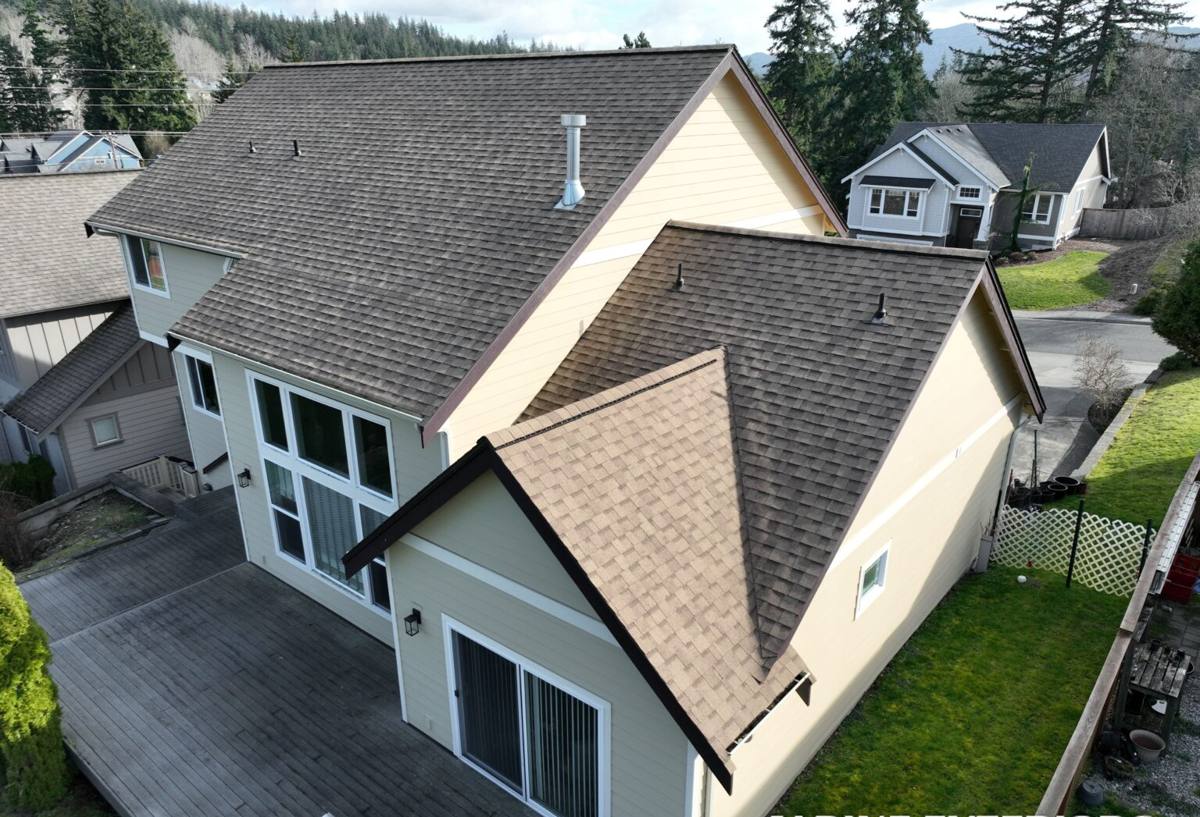
Why Skagit County Siding Fails the Way It Does
Siding repair calls in this area tend to fall into a handful of repeatable patterns, and knowing which one you're dealing with changes how the repair should be done.
Moss and Organic Growth
Shaded walls, especially north- and east-facing sides near mature trees, stay damp long enough for moss and algae to take hold. Left alone, moss holds moisture against the siding surface, breaks down paint film, and — on wood-based products — feeds rot at seams and butt joints. It's rarely the moss itself that causes structural damage; it's the trapped moisture underneath it.
Driving Rain and Wind-Driven Wetting
Storms moving in off the Salish Sea don't just rain straight down — wind pushes water sideways into laps, seams, and any gap around trim, window flashing, or penetrations. Over time this finds any weakness in the water-management layer behind the siding, which is often where the real damage is hiding, not on the visible face.
Salt Air and Fastener Corrosion
Homes closer to Padilla Bay and the tidal flats get a steady dose of salt-laden air. Standard steel fasteners and trim hardware corrode faster in this environment, which shows up as rust streaking, loosened boards, and eventually failed connections at panel edges.
Freeze-Thaw Cycling
Skagit County doesn't get brutal winters, but it does get repeated freeze-thaw swings. Water that has worked its way into a crack or seam expands when it freezes, widening the damage a little more each cycle.
Signs Mount Vernon Siding Needs Repair, Not Just a Wash
Pressure washing moss off a wall can make a problem look solved for a season while the underlying issue keeps working. Here's what actually signals a repair is needed:
- Soft or spongy spots when you press on the siding, especially near the bottom courses or around window and door trim
- Visible gaps opening up at butt joints or where panels meet corner trim
- Paint that's bubbling, peeling, or failing in patches rather than evenly across a wall
- Persistent moss or dark staining that returns within a season of cleaning
- Rust streaks running down from fasteners or trim hardware
- Warping, cupping, or visible board separation, particularly on sun-exposed or wind-exposed walls
- Interior signs — musty smell, discoloration on inside walls, or peeling interior paint near an exterior wall — that suggest moisture is already past the siding
If you're seeing any of the interior signs, that's a bigger flag than exterior cosmetic issues alone. It usually means water has been getting behind the siding for a while, and the repair needs to address the water-resistive barrier and flashing, not just the visible board.
What a Correct Repair Actually Involves
A siding repair that's done right is not just cutting out a bad board and nailing in a new one. It's a short investigation followed by a targeted fix.
1. Find the Actual Source
Damaged siding is often a symptom, not the cause. We look at flashing above the damaged area, caulking at trim and penetrations, gutter and downspout performance nearby, and grading or landscaping that might be splashing water onto the wall. Replacing a board without fixing what caused it to fail just buys a few more years before it happens again.
2. Check What's Behind the Siding
Once boards are pulled, we check the house wrap or building paper, sheathing condition, and any framing exposed by the damage. If sheathing or framing has soft spots from long-term moisture intrusion, that needs to be dealt with before new siding goes back on — patching over compromised structure just hides the problem.
3. Match or Replace Appropriately
For small, isolated repairs on siding that's otherwise in good shape, we can often match materials closely enough that the repair blends in. For larger areas of damage, or when the existing material is failing broadly, patching stops making sense — that's when we'll tell you honestly that a section or full replacement is the better use of your money, rather than repeatedly repairing a wall that's on its way out.
4. Rebuild the Water Management, Not Just the Surface
Correct flashing details, properly lapped house wrap, and sealed penetrations matter more to the longevity of a repair than the siding material itself. A beautiful patch over bad flashing will fail again.
Repair or Replace: How We Help You Decide
Homeowners often call about one bad spot and are surprised when we recommend looking at the whole wall, or vice versa. Here's roughly how that decision plays out.
| Factor | Favors Repair | Favors Replacement |
|---|---|---|
| Extent of damage | Isolated to one or two boards or a small area | Spread across a wall or multiple walls |
| Age and condition of existing siding | Siding is relatively young, otherwise sound | Siding is near end of service life or a discontinued product |
| Cause of damage | One-time or localized issue (single flashing failure, impact damage) | Systemic moisture or material failure across the assembly |
| Water intrusion behind siding | None found, sheathing dry | Sheathing or framing already affected |
| Material availability | Close match available for a clean blend | Original product no longer made or badly weathered/faded compared to new material |
We'll walk the wall with you, explain what we're seeing, and give you a straight answer — including telling you when repair is the smarter and cheaper option, which is often the case for isolated damage caught early.
Our Process for a Mount Vernon Repair Call
- Inspection. We assess the damaged area, the likely cause, and check surrounding areas that share the same exposure for early-stage problems.
- Honest scope and estimate. You get a clear explanation of what's needed — repair, partial replacement, or full replacement — and why, along with straightforward pricing.
- Address the cause first. Flashing, caulking, drainage, or gutter issues get corrected before new siding goes on, so the repair actually lasts.
- Repair or reside with James Hardie. Where new material is going in, we install James Hardie fiber cement — the only siding product we install — matched or planned to blend with the rest of the home.
- Final walkthrough. We show you what was done and why, so you understand the work and know what to watch for going forward.
Why We Rebuild and Repair With James Hardie
When a repair calls for new material — whether it's a few boards or a full wall — we use James Hardie fiber cement, and we don't install vinyl, LP SmartSide, cedar, primed spruce, Cemplank, or Allura as an alternative. That's a deliberate standard, not a sales preference.
In a climate like Skagit County's, the two things that matter most for siding longevity are how a material handles sustained moisture exposure and how well it holds paint over time. Fiber cement doesn't swell, rot, or feed organic growth the way wood-based products can when they stay damp for weeks at a time, and it's non-combustible, which matters given the region's dry summer wildfire smoke seasons even if fire risk isn't the primary driver here. James Hardie's ColorPlus factory finish is also engineered and warranted specifically to resist the fading and peeling that plain field-painted siding struggles with under our repeated wet-dry cycling. For a region with a genuine moss season, that combination of moisture resistance and finish durability is the difference between a repair that holds for decades and one you're revisiting again in a few years.
When we do a partial repair with Hardie material, we can generally match the profile, exposure, and color closely enough that the repair doesn't stand out. When damage is widespread enough that matching stops making sense, we'll say so plainly and talk through a full re-side instead of stretching a patch job past where it should go.
Why a Local Burlington Crew Matters for This Kind of Work
Siding repair depends heavily on correctly diagnosing why the damage happened in the first place, and that diagnosis gets easier with local familiarity. A crew that regularly works Mount Vernon and greater Skagit County has already seen how moss builds up on shaded north walls near the river, how wind-driven rain off Padilla Bay finds weak trim seams, and which fastener and flashing choices hold up against the area's salt air over years, not just on paper. That local pattern recognition shortens the diagnostic step and reduces the odds of a repair that looks fine for a season and fails again.
Being Burlington-based also means we're a short drive away if a repair needs a follow-up look, and we're not disappearing after the invoice clears. For homeowners comparing quotes, it's worth asking directly how much local repair work a contractor actually does in your specific area — the answer tells you a lot about how well they'll diagnose your problem before they ever pick up a pry bar.
Get an Honest Look at Your Siding
If you're seeing moss that keeps coming back, boards that feel soft, paint that's failing in patches, or any sign that water might be getting behind your siding, it's worth having it looked at before the damage spreads. We offer free, no-pressure estimates for Mount Vernon homeowners — we'll tell you honestly whether you need a repair, a partial re-side, or nothing urgent at all. Fill out the form below to get started.