 Burlington
 Building Decks for Conway's Particular Climate
Conway sits low in the Skagit River delta, close enough to Puget Sound and the Skagit Bay tideflats that salt-laden air is a daily fact of life, not an occasional coastal breeze. Add in Skagit County's long wet season, heavy morning dew off the flats, and the shade from mature fir and cedar that many Conway lots carry, and you get a deck-building environment that punishes shortcuts fast. We build decks for this specific mix of conditions — not a generic Pacific Northwest deck plan pulled off a shelf.
A deck built the same way you'd build one in a dry inland town will show problems within a couple of seasons here: fasteners bleeding rust through the decking, mildew and moss creeping into shaded corners, ledger boards trapping moisture against the house, and railings that stay damp long after the rain stops. None of that is inevitable. It comes down to material choice, drainage detail, and fastening — the parts of a deck build that don't show up in a quick estimate but decide whether the deck looks good in year eight or needs replacing.
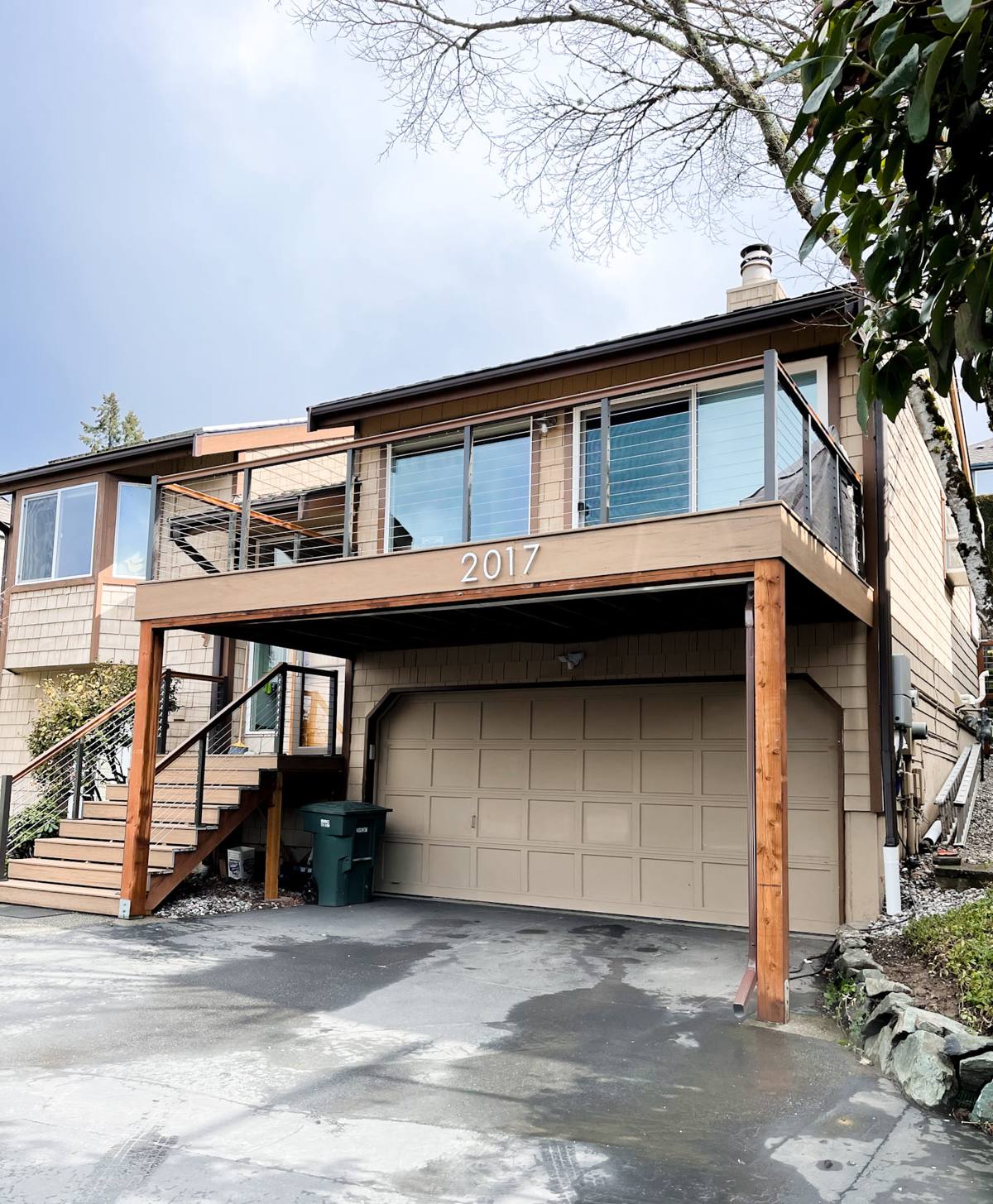
What Conway's Environment Does to an Ordinary Deck
Salt Air and Metal Hardware
Salt air accelerates corrosion on any fastener, bracket, or fixture that isn't rated for it. Standard electro-galvanized screws and joist hangers will start showing rust streaks on the decking within a season or two near the bay side of Skagit County. Once a fastener starts corroding, it loses holding strength long before it looks bad enough to notice — that's the real risk, not just the staining.
Driving Rain and Moisture Intrusion
Skagit County gets extended stretches of steady, wind-driven rain rather than short downpours. That pattern pushes water sideways into places a builder might assume are dry — under rail caps, behind fascia boards, and at the ledger connection where the deck meets the house. A ledger board that isn't flashed correctly is one of the most common sources of hidden rot we find on older Conway decks, and by the time it shows on the surface, the framing underneath has usually been wet for years.
Moss and Algae Growth
Long wet seasons and shaded lots mean moss and algae aren't a maintenance inconvenience here — they're a structural issue if ignored. Moss holds moisture against decking boards and stair treads, and on smooth-surfaced composite or painted wood it turns walking surfaces slick well before it's visually obvious. Deck orientation, gaps between boards, and surface texture all affect how fast moss takes hold, and we plan around that from the design stage rather than leaving it as a homeowner's cleaning problem.
What a Correctly Built Deck Includes Here
A deck that's going to hold up in Conway's conditions needs a handful of details done right, every time, not as upgrades:
- Corrosion-resistant fasteners and structural hardware rated for coastal or high-moisture exposure, not standard interior-grade hardware
- Proper ledger flashing with a drainage gap or standoff so water sheds away from the house rather than pooling at the connection
- Joist tape or butyl flashing over top of framing members to keep standing water out of the wood itself
- Board spacing and layout that lets water drain through quickly instead of sitting on the surface
- Footings sized and set below frost depth with drainage gravel, since low-lying delta soil holds water longer than well-drained upland lots
- Ventilation underneath the deck so the framing can dry out between rain events instead of staying damp for weeks
Skip any one of these and the deck may still look fine on installation day — the failures show up two, three, five years out, usually in the framing where you can't see them until something gives.
Choosing Materials for This Climate
There isn't one right material for every Conway deck — it depends on budget, how much upkeep the homeowner wants to take on, and how exposed the site is to sun, shade, and salt air. Here's how the common options actually perform in this environment:
| Material | Moisture & Salt Air Behavior | Maintenance | Typical Lifespan Here |
|---|---|---|---|
| Pressure-treated fir/hem-fir | Resists rot when properly sealed; needs re-sealing regularly in wet climates | Annual cleaning and re-staining or sealing | 15-20 years with upkeep |
| Cedar | Naturally rot- and insect-resistant; still needs sealing against gray weathering and moss | Sealing every 1-2 years, moss treatment in shaded areas | 20-25 years with upkeep |
| Composite decking | Doesn't rot or absorb water like wood; textured boards resist slickness better than smooth ones | Periodic washing; low upkeep overall | 25-30+ years |
| PVC decking | Fully moisture-resistant, unaffected by salt air corrosion | Lowest upkeep of the common options | 25-30+ years |
We steer most Conway clients toward composite or PVC decking for the walking surface when the deck sits in shade or close to the water, simply because wood in that combination of salt air and shade is a heavier maintenance commitment than most homeowners realize going in. That said, plenty of well-sited, sun-exposed Conway decks do great in cedar or treated fir for years — it's a genuine trade-off between upfront cost, look, and how much sealing and cleaning you're willing to keep up with, not a case where one material is simply better.
Our Process for a Conway Deck Build
1. Site Assessment
We walk the property and look at drainage, sun exposure, tree cover, and how close the site sits to open water or tideflats — that last point drives how aggressively we spec corrosion-resistant hardware.
2. Design and Material Selection
We talk through decking material, railing style, and layout against the budget, being upfront about the maintenance trade-offs of each option rather than steering everyone toward the highest-margin material.
3. Permitting
Deck permitting requirements depend on the deck's height, size, and attachment to the structure, and can involve either the City of Burlington or Skagit County depending on exactly where the Conway property falls. We handle that determination and the permit application as part of the job.
4. Framing and Flashing
This is where the long-term durability of the deck actually gets decided — ledger flashing, joist protection, hardware selection, and footing depth all happen here, before a single decking board goes down.
5. Decking, Railing, and Finish
Surface installation, railing systems, stairs, and any built-in features like benches or planters go in last, with attention to board spacing for drainage and moss resistance.
6. Walkthrough and Care Guidance
We go over what the specific materials on your deck need going forward — cleaning schedule, sealing timeline if applicable, and what early warning signs of moisture or moss problems to watch for.
Why It Matters That We Already Work in Conway
A crew that mostly builds decks in drier, inland parts of the county can still build a technically sound deck — but they're often making judgment calls about hardware grade, flashing detail, and material selection based on general best practice rather than what actually holds up two hundred yards from tidewater. We've seen what salt air does to standard fasteners on Conway-area decks, what moss does to north-facing stair treads under fir cover, and where ledger flashing tends to fail on older homes in this specific pocket of Skagit County. That's the kind of knowledge that only comes from doing the work here repeatedly, and it shows up in fewer callbacks and decks that still look right a decade later.
We're also a local crew in the practical sense that matters for a project like this: we're a short drive away for the walkthrough, the mid-project check-ins, and any follow-up after the build — not routing a warranty call through a call center two states away.
Before You Get a Deck Quote: A Quick Checklist
- Know roughly what you'll use the deck for — dining, entertaining, hot tub, grilling — since load and layout depend on it
- Think about sun versus shade exposure on your specific lot; it changes the material recommendation
- Ask any contractor what fastener and hardware grade they're specifying, not just what decking brand
- Ask how the ledger connection to the house will be flashed
- Get clarity on permitting responsibility before work starts, not after
- Ask about the maintenance schedule for whatever material you choose, in writing
If you're weighing options for a deck at your Conway property, we're happy to walk the site, talk through what materials make sense for your exposure and budget, and give you a straightforward estimate — no pressure, no pushy upsell, just a clear look at what the job actually involves. Use the form below to request a free estimate.