 Burlington
 Edison's Climate Is Harder on Windows Than Most Homeowners Realize
Edison sits in one of the wetter, saltier pockets of Skagit County. Being close to open water means the air itself carries salt, and that salt finds its way onto window frames, hardware, and glazing seals year-round. Add in the driving rain that comes off Puget Sound during fall and winter storms, plus a moss season that can stretch from October well into spring under the tree cover common around the area, and you have three separate forces working against ordinary windows at the same time. Most window products sold nationally are not engineered with this combination in mind. They're built to handle rain, or cold, or humidity individually — not all three, compounded by salt exposure, for months at a stretch.
That's the starting point for any honest conversation about window replacement in this area. A window that performs fine in a drier inland climate can fail early here, and the failure is rarely dramatic. It's slow: a little fogging between panes, a draft that wasn't there last year, frame corners that feel soft when you press on them. By the time it's obvious, moisture has usually been working behind the trim for a while.
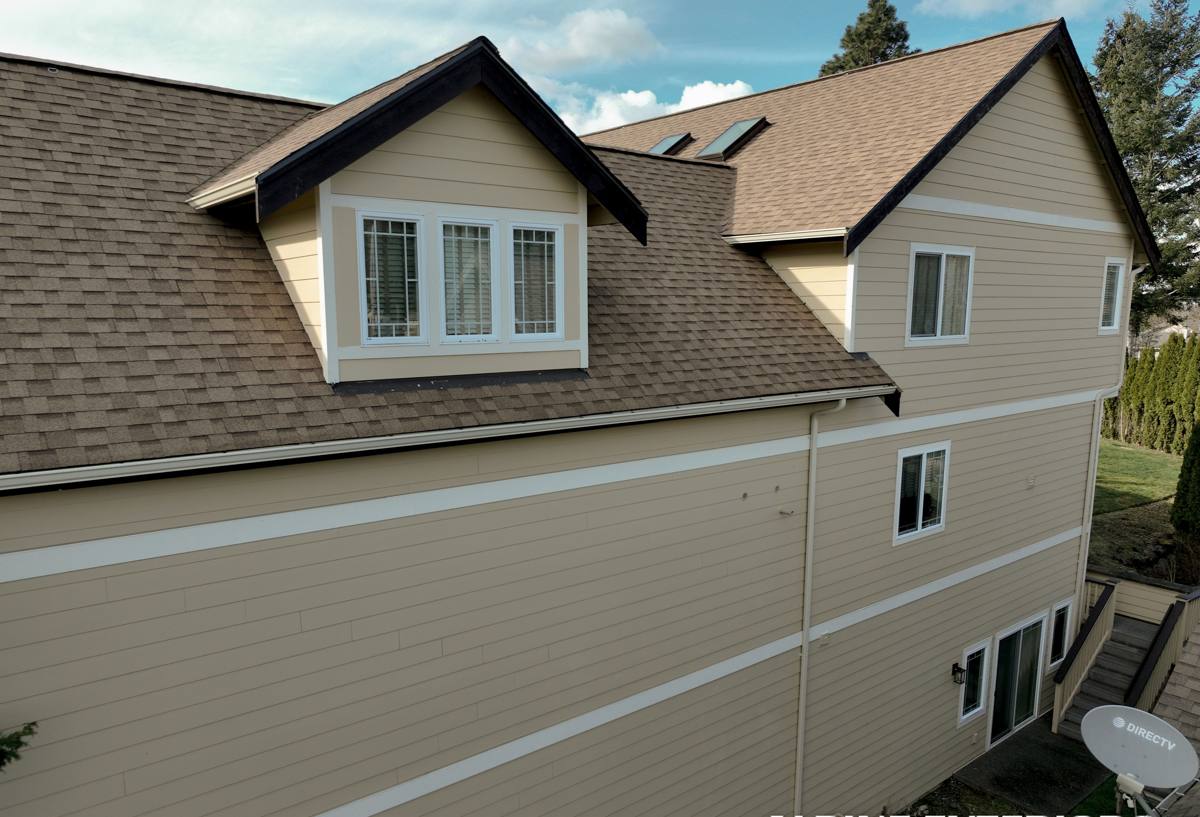
What Salt Air, Driving Rain, and Moss Actually Do to a Window
Salt Air and Corrosion
Salt-laden air accelerates corrosion on window hardware — hinges, cranks, locks, and especially aluminum components. It also degrades certain sealants faster than manufacturers' standard testing accounts for, since most of that testing isn't done in a coastal Pacific Northwest environment. Over time, salt exposure can pit finishes and weaken the seals that keep insulated glass units from fogging.
Driving Rain and Water Intrusion
Wind-driven rain doesn't just hit a window — it gets pushed sideways and upward into gaps that vertical rain would never reach. This is where flashing detail and installation quality matter more than the window product itself. A premium window installed with poor flashing will leak. A modest window installed correctly, with water managed properly around the opening, often won't.
Moss, Shade, and Trapped Moisture
Homes tucked under tree cover or facing north tend to stay damp longer after a storm passes. That prolonged dampness is what lets moss and mildew get a foothold on sills, trim, and siding around the window opening. Once organic growth establishes itself against wood trim, it holds moisture against the surface and speeds up rot — which is why window trim in shaded parts of Edison properties often shows wear well before the windows themselves are old.
Signs an Edison Home's Windows Need Replacing
Most homeowners wait too long to replace windows because the early signs are easy to dismiss as minor annoyances. Watch for these:
- Fogging or a milky haze between the panes of double-pane glass — the seal has failed and the gas fill is gone
- Visible gaps or daylight around the frame when the window is closed
- Soft or spongy wood at the sill or lower corners of the frame
- Windows that are difficult to open, close, or lock, especially after damp weather
- A noticeable draft near the window even with it fully closed and locked
- Paint or finish that's peeling or bubbling specifically around the window opening, not the whole wall
- Rising heating bills without any other clear cause
- Condensation forming on the inside of the glass regularly during cold months
Choosing a Window Built for This Environment
Frame material matters more here than in most parts of the country, because it determines how the window handles years of salt exposure and moisture cycling. There's no single "correct" answer for every home — budget, exposure, and the look of the house all factor in — but the trade-offs are worth understanding upfront.
| Frame Material | Salt/Moisture Resistance | Maintenance | Typical Trade-Off |
|---|---|---|---|
| Vinyl | Good — won't corrode or rot | Low | Limited color/finish options; can look less premium on higher-end homes |
| Fiberglass | Very good — dimensionally stable, resists moisture movement | Low | Higher upfront cost than vinyl |
| Aluminum | Poor in coastal air unless heavily coated — prone to corrosion and condensation | Moderate to high | We generally steer Edison homeowners away from bare aluminum for this reason |
| Wood-Clad | Depends heavily on clad quality and seal integrity at joints | High | Beautiful interior wood look, but the cladding seams are a common failure point in wet climates |
For most Edison homes, we lean toward vinyl or fiberglass because they hold up against salt and moisture with the least long-term fuss. That's a professional recommendation based on how these materials perform in this specific climate, not a statement that other materials are bad products — wood-clad windows, for example, can be a great fit on a home where the exposure is more sheltered and the owner is committed to the extra upkeep.
Glass Package Considerations
Beyond frame material, the glass package matters. Double-pane, low-E glass with argon fill is the practical baseline for this climate — it manages both heat loss and condensation risk better than older single-pane or basic double-pane setups. Triple-pane is available and does offer better performance, but for most Edison homes the added cost doesn't pay back as quickly as it would in a colder inland climate; it's worth discussing case by case rather than assuming it's always the right upgrade.
What a Correct Window Replacement Job Actually Involves
Flashing and Water Management
This is the single most important part of the job and the part most likely to be rushed by crews unfamiliar with wind-driven rain. Proper flashing directs any water that gets past the window itself back out and away from the wall structure — sill pan flashing, correctly lapped house wrap, and sealant placed in the right locations (and left out of the wrong ones, since sealing every seam actually traps water in some designs) all have to be done in sequence, not improvised.
Correct Sizing and Fit
Old openings are rarely perfectly square, especially in older homes that have settled over the years. A correct installation accounts for the actual as-built opening, not just the nominal size, and shims and levels the new unit so it operates smoothly and seals evenly on all four sides.
Insulation and Air Sealing
The gap between the window frame and the rough opening needs to be insulated without overpacking it, which can bow the frame and cause operational problems. Low-expansion foam or backer rod, used correctly, seals out air and moisture without distorting the unit.
Trim and Exterior Finish
Exterior trim gets re-flashed and sealed as part of the job, not just caulked over. Given how quickly moss and mildew take hold on damp trim in shaded areas, we also make sure the finished trim doesn't create ledges or gaps where water and organic debris can collect.
Our Process for an Edison Window Replacement Project
- On-site assessment: We look at each window opening individually — exposure, existing damage, framing condition — rather than quoting off a generic average.
- Product selection: We walk through frame material and glass package options based on that specific home's exposure and your budget, with honest trade-offs explained up front.
- Written estimate: A clear, itemized quote before any work begins, so there are no surprises about scope.
- Removal and inspection: Old windows come out carefully, and we check the framing underneath for hidden rot or water damage before anything new goes in.
- Installation: New windows are set, shimmed, flashed, insulated, and sealed following the sequence that actually holds up against wind-driven rain.
- Final check: Every window is tested for smooth operation and a proper seal before we consider the job finished.
Cost Factors for Window Replacement in Edison
Every home is different, so we don't quote prices without seeing the actual openings, but these are the factors that most influence cost:
| Factor | Why It Affects Cost |
|---|---|
| Frame material | Vinyl is typically the most affordable; fiberglass and wood-clad cost more upfront |
| Number and size of openings | Larger and custom-sized windows require more material and labor |
| Condition of existing framing | Hidden rot or water damage found during removal adds repair scope |
| Access and story height | Second-story or hard-to-access windows take more time and equipment |
| Glass package | Upgraded low-E coatings or triple-pane glass raise the per-unit cost |
| Trim and exterior finish work | Full trim replacement costs more than reusing sound existing trim |
As a broad range, straightforward vinyl window replacements often fall in the low-to-mid thousands per window installed, with fiberglass and wood-clad options running higher. Homes with hidden framing damage or extensive trim work will naturally cost more once that scope is confirmed. We'd rather give you real numbers after seeing your windows than a broad figure that doesn't match your home.
Why Hiring a Crew That Already Works in Edison Matters
Window replacement isn't just a product decision — it's a construction detail decision, and those details change based on exposure. A crew that regularly works in and around Burlington and the surrounding Skagit County communities has already seen how salt air corrodes hardware over a few winters, how driving rain finds the weak point in a poorly flashed sill, and how moss establishes itself on shaded trim faster than homeowners expect. That experience shows up in small decisions during the install — where extra flashing gets added, which sealant is used where, how tight the fit needs to be — that a crew unfamiliar with this specific climate might not think to make.
It also matters for accountability. A local contractor is easy to reach if something needs adjustment after the first real storm season, and has a reputation in the community worth protecting.
Get a Free, No-Pressure Estimate
If your Edison home's windows are showing any of the signs above, or you're simply planning ahead before the next wet season sets in, we're happy to take a look and give you a straightforward assessment — no pressure, no pushy sales pitch. Use the form below to request a free estimate, and we'll walk you through exactly what your windows need and why.